wayground logo

Free Printable Worksheets

NEW

Font size

S
M
L
XL
Worksheets

Waves Review Quiz

Total questions: 44

Worksheet time: 54mins

Name
Class
Date
1.
In the wave equation (λ) represents what?
a)
amplitude
b)
wavelength
c)
frequency
d)
wave speed
2.

The frequency of a wave is 3.3 Hz. If the wavelength is 7.4 m, how fast is the wave moving?

a)

2.24 m/s

b)

24.4 m/s

c)

0.45 m/s

d)

0.24 m/s

3.
A wave has wavelength of 10 m and a speed of 340 m/s. What is the frequency of the wave?
a)
34 m/s
b)
3400 Hz
c)
3400 m/s
d)
34 Hz
4.
What is the frequency of a wave traveling at 300 m/s with a 4 m wavelength?
a)
0.013 Hz
b)
75 Hz
c)
300 Hz
d)
1200 Hz
5.
 A wave has frequency of 50 Hz and a wavelength of 10 m. What is the speed of the wave?
a)
500 m/s
b)
50 m/s
c)
5 m/s
d)
0.5 m/s
6.
What is the speed of a 20 Hz with a 4m wavelength?
a)
0.2 m/s
b)
5 m/s
c)
80 m/s
d)
320 m/s
7.
The lowest point on a wave is the:
a)
Amplitude
b)
Crest
c)
Trough
d)
Wavelength
8.
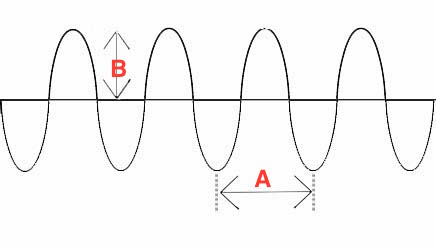
What property of the wave is represented by the letter "B"?
a)
amplitude
b)
crest
c)
trough
d)
wavelength
9.
The highest point on a wave is:
a)
the crest
b)
the trough
c)
the top
d)
the coast 
10.
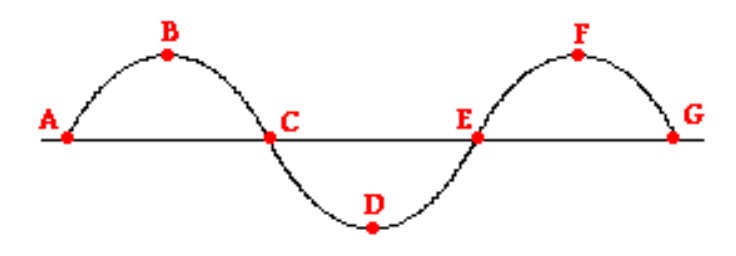
Which vocabulary term is used to identify the distance between points C & G?
a)
Amplitude
b)
Crest
c)
Frequency
d)
Wavelength
11.
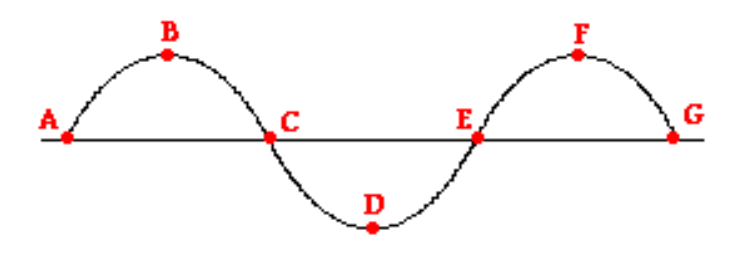
Which letter(s) represent the trough of the wave?
a)
A
b)
B & D
c)
D
d)
C & G
12.
Which letter(s) represent the crest of the wave?
a)
A
b)
B & D
c)
B & F
d)
F
13.

The distance from one crest to the next crest in a wave is

a)

wavelength

b)

crest

c)

trough

d)

amplitude

14.
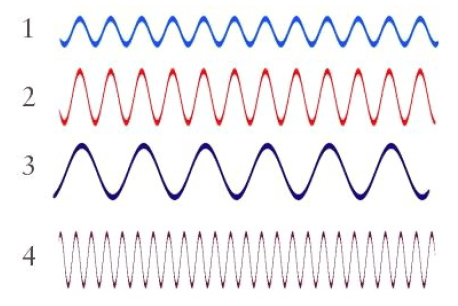
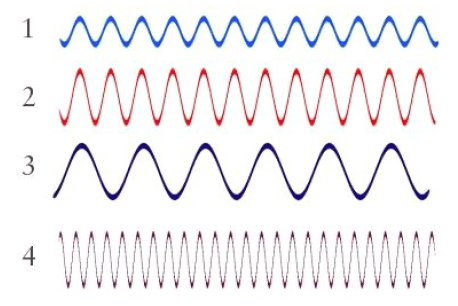
Which wave in the diagram has the greatest frequency?
a)
1
b)
2
c)
3
d)
4
15.
What do waves carry from place to place?
a)
Energy, but not matter or particles
b)
Energy and matter or particles
c)
Matter or particles but not energy
d)
Neither energy nor matter or particles
16.
Which wave in the diagram has the greatest wavelength?
a)
1
b)
2
c)
3
d)
4
17.
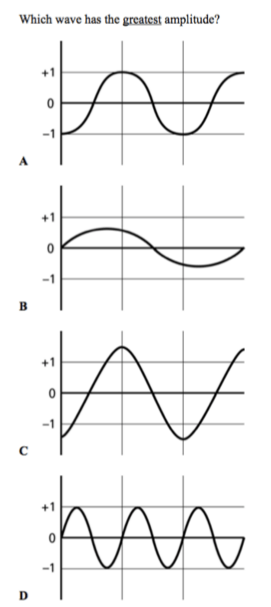
Which wave has the greatest amplitude?
a)
A
b)
B
c)
C
d)
D
18.
What is the amplitude of a wave related to?
a)
velocity
b)
speed
c)
mass
d)
height
19.
What is the measure of how many waves pass a point in a certain amount of time?
a)
frequency
b)
wavelength
c)
midpoint
d)
crest and trough
20.

Which of these provides the best explanation for why the pencil appears broken?

a)

The pencil absorbs the light rays that hit it.

b)

Water reflects light rays away from the pencil.

c)

Light rays are bent by the water in the glass.

d)

The surface of the water reflects the light rays.

21.

Caleb is sitting near the window on a sunny day. When he closes the curtain, the room becomes darker. What property of the curtain allows it to make the room darker?

a)

The curtain absorbs light.

b)

The curtain is brightly colored.

c)

The curtain folds easily.

d)

The curtain is rectangular shape.

22.

At what point is the laser being reflected?

a)

A

b)

B

c)

C

d)

D

23.

Light travels in straight lines until reflected by another object. Which illustration best shows the light being reflected?

a)
b)
c)
d)
24.

Which of the following is the best example of an object absorbing light?

a)

A black sweater in the sun.

b)

A clean window in the sun.

c)

A curved mirror in the sun.

d)

A long shadow in the sun.

25.

Light rays from any light source travel outward in all directions along a straight path until they hit something. which of the following best represents what occurs when light rays hit a glass of water?

a)

The light rays will pass straight through from air to water.

b)

The water absorbs the light, and it will no longer be seen.

c)

The light rays will bend at the boundary of air and water.

d)

The surface of the water will reflect the light off the water.

26.

Which of the following is demonstrated when light bounces off of mirrors or shiny surfaces?

a)

Scattering

b)

Refraction

c)

Absorption

d)

Reflection

27.

Which of the following types of electromagnetic radiation has the shortest wavelengths?

a)

Infrared

b)

Ultraviolet

c)

Visible light

d)

Radio waves

28.

Our eyes perceive colors because of differences in which of the following properties of light?

a)

Intensity

b)

Wavelength

c)

Angle

d)

Source

29.
This image is representing what wave interaction?
a)
Refraction
b)
Diffraction
c)
Reflection
d)
Interference
30.
What is the main difference between refraction and diffraction?
a)
refraction is a phenomenon that affects light; diffraction is a phenomenon that affects sound
b)
refraction involves the bending of light; diffraction involves the bending and spreading of light, usually around an obstacle
31.

What would you call this?

a)

Refraction

b)

Diffraction

c)

Bends

d)

Reflection

32.

What would you call this?

a)

Reflection

b)

Diffraction

c)

Refraction

d)

Friction

33.

What principle is responsible for light spreading as it passes through a narrow slit?

a)

refraction

b)

polarization

c)

diffraction

d)

interference

34.

What principle is responsible for alternating light and dark bands when light passes through two or more narrow slits?

a)

refraction

b)

polarization

c)

diffraction

d)

interference

35.
When two waves combine to form a new wave with a smaller amplitude, it is called 
a)
Refraction
b)
Constructive Interference
c)
Resonance
d)
Destructive Interference
36.
Wavelengths on the right side of the Electromagnetic spectrum are ______________.
a)
short
b)
long
c)
average
37.
When two waves combine to form a new wave with a larger amplitude, it is called 
a)
Diffraction
b)
Destructive Interference
c)
Resonance
d)
Constructive Interference
38.
When 2 waves meet and there amplitude increases it is known as what?
a)
Constructive Interference
b)
Amplitude Addition
c)
Positive Interference
d)
Destructive Interference
39.
When a wave moves around a barrier or though an opening it is known as what?
a)
Diffraction
b)
Refraction
c)
Rarefaction
d)
Destruction
40.

What type of interference is represented in this diagram?

a)

Constructive

b)

Destructive

41.

What type of interference do noise cancelling headphones use?

a)

Constructive Interference

b)

Destructive Interference

42.

Sound waves in musical instruments or tubes create standing waves that enhance which type of interference to make louder sounds?

a)

Constructive

b)

Destructive

43.

What creates the Doppler Effect?

a)

The bunching of waves, then the spreading out of waves creating a change in pitch.

b)

The spreading of sound waves, then the bunching up of sound waves creating a change in pitch.

c)

A consistent frequency that creates the same pitch.

44.

The production of light with a specific pattern of oscillation.

a)

reflection

b)

polarization

c)

refraction

d)

diffraction