wayground logo

Free Printable Worksheets

NEW

Font size

S
M
L
XL
Worksheets

Unit 8 Review: Optics

Total questions: 44

Worksheet time: 37mins
Name
Class
Date
1.
Spherical mirrors are part of a 
a)
Rectangle
b)
Cube
c)
Sphere
d)
Biryani
2.
a mirror with a surface that curves inward like the inside of a bowl
a)
concave mirror
b)
convex mirror
c)
plane mirror
d)
flat mirror
3.
An image that forms where light seems to come from a point but light rays don't actually meet is a 
a)
virtual image
b)
real image
c)
Inverted Image
d)
Pizza
4.
Convex Mirrors produce...
a)
only virtual images
b)
virtual or real images
c)
only real images
d)
inverted images
5.
Real images are :
a)
Always inverted
b)
Magnified or Diminished
c)
can be obtained on screen
d)
all the above
6.
Virtual Images are
a)
Always erect
b)
can be obtained on screen
c)
magnified or diminished
d)
all the above
7.
convex mirrors are
a)
plane mirrors
b)
converging mirrors
c)
diverging mirrors
d)
smaller than concave mirrors
8.

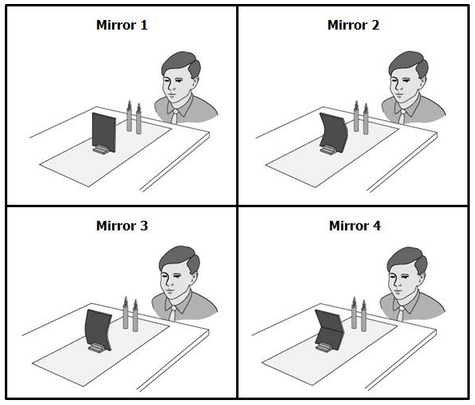
A student is conducting an experiment with four different types of mirrors. Which mirror in the experiment converges light and UP CLOSE, produces an upright, magnified image of the candles? (hint: no two mirrors are the same)

a)

mirror 1

b)

mirror 2

c)

mirror 3

d)

mirror 4

9.

A student is conducting an experiment with four different types of mirrors. Which mirror in the experiment is a convex mirror?

a)

mirror 1

b)

mirror 2

c)

mirror 3

d)

mirror 4

10.

What word means to bend light rays toward each other?

a)

Converging light

b)

Diverging light

c)

Virtual Light

d)

Real Light

11.

A dentist uses a small dental mirror to help magnify teeth in your mouth. What type of mirror is this?

a)

a convex mirror

b)

a concave mirror

c)

a convex lens

d)

a concave lens

12.
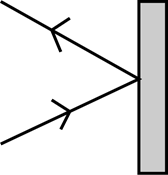
The illustration shows a light ray striking an object.
In the illustration, the light ray striking the object is-
a)
absorbed
b)
stopped
c)
reflected
d)
refracted
13.
A student is 2.50m away from a convex lens while her image is 1.80m from the lens, what is the focal length?
a)
1.05m 
b)
2.50m
c)
1.39m
d)
0.72m
14.
An object is placed at a distance of 27.0 cm away from a thin convex lens with a focal length of 9.00 cm.  How far from the lens is the image located and what type of image is formed? 
a)
13.5 cm and real
b)
3.00 cm and real
c)
0.33 cm and virtual
d)
0.15 cm and virtual
15.
The line that passes through the center of a curved mirror is called
a)
focal point
b)
center of curvature 
c)
principle axis
d)
light ray
16.

Law of Reflection states that the incident angle is ____ the reflected angle

a)

greater than

b)

less than

c)

equal to

17.

If Θ1 is 70 degrees what is Θ2?

a)

20

b)

40

c)

70

d)

90

18.

Images in a plane mirror are

a)

real

b)

larger

c)

same size

d)

smaller

19.

The distance from the vertex of the mirror to the center of curvature is also known as the

a)

focal length.

b)

radius of curvature.

c)

object distance.

d)

image distance.

20.

If the focal length is 10 cm and the object is placed 15 cm away, where is the image located?

a)

-30

b)

5

c)

150

d)

30

21.

Which EM wave travels the fastest through space?

a)

Gamma

b)

X-rays

c)

Radio

d)

All are the same speed

22.

This image is

a)

real.

b)

virtual.

23.

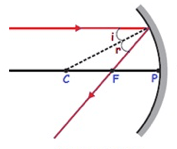
The image formed by this converging mirror is

a)

upright, same size, virtual

b)

inverted, same size, real

c)

inverted, larger, virtual

d)

upright, smaller, real

24.

This ray diagram is for which mirror?

a)

concave

b)

convex

c)

plane

d)

window

25.

This type of mirror is used in supermarkets to see around bends

a)

concave

b)

convex

c)

plane

d)

window

26.

A dentist uses a small dental mirror to help magnify teeth in your mouth. What type of mirror is this?

a)

a convex mirror

b)

a concave mirror

c)

a convex lens

d)

a concave lens

27.

The side view mirrors on your car help shrink the image on both sides of the car, allowing you to see a larger field of view. What type of mirror is this?

a)

a convex mirror

b)

a concave mirror

c)

a convex lens

d)

a concave lens

28.

An image that forms when light rays actually meet

a)

virtual image

b)

real image

c)

diffuse reflection

d)

regular reflection

29.
The point in the middle way between a curved mirror and the center of curvature is the
a)
principle point
b)
focal point
c)
center of curvature
d)
principle axis
30.
The point where the rays meet is known as....
a)
Fire
b)
the focal point
c)
refraction
d)
Plane of the lens
31.
___ is when light travels through a material and bends.
a)
Diffraction
b)
Dispersion
c)
Mirage
d)
Refraction
32.
Which describes a convex lens?
a)
triangular in shape
b)
more transparent in the middle
c)
thicker on the edges than in the middle
d)
thicker in the middle than on the edges
33.
Is a convex lens thicker or thinner in the middle?
a)
Thicker 
b)
Thinner 
34.
Is a concave lens thicker or thinner in the middle? 
a)
Thicker 
b)
Thinner 
35.

When light waves move from passing through air to passing through a glass lens when happens to them?

a)

They slow down and change direction

b)

They speed up and change direction

c)

They maintain the same speed and change direction

d)

They maintain their same speed and direction

36.

A concave lens has an inward curved shape. It refracts light outward from the lens. They light rays spread apart as they exit the lens. Which represents a concave lens?

a)

A

b)

B

c)

A and B

d)

neither A or B

37.
What does the word "diverging" mean?
a)
to spread apart
b)
to come together
c)
parallel
d)
perpendicular
38.
What does the word "converging" mean?
a)
to separate
b)
to come together
c)
parallel 
d)
perpendicular
39.
A converging lens is also known as a ____ lens.
a)
convex
b)
concave
c)
double
d)
refracted
40.

What type of lens do you have in your eye?

a)

Concave

b)

Prismatic

c)

Objective

d)

Convex

41.
When an object is placed between the focal point and the convex lens, the image produced is ___.
a)
real, reduced, and inverted
b)
real, enlarged, and inverted
c)
virtual, enlarged, and upright
d)
virtual, reduced, and upright
42.
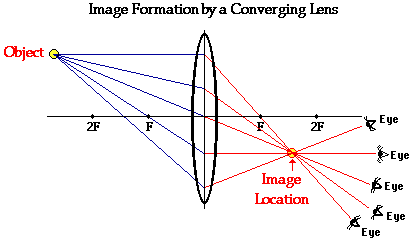
This image is.....
a)
inverted and smaller
b)
inverted and larger
c)
not inverted and smaller
d)
not inverted and larger
43.
This image is...
a)
Inverted and smaller
b)
inverted and bigger
c)
not inverted and smaller
d)
not inverted and bigger
44.
The dfor a virtual image will have a ______ value.
a)
positive
b)
negative