
 Worksheets
cK12 Newton's Laws and 2D Motion
Total questions: 40
Worksheet time: 4hrs 32mins
An object in motion will _______ if the sum of forces applied equals zero.
stay in motion
increase velocity
decrease mass
come to a rest
The SI units for force are...
kilograms
newtons
meters per second
pounds

If a hammer and nail are dropped from the same height at the same time, which object will hit the ground first?
the hammer
the nail
the hammer and nail hit the ground at the same time.
the object with the larger volume

A sled sliding on a flat, icy surface with a constant velocity is best described by
Newton’s first law of motion for objects at rest.
Newton’s first law of motion for objects in motion.
Newton’s second law of motion.
Newton’s third law of motion.
Pick two pairs of terms - one term describes magnitude alone while another term describes both magnitude and direction.
mass, weight
displacement, distance
matter, antimatter
speed, velocity
If a force of 88 N is exerted on two balls in separate experiments, one with a mass of 0.50 kg and the other with a mass of 0.75 kg, which ball will have the greater acceleration?
The one with a mass of .75 kg will have the greatest acceleration.
The one with a mass of .50 kg will have the greatest acceleration.
They will both accelerate at the same rate.

The masses of four vehicles and the net forces acting on them as they enter a highway are recorded in the table below. Which vehicle has the smallest acceleration as it enters the highway?
Sedan
Coupe
SUV
Truck

A student lets a toy car roll four times down a ramp. Each time the student covers the surface of the ramp with a different material. The student measures and records the time it takes the car to roll down the ramp. Which of these would be the best conclusion based on the data in the table?
Different surfaces affect how fast a toy car accelerates.
Different toy cars travel at different speeds.
Gravity has little effect on the speed of toy cars on different surfaces.
Air resistance is the greatest factor in limiting the acceleration of different toy cars.

A ball thrown into the air starts out with an initial upward velocity, but eventually slows and stops before falling back to the ground. Which of the following contributes the most to the change in motion of the ball?
The initial force with which the ball is thrown
The downward force of gravity
The resistance against the atmosphere
The increase of inertia

An object is moving to the right at a constant velocity. What will happen if a force of 20N starts acting on it in the opposite direction?
The object’s velocity will increase.
The object’s velocity will decrease.
The object will come to a stop.
The object will move at the same velocity.


The mass of a 2019 Lincoln Continental is 2000 kg. The car accelerates at a rate of 3 m/s2. If the car’s engine generates a 4400 N force forward, calculate the force of friction.
- 1600 N
- 4400 N
- 6400 N
10400 N
An object of mass 30 kg is falling in air and experiences a force due to air resistance of 100 newtons. Calculate the acceleration of the object.
-8.1 m/s2
-.666 m/s2
-4.8 m/s2
-.83 m/s2

An elevator accelerates upward at 2.0 m/s2, as illustrated in the diagram above. The passenger has a mass of 85 kg. Calculate the force the floor exerts on the passenger.
1000 N
0 N
830 N
660 N
A measure of how much matter is in an object has an SI unit of kilograms.
weight
mass
volume
length
This force happens when surfaces rub against each other.
friction
gravity
momentum
weight
SI unit for force (and also weight)
gram
liter
meter
newton

How far did the runner go in 4 seconds?
10 meters
20 meters
30 meters
40 meters
What is the average velocity between 0 and 2 seconds?
5 m/s
2 m/s
8 m/s
7.5 m/s
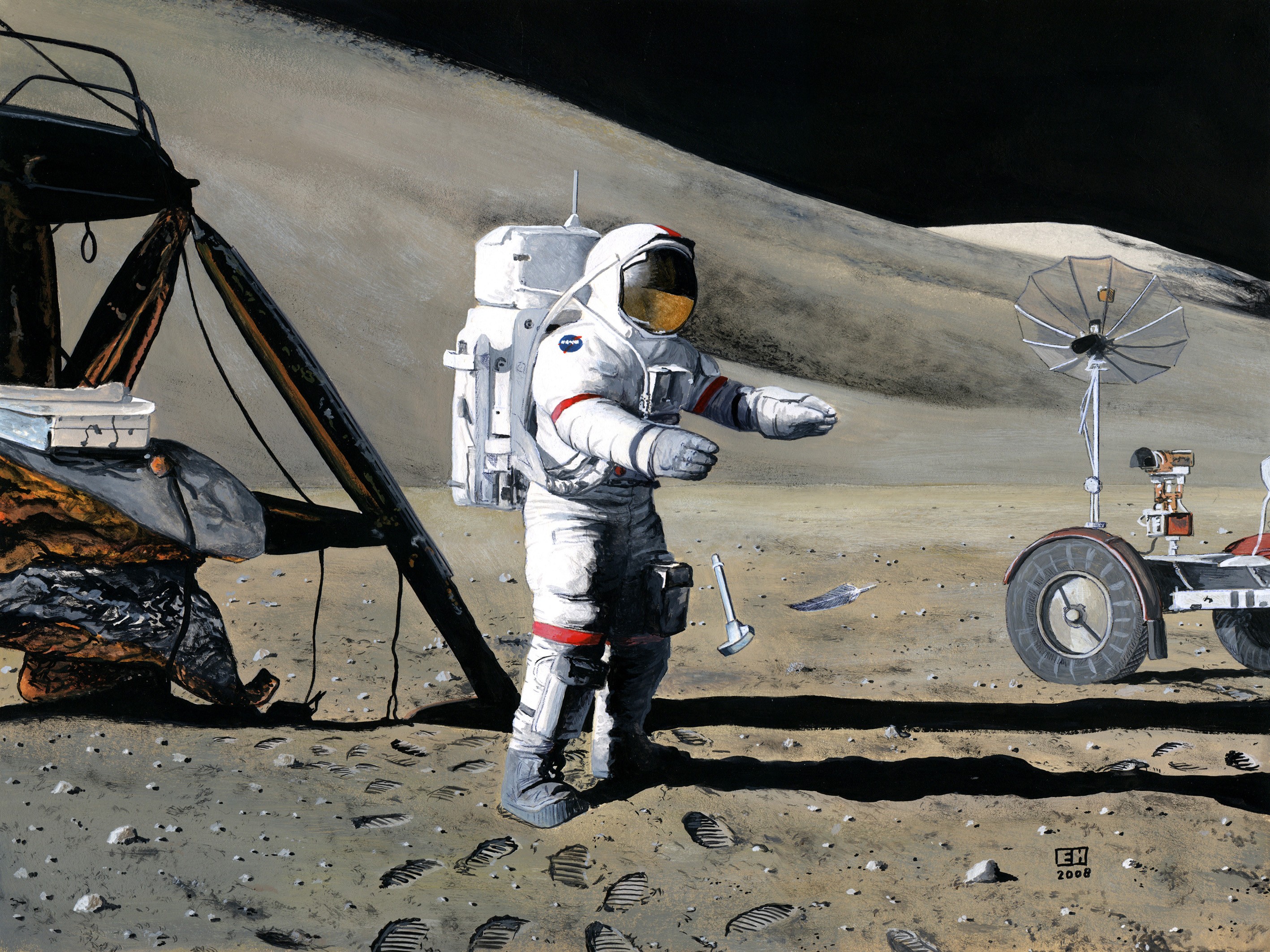
If a feather and a hammer are dropped at the same time on the moon, where there is no atmosphere, which one will hit the ground first?
neither, there is no gravity on the moon.
hammer because it has more mass
feather because it has less mass
both will hit at the same time
A box weighing 72 Newtons rests on an incline that makes an angle of 32° with the horizontal. What is the magnitude of the component of the box’s weight parallel to the incline?
19N
61N
38N
26N

A cart rolls down an inclined plane with constant speed as shown in the diagram below. Which arrow represents the direction opposite the normal force?
A
B
C
D

A 3.0-kg block slides on a frictionless 20° inclined plane. A force of 16 N acting parallel to the incline and up the incline is applied to the block. What is the acceleration of the block?
2 m/s2 down the incline
5.3 m/s2 up the incline
2 m/s2 up the incline
3.9 m/s2 down the incline

A block rests on a ramp, making angle θ with the horizontal. As the angle theta (θ) is increased
the blocks mass will decrease
the blocks mass will increase
the blocks component of weight parallel to the ramp will increase
the blocks component of the weight parallel to the ramp will decrease
A bullet is fired horizontally at a height of 2 meters at a velocity of 950 m/s. What time transpires until the bullet strikes the ground? How far will the bullet travel horizontally?
0.64 s, 610 m
0.41 s, 390 m
0.14 s, 133 m
0.36 s, 342 m

What is the vertical acceleration of a projectile?(neglect air resistance)
0 m/s2
9.8 m/s2
-9.8 m/s2
4.9 m/s2
Which of the following values remain constant during projectile motion?
vy
vx
vertical acceleration
both vx and vertical acceleration
What is true about the horizontal motion of a projectile?
It accelerates backwards at 9.81 m/s2
It accelerates forwards at 9.81 m/s2
It moves at a constant horizontal velocity.
It cannot be determined.
If you are trying to find the vertical component (vx) of a projectile's velocity, what trigonometry function would you use?
Cosine
Sine
Tangent
Cosecant
A plane flying horizontally at 120 m/s drops a crate. When the crate strikes the water 7 seconds later, what is the magnitude of the velocity?
240 m/s
120 m/s
268 m/s
8 m/s
A soccer ball is kicked with a 36° angle and a velocity of 23 m/s. Find the vertical component of the ball's velocity.
13.5 m/s
14.1 m/s
18.6 m/s
33.1 m/s
A horizontally-launched projectile arcs out and hits the ground below. The vertical displacement and the horizontal displacement are measured. What is the best equation to use to find the time the projectile was in the air?
Δx=vx⋅Δt
Δy=vyi⋅Δt+21⋅g⋅Δt2
vyf=vyi+g⋅Δt
Δt=g2⋅Δy

In the picture, cannonball A was launched at 10 m/s at 60°, and B was launched at 18 m/s at 25°. The cannonball that hit the ground first was
A, because it had less total velocity.
B, because it had more total velocity.
A, because it had less initial vertical velocity.
B, because it had less initial vertical velocity.

Calculate the acceleration of the system of masses on the incline ramp shown here. m1 = 8 kg and m2 = 3 kg. Gravity is 9.8 m/s2.
5.5 m/s2
3.15 m/s2
1.92 m/s2
0 m/s2

What is a Free Body Diagram?
Visual representation of force
Visual representation of objects
Visual representation of force and objects interactions
Visual representation of gravity

Calculate the net force and acceleration of the object if its mass is 4 kg.
6 N, 0 m/s2
17 N, 1.50 m/s2
17 N, 4.25 m/s2
6 N, 1.50 m/s2

