wayground logo

Free Printable Worksheets

NEW

Font size

S
M
L
XL
Worksheets

Newton's Laws Speed Velocity Acceleration Motion Graphs Energy

Total questions: 46

Worksheet time: 55mins

Name
Class
Date
1.
Look at the graph.  Which is the best description of this object's motion? 
a)
A person left home, ran up a hill, down a hill, then up another hill. 
b)
A person walked away from home, turned back towards home, then turned away from home. 
c)
A person left home, walked for a few minutes, then turned around and went back home. 
d)
A person ran slowly, sped up, then slowed back down. 
2.
Which of the following statements is true, based on the graph? 
a)
The object moved faster from A to B than from B to C. 
b)
The object was stopped from D to E.
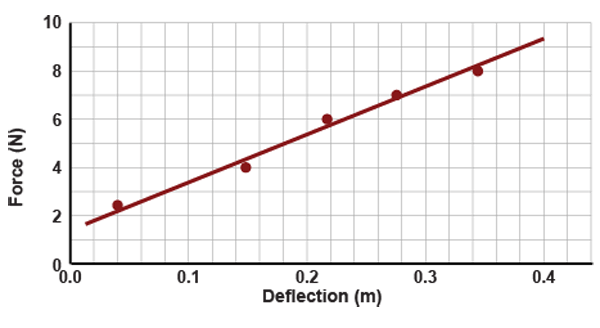
c)
The object moved faster from B to C than from A to B. 
d)
The object never stopped moving. 
3.
Which of the following can be concluded from the graph? 
a)
The object moved at a constant speed.  
b)
The object returned to the starting point twice. 
c)
The object stopped moving twice. 
d)
The object traveled a total of 8 miles. 
4.

From 1.5s to 2.0s, what is the object's speed?

a)

4 miles/hour

b)

0 meters/second

c)

4 meters/second

d)

0 miles/hour

5.
From 3.5s to 5.5s, in which direction was the object moving? 
a)
away from the starting point
b)
toward the starting point
c)
the object is not moving
d)
there is no way to tell
6.
What will happen if you're in a car, and the driver slams on the brake?
a)
You will stop moving.
b)
You will continue moving forward.
c)
You will gradually slow down. 
d)
You will speed up.  
7.
According to Newton's first law, an object in motion will stay in motion unless:
a)
An opposing force acts on it. 
b)
It's in outer space. 
c)
It stops.
d)
It remains at rest. 
8.
What causes a ball rolling across a rug to slow to a stop?
a)
The rug doesn't have enough force to hold the ball. 
b)
Friction resists the ball's forward motion.
c)
The rug doesn't have enough momentum to keep the ball rolling.
d)
The ball isn't rolling fast enough. 
9.
If an unbalanced force acts on an object, what will happen?
a)
It will not move at all. 
b)
It will accelerate in the same direction as the force. 
c)
It will accelerate in the direction opposite the force. 
d)
It will accelerate at an angle of 90 degrees to the force. 
10.
What is net force? 
a)
A force associated with the internet. 
b)
The combined forces acting on a particular object. 
c)
The same thing as inertia.
d)
The same thing is gravity. 
11.
According to Newton's third law, what happens when you push against a wall?
a)
The wall pushes back at you half has hard as you push against it. 
b)
The wall doesn't resist at all. 
c)
The wall pushes back at you with the same amount of force. 
d)
The wall pushes back at you twice as hard as you push against it. 
12.
Which sentence best describes the runner whose distance-time graph is shown?
a)
The runner ran forward for 2 seconds, and then ran backward for 2 more seconds.
b)
The runner ran forward for 2 seconds, and then stood still for 2 more seconds.
c)
The runner ran forward for 2 seconds, and then ran forward more slowly for 2 more seconds
d)
The runner ran forward for 2 seconds, and then turned right and continued forward at the same speed for 2 more seconds.
13.
In which of the following graphs is the runner running the fastest?
a)
Graph A
b)
Graph B
c)
Graph C
d)
Graph D
14.

What happens to an object when the forces on it are balanced?

a)

The object accelerates

b)

The object doesn't move or stays at its constant speed.

c)

The objects changes direction

15.

Why does the skydiver fall slowly?

a)

The force of drag opposes gravity.

b)

The force of drag is stronger than gravity.

c)

The force of gravity is equal to force of drag.

16.

What happens if the player on the right has more force than the player on the left?

a)

They will move to the right (→)

b)

They will move to the left (←)

c)

The will not move.

17.

Which direction will the car move?

a)

← 285 N

b)

1230 N →

c)

110 N →

d)

Will not move

18.

What is the acceleration of the car, if it takes 2.5 s to stop.

a)

-24 m/s2

b)

12 m/s2

c)

30 m/s

d)

90 m/s

19.
a)

A) shows constant speed

b)

B) shows constant speed

c)

C) shows moving backward

20.
a)

The Green line is faster than the red line

b)

The Blue line shows constant speed.

c)

The Red line shows decreasing speed.

21.

Which law explains why a desk "pushes" on a book that rest on it?

a)

Newton's 3rd

b)

Newton's 2nd

c)

Newton's 1st

d)
22.
a)
b)
c)
d)
23.
a)

Newton's

1st

Law of Motion

b)

Newton's

2nd

Law of Motion

c)

Newton's

3rd

Law of Motion

24.

F=ma

a)

Newton's

1st

Law of Motion

b)

Newton's

2nd

Law of Motion

c)

Newton's

3rd

Law of Motion

25.
For every action, there is an equal and opposite reaction.
a)
Newton's
1st
Law of Motion
b)
Newton's
2nd
Law of Motion
c)
Newton's
3rd
Law of Motion
26.

An automobile you are riding in suddenly stops, but you continue to go forward.

a)

Newton's

1st

Law of Motion

b)

Newton's

2nd

Law of Motion

c)

Newton's

3rd

Law of Motion

27.

When the force on a car is doubled, the acceleration is doubled.

a)

Newton's

1st

Law of Motion

b)

Newton's

2nd

Law of Motion

c)

Newton's

3rd

Law of Motion

28.

When you double the force the acceleration

a)

decreases by 1/2

b)

doubles

c)

triples

d)

decreases by 1/3

29.

Force and acceleration have

a)

a direct relationship

b)

an inverse relationship

30.

Mass and acceleration have

a)

a direct relationship

b)

an inverse relationship

31.
If F is force, k is spring constant and x is extension, Hooke's Law tells us that:
a)
F=k/x
b)
x=Fk
c)
k=Fx
d)
F=kx
32.
A graph of extension against force for an elastic material is:
a)
A downward curve
b)
An upward curve
c)
A straight line from any point on the x and y axis
d)
A straight line from the origin
33.
A spring extends 1.5m under load 10N. What is its spring constant?
a)
0.15N/m
b)
10N/m
c)
6.7N/m
d)
15N/m
34.
What Quantity can you calculate from the graph and give the magnitude of that quantity.  
a)
distance 4.5 m
b)
Force 15 N
c)
spring constant 20 N/m
d)
spring constant 200 N/m
35.
A net force of 430 N acts to stretch an extension spring.  How far will the spring stretch if its spring constant is 700 N/m?
a)
43.9
b)
0.307 m
c)
1.63 m
d)
0.614 m
36.

Select the description of motion from A - B.

a)

Slowing down away from the origin

b)

Speeding up away from the origin

c)

Constant velocity away from the origin

d)

Constant velocity towards the origin

37.

What segment of the graph shows no motion, or standing still?

a)

A - B

b)

B - C

c)

C - D

d)

None

38.

What kind of line on a P-T graph would create the segment B - C on this V-T graph?

a)

Straight, linear line

b)

Horizontal line

c)

Curved line

d)

Wouldn't happen

39.

Segment D - E would have come from what type of P-T graph line?

a)

Straight, linear

b)

Horizontal

c)

Curved

d)

Wouldn't happen

40.

During section A of the graph (between 0s and 25s), the object is accelerating.

Change in velocity in this time = 3 - 0 = 3m/s

Time taken = 25 - 0 = 25s

What is its acceleration?

a)

Acceleration = Change in velocity x time = 3 x 25 = 75m/s2

b)

Acceleration = Change in velocity / time = 3/25 = 0.12m/s2

41.

The area between the x-axis and the line of a velocity - time graph represents?

a)

Velocity

b)

Displacement

c)

Acceleration

d)

Time

42.

Find the velocity from the given graph.

a)

-2m/s

b)

12  ms-\frac{1}{2}\ \ \frac{m}{s}

c)

2m/s

43.

what does this graph show?

a)

positive acceleration

b)

negative acceleration (deceleration)

c)

positive uniform velocity

d)

negative uniform velocity

44.

Find the displacement from A to B?

a)

625m

b)

25m

c)

50m/s

45.

Calculate the displacement traveled in section B. Hint: Remember the area under a v-t graph = displacement!

a)

150 m

b)

50 m

c)

100 m

d)

200 m

46.

Calculate the displacement traveled in section C. Hint: Remember the area under a v-t graph = displacement and you will need to use TWO shapes!

a)

200 m

b)

100 m

c)

50 m

d)

400 m