
 Worksheets
Honors Physics Final Exam Review
Total questions: 50
Worksheet time: 46mins


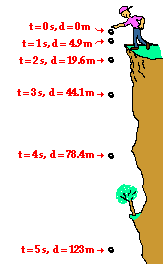

What shape does a projectile make?
Parabola
Hyperbola
Linear Line
Projectiles do not follow a predictable path
Two objects are released at the same time. One object is dropped in the vertical direction and one is launched horizontally into projectile motion. Which object hits the ground first?
Both hit the ground at the same time
The object dropped hits the ground first
The object launched horizontally hits the ground first
Unable to determine without further information

Two identical balls, X and Y, are projected horizontally from the edge of a cliff. The path of each ball is shown in the picture. Which of the following statements are true (mark all that apply)?
They have the same initial horizontal speed
They have the same vertical acceleration
They have the same initial vertical velocity
They take the same amount of time to reach the water
The resistance of an object to any change in its motion is called ______________________.
inertia
friction
gravity
weight

The picture is an example of Newton's...
1st Law
2nd Law
3rd Law


If you push horizontally on a crate with a force of 100 N, and it slides along the floor at a constant velocity, what is the net force on the crate?
100 N
unknown
10 N
0 N
What two factors affect an object's kinetic energy?
area and volume
mass and weight
weight and height
mass and speed
the capacity necessary to do work; controls the amount of change that can occur within a system
speed
joule
momentum
energy
the standard international unit for energy
newton
joule
kilogram
m/s/s
speed up, slow down, change direction
speed
motion
movement
acceleration

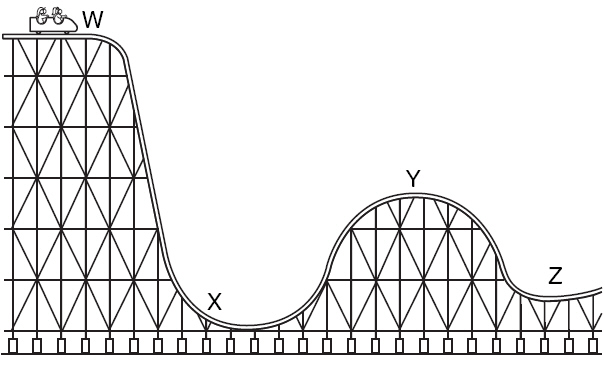
Where would this tossed baseball have the least amount of kinetic energy?
point W
point X
point y
point z
An egg landing on a soft surface will remain intact. The surface increases the _____ and decreases the _____ during the impact
impulse, time
impulse, force
force, time
time, force
A 5 N force is applied to a 3 kg ball to slow it down from 9 m/s to 3 m/s. What is the impulse on the ball?
-2.5 N⋅s
-10 N⋅s
-18 N⋅s
-45 N⋅s

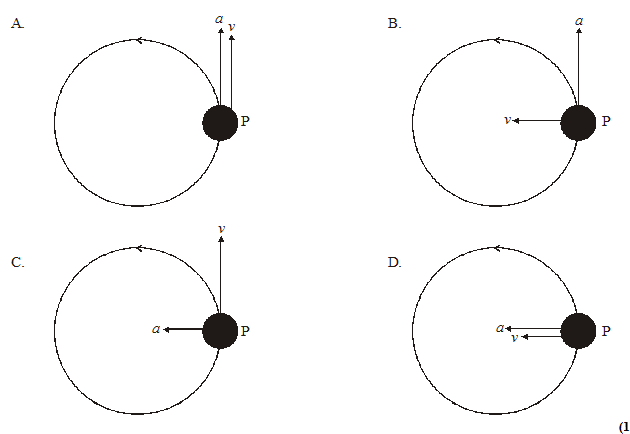
An object is moving in a circle at constant speed. From this, you know that there
is no net force acting on the object
are two balanced forces acting
is an unbalanced force acting on the object
must be more than two forces acting on the object

Normal force is
Always opposite the weight
Always parallel and down the incline
Always perpendicular to the surface
It depends on the direction of motion

Describe the motion at point a. on the graph.
terminal velocity
accelerating
decelerating
stationary

If this was the journey of a parachutist, what is happening at point e. ?
He is decelerating
He is accelerating
He has reached terminal velocity without his parachute.
He has reached terminal velocity with his parachute.
Terminal velocity is...
the consistent velocity attainable by an object as it falls through a medium
the average velocity attainable by an object as it falls through a medium
the highest velocity attainable by an object as it falls through a medium
the lowest velocity attainable by an object as it falls through a medium

Which term means the distance from the crest of one wave to the next crest?
Amplitude
Frequency
Wavelength
How are electromagnetic waves different from other waves?
They have short wavelengths
they transmit energy instead of matter
they can travel through empty space
they can change direction by reflection

Which has the LONGEST wavelength and therefore the lowest frequency/energy? These waves are used in broadcasting, wifi, and texting.
Gamma rays
Visible light
Radio waves
Infrared rays

The diagram shows a person observing a thunderstorm located several kilometers away. The person hears the thunder several seconds after seeing the lightning. Which statement accurately explains the difference in observations of sound and light by the observer?
Human eyes see light faster than their ears can hear sound.
The medium the waves are traveling through is different for each type of wave.
Light waves travel faster than sound waves.
Sound waves travel faster than light waves.

What electromagnetic wave do humans emit as heat energy?
infrared light
ultraviolet light
visible light
microwaves

Through which of these media do sound waves travel the fastest?
rock
hot air
seawater
foam

At what point is vy= 0 m/s?
A
B
C
D
None of these points
In the absence of air resistance, the angle at which a thrown ball will go the farthest is?
90°
30°
60°
45°

A 10.0 kg box is accelerated from 2.0 m/s to 4.0 m/s. What is the amount of work needed to accelerate the box?
50 J
60 J
20 J
45 J

