wayground logo

Free Printable Worksheets

NEW

Font size

S
M
L
XL
Worksheets

Physics Final Exam 20-21

Total questions: 50

Worksheet time: 1hrs 1mins
Name
Class
Date
1.
Distance and direction of an object's change in position from a starting point
a)
displacement
b)
distance
c)
motion
d)
reference point
2.
 Amy runs 2 miles south, then turns around and runs 3 miles north. What is displacement?
a)
5 miles
b)
1 mile 
c)
2 miles south
d)
1 mile north 
3.
Which of the following may you do to a vector without changing it?
a)
Add a nonzero vector to a vector.
b)
Multiply a vector by a scalar other than 1.
c)
Rotate a vector through any angle other than 360 degrees.
d)
Move the vector without changing its orientation.
4.
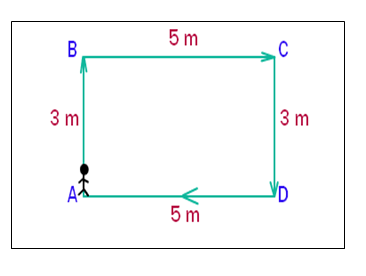
Sara walks from Point A to Point B. Which is true?
a)
Distance and displacement are EQUAL
b)
Distance is less than displacement
5.
Find the distance Sara walks from A to B,  B to C then C to D?
a)
11m
b)
3m
c)
5m
6.

Michael walks in the following order: from Point A, to Point B, and finally to Point C. Which is true?

a)

Distance and displacement are EQUAL

b)

Distance is less than displacement

c)

Displacement is less than distance.
7.

Juan walks in the following order: from Point A, to Point B, to Point C, and stops at Point D. Which is true?

a)

Distance and displacement are EQUAL

b)

Distance is less than displacement

c)

Displacement is less than distance.

8.
Which force produces a change in motion?
a)
unbalanced force
b)
balanced force
c)
gravitational force
d)
frictional force
9.
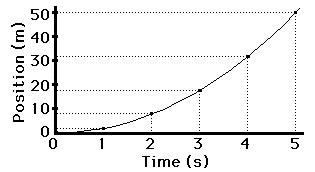
The picture of the position vs. time graph shows an object that is...
a)
accelerating/speeding up
b)
moving at a constant speed 
c)
not moving 
d)
accelerating/slowing down. 
10.
What is the standard unit force is measured in?
a)
Newtons
b)
pounds
c)
grams
d)
meters
11.
What is Newton's First Law known as? The Law of
a)
Friction
b)
Mass
c)
Inertia
d)
Gravity
12.
What is the formula for force?
a)
F=M/A
b)
F=MA
c)
F=AX
d)
what is force?
13.
What is Newton's Third Law?
a)
Object in motion stays in motion and an object at rest stays at rest unless acted on by a outside force
b)
Force = mass x acceleration
c)
For every action there is an equal and opposite reaction
14.
According to Newton's second law, if you increase the force applied to an object :
a)
it accelerates more
b)
it doesn't move
c)
you get more inertia
d)
it decelerates
15.
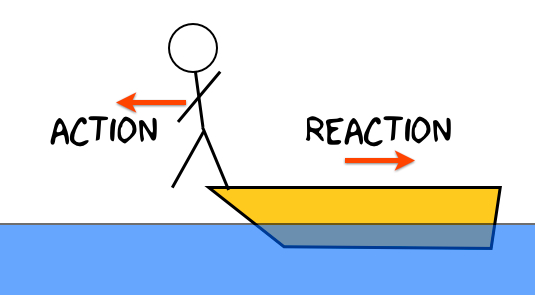
What law of motion does this picture represent?
a)
Newtons 1st law
b)
Newtons 4th law 
c)
Newtons 3rd law 
d)
Newtons 2nd law
16.
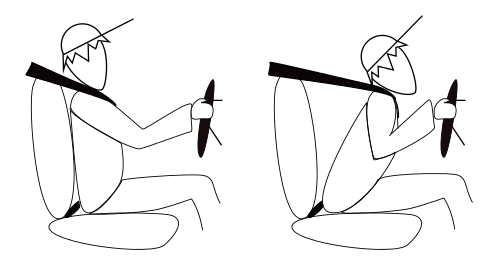
What Newtons law does this picture represent
a)
Newtons 2nd law 
b)
Law of gravity 
c)
Newtons 1st law
d)
Newtons 5th law
17.
When something has speed in a certain direction it is called ___________.
a)
motion
b)
position
c)
velocity
d)
speed
18.
Acceleration of an object happens when things ________
a)
slow down
b)
go faster
c)
change direction (turn)
d)
All of the above
19.
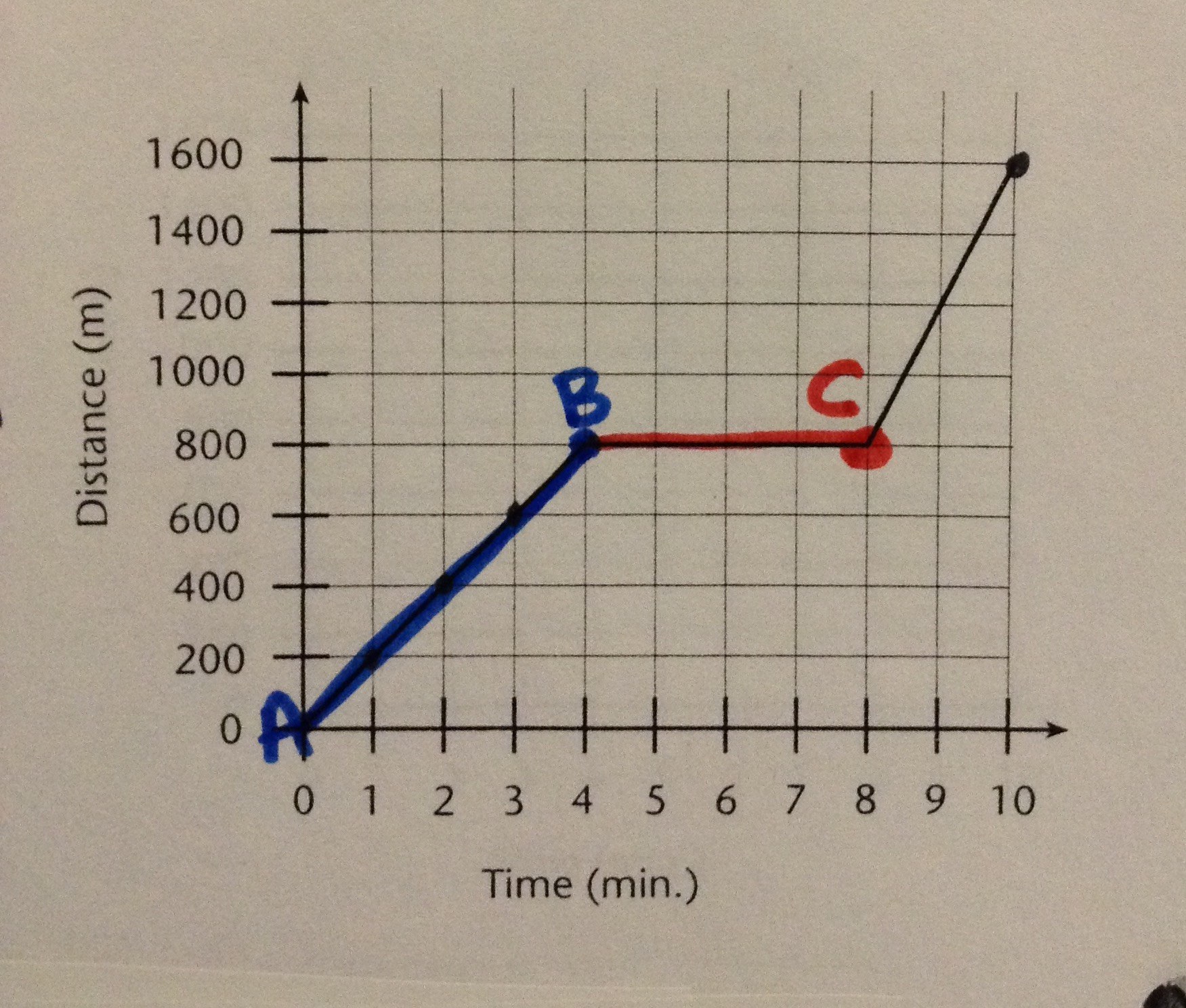
LT4: The graph shows Ashley riding her bike to Maria's house. 
What was occurring from point B to point C?
a)
She was increasing her speed.
b)
She stopped for 4 minutes
c)
She was decreasing in speed
20.
Newton's first law of motion states that __________.
a)
when a force is applied on an object, there is an equal force applied by the object in the opposite direction
b)
hen a force acts on an object, its acceleration is in the same direction as the force
c)
an object will remain at rest or keep moving with a constant velocity unless a force acts on it
d)
cceleration is calculated by dividing the force exerted on an object by the mass of the object
21.
If a 10 kilogram object accelerates suddenly at 15 m/s^2, how much force was applied to the object?
a)
150 Newtons
b)
15 Newtons
c)
150 kilograms
d)
100 kilograms
22.
If a force of 26 N is exerted on two balls, one with a mass of 0.52 kg and the other with a mass of 0.78 kg, which ball will have the greater acceleration?  (F=ma)
a)
The one with a mass of .78 kg will have the greatest acceleration.
b)
The one with a mass of .52 kg will have the greatest acceleration.
c)
They will both accelerate at the same rate.
23.
A 20 kg bike accelerates at 10 m/s2.  what was the force?
a)
25 Newtons
b)
20 Newtons
c)
200 Newtons
d)
10 Newtons
24.
A 5 kg block is pulled across a table by a net force of 32 N. Calculate the acceleration of the object. To solve this problem you must do - 
a)
32 ÷ 5
b)
5 ÷ 32
c)
32 x 5
25.
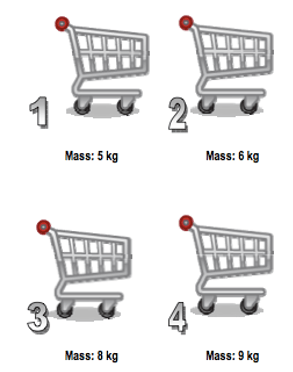
A force of 90N is applied to each cart below, which one will accelerate the fastest?
a)
Cart 1
b)
Cart 2
c)
Cart 3 
d)
Cart 4
26.
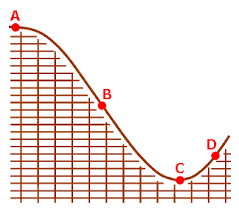
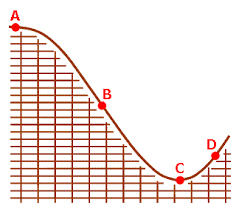
At which point(s) on the roller coaster is the gravitational potential energy at its maximum?
a)
A
b)
B
c)
C
d)
D
27.
At which point(s) on the roller coaster is the kinetic energy at its maximum?
a)
A
b)
B
c)
C
d)
D
28.
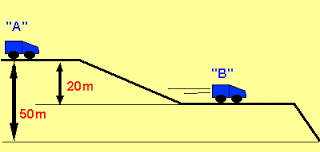
In diagram 2, if the mass of the car is 600 kg, what is the change in potential energy from point A to point B?
a)
411,600 J
b)
294,000
c)
176,400 J
d)
117,600 J
29.

1. A ball has a 17 J of kinetic energy and its mechanical energy is 25 J. If the ball has a mass of 3.2 kg, what is its height above the ground?

a)

0.26 m

b)

0.52 m

c)

5.2 m

d)

25 m

30.
What is mechanical energy?
a)
It is what metal creates when heated.
b)
All potential and kinetic energy in a system.
c)
It is motion of all matter.
d)
Energy of momentum.
31.
What does the Law of Conservation of Energy state?
a)
Energy cannot be created or destroyed
b)
Nothing can exchange energy
c)
Energy will increase over time.
d)
Energy will decrease over time.
32.
What type of energy is in this picture?
a)
Kinetic
b)
Potential
c)
Chemical
d)
Sound
33.
Work is:
a)
A transfer of energy by a force to move and object
b)
Something you get paid for
c)
Something you take home
d)
Makes you sweat
34.
On a roller coaster, where is maximum potential energy?
a)
At the bottom of a big hill
b)
When going around a corner
c)
When going upside down
d)
At the top of a big hill
35.
The formula for work is:
a)
d = r x t
b)
p = m x v
c)
f = m x a
d)
w = d x f
36.
What force ultimately slows the roller coaster to a stop?
a)
Applied
b)
Normal
c)
Friction
d)
Magnetic
37.

What is the correct unit for energy?

a)

meters (m)

b)

kilogram meters per second (kg m/s)

c)

Newtons (N)

d)

Joules (J)

38.
The faster an object moves, the ________ kinetic energy it has. 
a)
more
b)
less
c)
none of the above
d)
all of the above 
39.
Gravitational potential energy depends on the ________ and ________ of the object. 
a)
Height and mass
b)
Friction and movement
c)
Mass and Movement
d)
Height and Friction 
40.

What is the equation for calculating gravitational potential energy

a)

mv

b)

1/2 mv^2

c)

mgh

d)

Ft

41.

What is the equation for calculating kinetic energy?

a)

mv

b)

1/2 mv^2

c)

mgh

d)

Ft

42.

Calculate the potential energy of a car with a mass of 2,500 kg that is on a hill 100 meters above sea level. (g = 10 Nkg-1)

a)

250,000 J

b)

2,500,000 J

c)

25,000,000 J

d)

250 J

43.

Lilly's cat ran through your yard. The cat has a mass of 5 kg. He is running at a speed of 3 m/s. What is the kinetic energy of the cat as he runs? (KE = 1/2mv2)

a)

8.5 J

b)

45 J

c)

7.5 J

d)

22.5 J

44.

Alice kicks a soccer ball with a mass of 2.1 kg. The ball leaves the ground moving 30 meters per second. What is the kinetic energy of the soccer ball? (KE = 1/2mv2)

a)

567 J

b)

900 J

c)

945 J

d)

30 J

45.

If the 0.3 kg marble was moving at 6 m/s at the bottom of the ramp, how much kinetic energy did the marble have? (KE = 1/2mv2)

a)

5.4 J

b)

1.8 J

c)

3 J

d)

6 J

46.

If the 1.2 kg basketball rolls at 3 m/s, what is it's kinetic energy? (KE = 1/2mv2)

a)

2.7

b)

5.4

c)

3.6

d)

9

47.

A 5 Kg body is having a Kinetic energy of 250 J. What is the velocity (or speed) of the body?

a)

10 m/s

b)

15 m/s

c)

20 m/s

d)

40 m/s

48.

What is the mass of a ball that has a kinetic energy of 115 J and is traveling at a speed of 9 m/s?

a)

1035 kg

b)

23.5 kg

c)

12.8 kg

d)

2.84 kg

49.

A exercise ball is on a table 2.5 m above the ground. What is the mass of the ball if it has a GPE of 56.8 J?

a)

71 kg

b)

22.72 kg

c)

142 kg

d)

2.32 kg

50.
Which of the following is a true statement about work?
a)
It measures how quickly an object accelerates 
b)
It measures how much effort is applied over a certain distance
c)
It measures the change in an object's rate of speed
d)
It measures how much time it takes to move a massive object