wayground logo

Free Printable Worksheets

NEW

Font size

S
M
L
XL
Worksheets

2nd Quiz - The characteristics of mechanical waves

Total questions: 46

Worksheet time: 1hrs 20mins
Name
Class
Date
1.
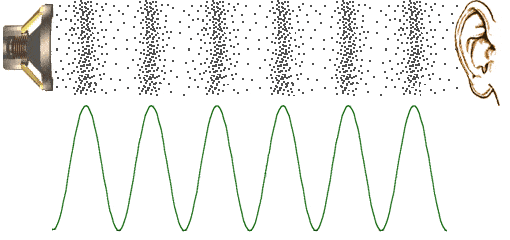
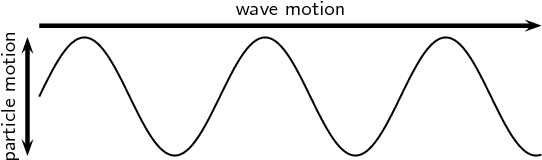
What kind of wave is pictured below?
a)
compressional wave
b)
transverse wave
c)
sound wave
d)
mechanical wave
2.
Waves are a transfer of what?
a)
Heat
b)
Light
c)
Energy
d)
Food
3.
Waves are a transfer of what?
a)
Heat
b)
Light
c)
Energy
d)
Food
4.
Amplitude reflects the amount of ____________________ in a wave.
a)
energy
b)
compression
c)
rarefaction
d)
speed
5.
The units for frequency are measured in _____________.
a)
hertz
b)
seconds
c)
m/s
d)
m
6.
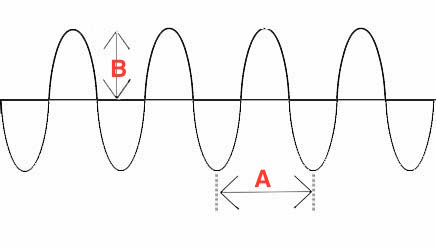
What property of this wave is represented by the letter "A"
a)
amplitude
b)
crest
c)
trough
d)
wavelength
7.
The highest point on a wave is:
a)
the crest
b)
the trough
c)
the top
d)
the coast 
8.
The lowest point on a wave is the:
a)
Amplitude
b)
Crest
c)
Trough
d)
Wavelength
9.
The number of wavelengths that pass a point each per second is:
a)
frequency
b)
period
c)
longitudinal 
d)
transverse wave 
10.
The type of waves that require medium to pass:
a)
Mechanical Waves
b)
Electromagnetic Waves
11.
When the frequency of a wave increases, what happens to the wavelength?
a)
The wavelength is not directly affected by the frequency of a wave.
b)
The wavelength increases.
c)
The wavelength decreases.
d)
More specific information is needed to form a conclusion about the wavelength.
12.
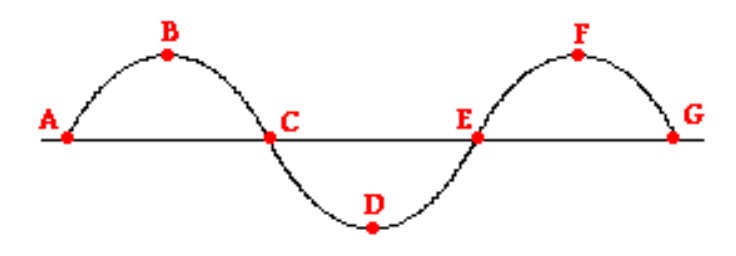
Which letter(s) represent the trough of the wave?
a)
A
b)
B & D
c)
D
d)
C & G
13.
What is the speed of a sound wave that has a frequency of 250 hertz and a wavelength of 8 meters? 
a)
31 m/s
b)
250 m/s
c)
2000 m/s
d)
5280 m/s
14.
The SI unit for frequency is ________.
a)
m
b)
m/s
c)
hertz
d)
s
15.
A wave in which the particles of the medium move perpendicularly to the direction the wave is traveling
a)
A. surface wave
b)
B. transverse wave
c)
C. electromagnetic  wave
d)
D. longitudinal wave
16.
How many waves are in this wave chain?
a)
6
b)
3
c)
4
d)
5
17.
A wave has wavelength of 10 m and a speed of 340 m/s. What is the frequency of the wave?
a)
34 m/s
b)
3400 Hz
c)
3400 m/s
d)
34 Hz
18.

Which of the following is true for sound waves?

a)

They require a medium.

b)

They are unrelated to vibrations.

c)

They cannot travel through liquids

d)

They can travel in a vacuum

19.

A student asks a series of questions about a wave. The answer to which question will allow the student to determine whether the wave is electromagnetic or mechanical?

a)

Does it require a medium in order to travel?

b)

Can it pass through air and water?

c)

Does it have a measurable speed?

d)

Does it have a measurable frequency?

20.

What is the term used to describe the maximum distance that a sound wave displaces air molecules from their original undisturbed position?

a)

Amplitude

b)

Speed

c)

Frequency

d)

Wavelength

21.

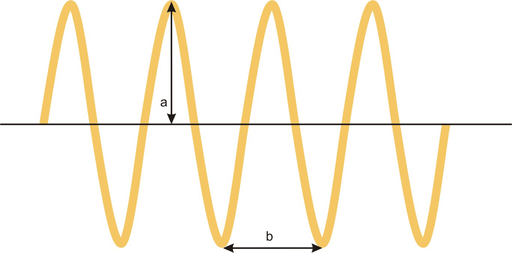
Which distance represents the wavelength?

a)

W

b)

X

c)

Y

d)

Z

22.

Which distance represents the amplitude?

a)

W

b)

X

c)

Y

d)

Z

23.

What do radio waves, microwaves, X-rays, and gamma rays all have in common?

a)

They all have the same wavelength.

b)

They are electromagnetic waves.

c)

They are detected in the same way.

d)

They store the same amount of energy.

24.

How many wavelengths separate point A and point B?

a)

1.5

b)

2.0

c)

2.5

d)

3.0

25.
Energy can be transferred from one medium to another through _________.
a)
vibrations
b)
stacking objects
c)
an ordered sequence
d)
colors
26.
Which of these waves cannot travel in a vacuum?
a)
light wave
b)
sound wave
c)
electromagnetic wave
d)
microwave
27.
Which is true of a mechanical wave?
a)
It must have a medium
b)
It must travel in empty space.
c)
It can travel in a vacuum.
d)
Both sound and light are examples.
28.
What is the amplitude of a wave?
a)
the amount of time that occurs in one full cycle
b)
the distance traveled by the wave during one full cycle
c)
the amount of cycles that occur in a given time
d)
the size of the disturbance
29.
What is the wavelength of a wave?
a)
the size of the disturbance
b)
the amount of time that occurs in one full cycle
c)
the distance between two crests of a wave
d)
the amount of cycles that occur in a given time
30.
Unlike a transverse wave, the disturbance in a longitudinal wave is
a)
in a circular motion.
b)
parallel to the wave motion.
c)
perpendicular to the wave motion.
d)
in the opposite direction of the wave motion
31.
A transverse wave can be created in a Slinky® by moving it
a)
side to side.
b)
in a circular motion.
c)
together and apart.
d)
up and down.
32.
Which is true about a surface wave?
a)
It only has properties of transverse waves.
b)
It only has properties of longitudinal waves.
c)
has neither properties of transverse or longitudinal waves.
d)
It has properties of both transverse and longitudinal waves.
33.
What is the speed of a wave if the wavelength is 100 m and the period is 20 s?
a)
2,000 m/s
b)
120 m/s
c)
80 m/s
d)
5 m/s
34.
What is the period of a wave if the wavelength is 100 m and the speed is 200 m/s?
a)
200,000 s
b)
0.5 s
c)
2 s
d)
100 s
35.
Sound waves are _______________
a)
Transverse waves
b)
Longitudinal waves
c)
Circular waves
d)
Seismic waves
36.
A wave transfers:
a)
matter
b)
water
c)
energy
d)
particles
37.
When the particles of a medium are vibrating perpendicular to the direction of the wave,  this is a __________wave.
a)
sound
b)
water
c)
transverse
d)
longitudinal
38.
The maximum height of a wave.
a)
crest 
b)
trough
c)
amplitude
d)
wavelength
39.
The SI unit for frequency is ________.
a)
m
b)
m/s
c)
hertz
d)
s
40.
What do waves transfer?
a)
energy
b)
matter
c)
work
d)
power
41.
The number of times a waves passes a given point in one sec
a)
frequency
b)
amplitude
c)
energy
d)
trough
42.
 travels only through matter
a)
mechanical wave 
b)
electromagnetic wave 
43.
material in which a mechanical wave travels
a)
medium 
b)
vacuum 
c)
black holes
d)
chocolate
44.
disturbance that transfers energy from one place to another
a)
wave
b)
energy
c)
vacuums 
45.
What kind of wave is this?
a)
Transverse Wave
b)
Longitudinal Wave
46.
What kind of wave is this?
a)
Transverse
b)
Longitudinal