
 Worksheets
Waves & Thermodynamics Unit Test Review
Total questions: 51
Worksheet time: 26mins
What is this a description of?
What behavior of waves do bats use to learn about their environment?

Sound waves are mechanical waves in which the particles in the medium vibrate in a direction parallel to the direction of energy transport. Identify another name for this type of wave motion.
transverse waves
pressure waves
longitudinal waves
electromagnetic waves
Two people each hold the end of a rope and create waves by moving their arms up and down. This wave is best classified as a transverse wave because ___________.
both the rope particles and the wave are moving in the same direction
the wave is moving up and down as the particles of the rope move horizontally.
the wave is moving horizontally as the particles of the rope move up and down.
the wave is moving in a parallel direction with the motion of the person's arms.
A student looks at ocean waves coming into the beach. An ocean wave with more energy will
have a greater height.
have a greater period.
travel toward the beach faster.
strike the beach with greater frequency.

Looking at waves A and B. Which description correctly describes the waves?
Wave A has twice the energy because it has a frequency twice as large.
Wave A has twice the energy because it has an amplitude twice as large.
Wave B has twice the energy because it has an amplitude twice as large.
Waves A and B gave the same energy because they have the same amplitude.

The diagram shows a wave. The quantity shown is the amplitude. This quantity is directly proportional to which of these other quantities?
Energy
Frequency
Period
Wavelength

What do these two sound waves have in common?
They have the same amplitudes.
They have the same wavelengths.
They make the same exact sound.
They have crests in the same position.
Heat is
A measure of the temperature of an object
The flow of energy due to a temperature difference
How hot or cold something is
How spicy your burrito tastes


The condition where two substances in physical contact with each other exchange no heat energy. They are said to be the same temperature.
Thermal Energy
Cooler to Warmer
Energy Transfer
Thermal Equilibrium
Energy can never be created nor destroyed. Which law does this refer to?
0th law of thermodynamics
1st law of thermodynamics
2nd law of thermodynamics
3rd law of thermodynamics
While running your kinetic energy converts to thermal energy. Which law does this refer to?
0th law of thermodynamics
1st law of thermodynamics
2nd law of thermodynamics
3rd law of thermodynamics
As temperature decreases, entropy decreases. At absolute zero, entropy is zero. Which law does this refer to?
0th law of thermodynamics
1st law of thermodynamics
2nd law of thermodynamics
3rd law of thermodynamics
The entropy of the universe is always increasing. Which law does this refer to?
0th law of thermodynamics
1st law of thermodynamics
2nd law of thermodynamics
3rd law of thermodynamics
True or False: Entropy increases as temperature increases
True
False
If A has the same temperature as B and C. B and C are in thermal equilibrium. Which law does this refer to?
0th law of thermodynamics
1st law of thermodynamics
2nd law of thermodynamics
3rd law of thermodynamics

What method of heat transfer is this?
Convection
Radiation
Conduction

What method of heat transfer is occurring in the pot?
Radiation
Conduction
Convection

What method of heat transfer is occurring from the handle to the hand?
Convection
Radiation
Conduction


This image depicts which of the following wave behaviors?
Reflection
Refraction
Diffraction
Resonance
Definition: When one object vibrating at the same natural frequency of a second object forces that second object into vibrational motion.
Reflection
Refraction
Diffraction
Resonance

The image depicts which of the following wave behaviors?
Resonance
Doppler Effect
Interference
Polarization

The two blue and purple waves will undergo _________________ when they meet.
Constructive interference
Destructive interference


In the diagram, the light ray strikes the mirror with an angle of incidence of 30 degrees. What is the angle between the incident ray and the reflected ray?
90 degrees
60 degrees
30 degrees
0 degrees

Which example below is an example of a decrease in entropy?
water freezing
campfire burning
water boiling
a copper coin rusts

The heat from a hot burner to a pot is transferred by ______.
convection
insulation
radiation
conduction
An ice cube is placed on a table and begins to melt. The following conclusion can be made.
Energy is being absorbed by the table which causes the cube to melt.
Energy is being transferred from the table to the ice cube.
Energy is being created by the air and table and making the cube heat up.
Which is the correct order of increasing entropy?
Gas>Liquid>Solid
Liquid>Gas>Solid
Solid>Gas>Liquid
Solid>Liquid>Gas
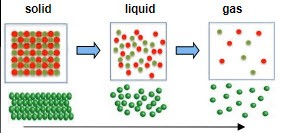
Entropy increases from solid, liquid to gas. Why?
Molecular disorder increases
Molecular randomness decreases
Molecules are more energetic
Molecules are more reactive

A hot cup of tea absorbs thermal energy from a cold room.
True
False

Which direction will the heat flow while this person holds a hot cup of tea?
from the cup to her hand
from her hand to the cup
no heat is transferred
What is the frequency of a wave with a speed of 1 m/s and a wavelength of 0.5 m?
2 Hz
2 m/s
0.5 Hz
1.5 m
What is the speed of a wave with a wavelength of 42.8 m and a frequency of 100 Hz?
428 m/s
4,280 m/s
2.3 m/s
0.428 m/s
Find the Wavelength of a wave with a speed of 3,000 m/s and frequency of 20 Hz.
20 m
150 m
60, 000 m
3, 000 m
A wave has a speed of 24 m/s and a wavelength of 0.04 m. What is the frequency of the wave?
600 Hz
600 m/s
0.096 Hz
0.04 Hz
Find the speed of a 10 m wave that has a frequency of 1 Hz.
9 m/s
10 Hz
10 m/s
10 m

