wayground logo

Free Printable Worksheets

NEW

Font size

S
M
L
XL
Worksheets

Test - Optics

Total questions: 49

Worksheet time: 2hrs 38mins

Name
Class
Date
1.

The hole in the eye through which light enters.

a)

cornea

b)

pupil

c)

lens

d)

retina

2.

The nerve that carries the nerve impulses from the eye to the brain.

a)

nerve impulse

b)

optic nerve

c)

auditory nerve

d)

motor nerve

3.

Which part of the eye has a function that opens and closes to change the size of the pupil?

a)

lens

b)

iris

c)

retina

d)

cornea

4.

Having a longer eyeball results in __________________________, a condition which causes the light to focus in front of the retina.

a)

astigmatism

b)

glaucoma

c)

farsightedness

d)

nearsightedness

5.

Which part of the eye is labeled with the letter "A"?

a)

cornea

b)

lens

c)

retina

d)

optic nerve

6.

Which part of the eye is labeled with the letter "E"?

a)

cornea

b)

pupil

c)

iris

d)

lens

7.

Which part of the eye is labeled with the letter "C"?

a)

retina

b)

optic nerve

c)

vitreous fluid

d)

iris

8.

True/False: The two types of photoreceptors in the retina are rods and cones

a)

True

b)

False

9.
What does the word "converging" mean?
a)
to separate
b)
to come together
c)
parallel 
d)
perpendicular
10.
What does the word "diverging" mean?
a)
to spread apart
b)
to come together
c)
parallel
d)
perpendicular
11.
Is a convex lens thicker or thinner in the middle?
a)
Thicker 
b)
Thinner 
12.
The point where the rays meet is known as....
a)
Fire
b)
the focal point
c)
refraction
d)
Plane of the lens
13.
What type of image is formed when rays of light actually intersect?
a)
real
b)
virtual
c)
projected
d)
curved
14.
The pictures shows what a student observed when he looked through a hand lens at a penny.
What happens to light passing through a hand lens that makes the image of the penny appear larger? The light is-
a)
absorbed
b)
reflected
c)
refracted
d)
stopped
15.
An image that you can see , but does not really exist is called which of the following?
a)
Real Image
b)
Fake Image
c)
Virtual Image
d)
Digital Image
16.
_____ is a lens that is thicker in the middle and makes an object appear bigger.
a)
prism
b)
convex lens
c)
concave lens
d)
mirror
17.
Glass has a _____________ index of refraction than air.
a)
Equal
b)
Greater
c)
Less
d)
Impossible to say
18.
Refraction occurs when _____________
a)
the wave's speed changes by entering a new medium
b)
a wave bounces off of a boundary
c)
waves parts meet each other
d)
waves bend around a barrier
19.

What is the ratio of the speed of light in a vacuum over the speed of light in a material?

a)

index of refraction

b)

critical angle

c)

total internal reflection

d)

aperture

20.

Which of the following does fiber optics technology use?

a)

index of refraction

b)

critical angle

c)

total internal reflection

d)

aperture

21.
Light travels in ___________ lines
a)
wavy
b)
bent
c)
straight
d)
backwards
22.
a flat sheet of glass that has a smooth, silver-colored coating on one side
a)
plane mirror
b)
concave mirror
c)
convex mirror
d)
solid mirror
23.
Seeing your face in a mirror is an example of 
a)
Refraction
b)
Fiber Optics
c)
Reflection
d)
Absorption
24.
Which of the following is not a source of light? 
a)
A. candle
b)
B. caver’s lamp
c)
C. mirror
d)
D. sun
25.
What is this called? 
a)
 reflection
b)
 bending
c)
refraction
d)
45 degree angle
26.

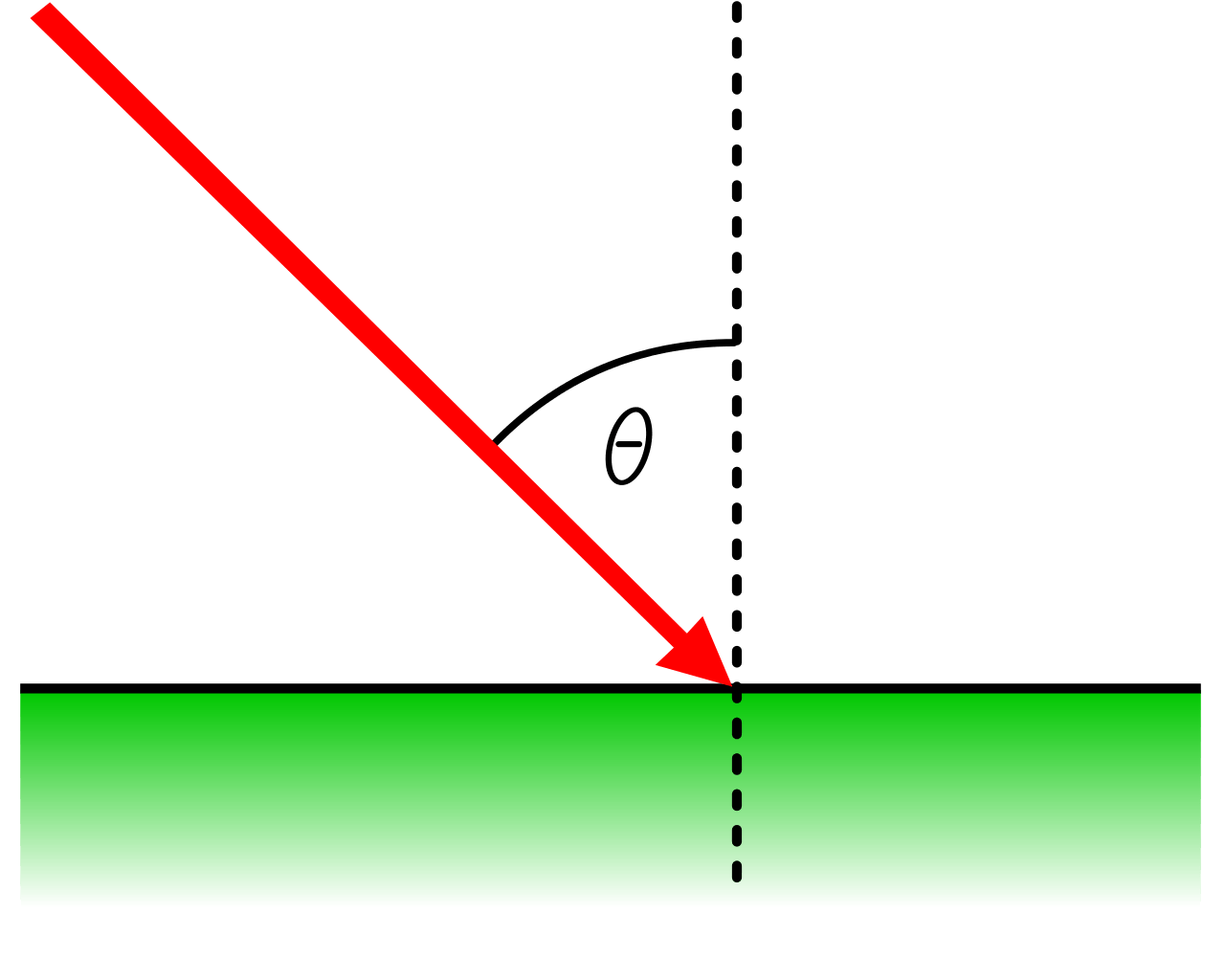
straight lines that represent light waves are called

a)

rays

b)

image

c)

reflection

d)

visible light

27.
The imaginary line perpendicular to a reflecting surface is called _____.
a)
crooked line
b)
parallel line
c)
angular line
d)
normal line
28.
The ray of light that strikes a reflecting surface is called ________.
a)
incident ray
b)
reflected ray
c)
normal ray
d)
none of the above
29.
Law of reflection state that - The angle of incidence is .................. to the angle of reflection.
a)
equal
b)
double
c)
half
30.

Which letter represents the angle of incidence?

a)

A

b)

B

c)

C

d)

D

31.
what is the angle between the incident ray and the normal called as
a)
angle of incidence
b)
angle of reflection
c)
angle of convergent
d)
angle of divergent
32.

if angle of incidence is 50, what is angle of reflection

a)

60

b)

80

c)

180

d)

50

33.
A virtual image is a copy of an object formed at the location from which the light rays appear to come.
a)
True
b)
false
34.
a flat sheet of glass that has a smooth, silver-colored coating on one side
a)
plane mirror
b)
concave mirror
c)
convex mirror
d)
solid mirror
35.
According to the Law of reflection, a light ray striking a mirror
a)
continues moving through the mirror in the same direction
b)
moves into the mirror at a slightly different angle
c)
bounces off the mirror toward the direction it came from
d)
bounces off the mirror at the same angle it hits.
36.
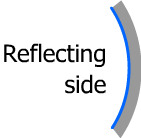
The following is a picture of what type of mirror? 
a)
Convex (diverging) Mirror
b)
Concave (converging) Mirror
c)
Plane Mirror
d)
Flat Mirror
37.
The following is a picture of what type of mirror? 
a)
Convex (diverging) mirror
b)
Concave (converging) mirror
c)
Plane Mirror
d)
Flat Mirror
38.

Plane mirrors create real images.

a)

True

b)

False

39.

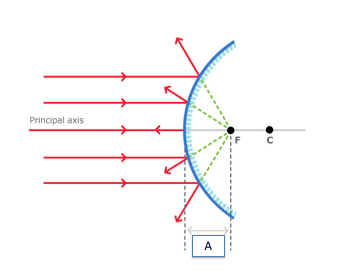
In the image, all the rays meet at F, What is F

a)

focal length

b)

focal point

c)

center of curvature

d)

reflection

40.
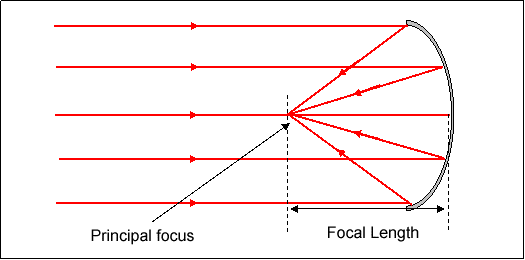
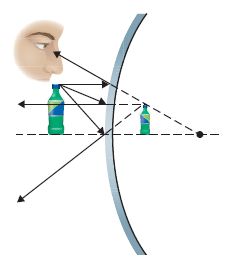
This is an example of a __________ mirror.
a)
Concave
b)
Convex
c)
Plane
d)
Magnifying
41.
A mirror with a flat surface is a plane mirror.
a)
true
b)
false
42.
What kind of mirror is shown here?
a)
plane
b)
concave
c)
convex
d)
diffuse
43.
What does it mean to reflect?
a)
bounce off
b)
bend
c)
refract
d)
energy
44.
Smooth surfaces _______ a lot of light.
a)
reflect
b)
bend
c)
absorb
d)
twist
45.
The color you see is the color that is ___.
a)
reflected
b)
absorbed
46.

At what height would you need a mirror to be to see your shoes?

a)

eye level

b)

halfway between your shoes and eyes

c)

at shoe level

d)

light acts all crazy so you can't tell

47.

Where do the light rays intersect to form an image of your reflection?

a)

at your eyes

b)

at your shoes

c)

on the surface of the mirror

d)

where you see the reflection of your shoes

48.

If you can't see your shoes in a mirror, would stepping closer help

a)

it depends how big the mirror is

b)

yes

c)

no

d)

it's a toss up really

49.

What class are you in?

a)

Physics 1st

b)

Biology

c)

I'm not really sure

d)

English?