wayground logo

Free Printable Worksheets

NEW

Font size

S
M
L
XL
Worksheets

PhySci Honors Motion Review

Total questions: 50

Worksheet time: 1hrs 15mins

Name
Class
Date
1.

Describe the motion of the object from point A to point B.

a)

Accelerating away from starting point

b)

Moving away from the starting point with constant speed

c)

Accelerating toward the starting point

d)

Moving toward the starting point with constant speed

2.

During which part of the graph is the speed the greatest?

a)

A to B

b)

B to C

c)

C to D

d)

D to E

3.

Describe the motion of the object from point D to point E.

a)

moving quickly away from the starting point

b)

moving slowly away from the starting point

c)

moving at a constant speed toward the starting point

d)

no motion

4.

What is the velocity of the object between points B and C?

a)

6 m/s away from the starting point

b)

6 m/s toward the starting point

c)

0.2 m/s away from the starting point

d)

0.2 m/s toward the starting point

5.

Is the velocity constant from point A to point D?

a)

No

b)

Yes

c)

There is not enough information to determine

6.

What is the difference between a scalar quantity and a vector quantity?

a)

vectors include direction

b)

scalars include direction

c)

vectors have magnitude

d)

scalars have magnitude

7.

What is acceleration?

a)

rate of change in velocity

b)

the time it takes for velocity to change

c)

how fast an object is moving

d)

the rate of distance over time

8.

Which of the following would be considered acceleration?

a)

a car drives for 30 min at 40 km/h

b)

a car is driving at 40 km/h and turns north

c)

a car travels north

d)

a car travels 30 km

9.
Which section represents no movement?  
a)
A
b)
B
c)
C
10.
Which graph represents the faster object? 
a)
A
b)
B
c)
Both graphs show the same speed
11.
which object traveled the fastest?  
a)
A
b)
B
c)
C
12.
Which section represents the object turning around and traveling back to the point of origin?  
a)
A-B
b)
C-D
c)
D-E
d)
E-F
13.
How many times did this object stop?  
a)
1
b)
2
c)
3
d)
This object did not stop
14.
A runner races in the 100 meter dash.  It takes her 10 seconds to finish.  What is her average speed?
a)
10 m/s
b)
1000 m/s
c)
100 seconds
d)
10 seconds
15.
What is the speed of an object that travels 60 meters in 4 seconds?
a)
240 m/s
b)
15 m/s
c)
0.067 m/s
d)
15 mph
16.
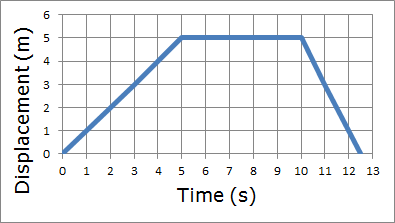
What is the person doing from 5 seconds to 10 seconds?
a)
Walking 
b)
Running
c)
Standing Still 
d)
Walking Fast
17.
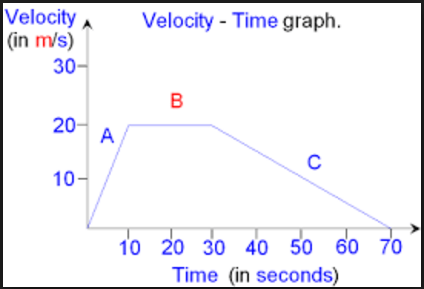
This is a velocity-time graph.  What is the object doing in segment A?
a)
Positive acceleration
b)
Negative acceleration
c)
Constant Velocity
d)
Not moving
18.
A car driving at 50 miles per hour drives for 2 hours. What distance did it cover?
a)
50 miles
b)
25 miles
c)
100 miles
d)
75 miles
19.
A truck driving at 60 miles per hour travels 150 miles. How long is it driving for?
a)
9000 hours
b)
0.4 hours
c)
210 hours
d)
2.5 hours
20.
Acceleration of an object happens when things ________
a)
slow down
b)
go faster
c)
change direction (turn)
d)
All of the above
21.

Image A matches graph:

a)

1

b)

2

c)

3

d)

4

e)

5

22.

Image B matches graph:

a)

1

b)

2

c)

3

d)

4

e)

5

23.
Find the velocity of a truck that travels 75 miles north in 2.5 hours.
a)
187.5 mph north
b)
30 mph north
c)
300 mph north
d)
200 mph north
24.
It took 3.5 hours for a train to travel the distance between two cities at a velocity of 120 miles/hr.  How many miles lie between the two cities? 
a)
34 miles 
b)
420 miles
c)
120 miles 
d)
360 miles 
25.
A car accelerates from 15 m/s to 60 m/s in 30 seconds.  What is its acceleration?
a)
2 m/s2
b)
3 m/s2
c)
1.5 m/s2
d)
0.75 m/s2
26.
A dog runs with an initial speed of 7.5 m/s on a waxed floor.  It slides to a stop in 15 seconds.  What is the acceleration?
a)
-7.5 m/s
b)
-7.5 m/s2
c)
-0.5 m/s2
d)
7.5 mi//hr
27.
Long sound waves are...
a)
high pitched
b)
low pitched
c)
medium pitched
28.
When the car moves AWAY from you, its horn seems...
a)
Low pitched
b)
High pitched
c)
Normal
29.
When an ambulance move TOWARD you it sounds ________ pitched. 
a)
high
b)
low
c)
medium
30.
The Doppler effect is seen when a wave-making source moves toward an observer. 
a)
True
b)
False
31.
What can you tell about this object's motion?
a)
Moving to the North (up).
b)
Moving to the South (down). 
c)
Moving to the West (left). 
d)
Moving to the East (right). 
32.
What can you tell about the motion of this object?
a)
Moving left.
b)
Moving right quickly.
c)
Standing still. 
d)
Moving up slowly. 
33.
What do the light waves of a galaxy that is moving AWAY from us look like?
a)
red shifted
b)
blue shifted
c)
green shifted
d)
yellow shifted
34.
How does the Big Bang Theory explain observations of the Doppler effect in the universe?
a)
Galaxies make lots of sound waves. 
b)
Galaxies are blue shifted and moving toward us.
c)
Galaxies are redshifted and moving away from us. 
d)
No connection. Light waves aren't visible in the universe. 
35.
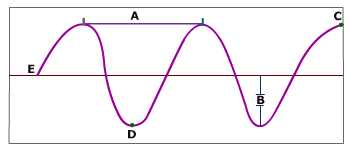
Which letter represents wavelength?
a)
A
b)
B
c)
C
d)
D
36.
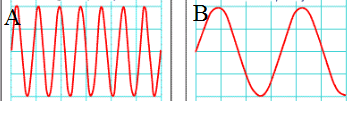
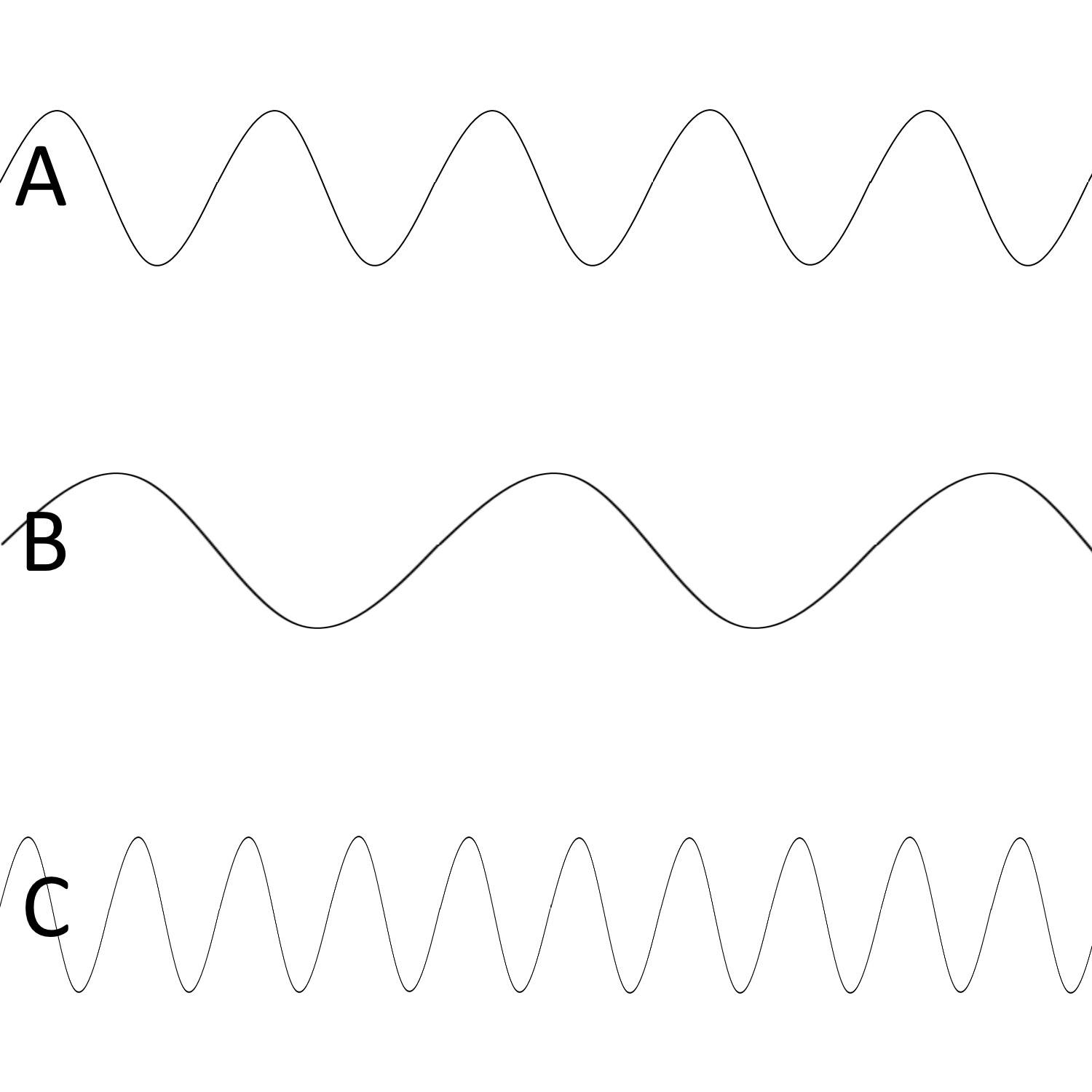
Which wave has a greater frequency?
a)
A
b)
B
37.
What is measured from crest to crest or trough to trough?
a)
Frequency
b)
Amplitude
c)
Wavelength
d)
Origin
38.
If a wave has a greater frequency, what happens to the wavelength?
a)
increases
b)
decreases
c)
stays the same
39.
Which wave has the largest wavelength?
a)
A
b)
B
c)
C
d)
None (same wavelength)
40.
If all three are waves of light, which wave has the largest speed?
a)
A
b)
B
c)
C
d)
None (same speed)
41.
Which type of light has the lowest energy of this group?
a)
Radio
b)
Microwave
c)
Infrared
d)
Ultraviolet
42.
Which type of light has the largest wavelength of this group?
a)
X-rays
b)
Microwave
c)
Infrared
d)
Ultraviolet
43.
This color in the visible part of the spectrum has the lowest energy. 
a)
Blue
b)
Green
c)
Red
d)
Violet
44.
This color in the visible part of the spectrum has the highest energy.
a)
Blue
b)
Red
c)
Violet
d)
Yellow
45.

Sound waves are which type of waves?

a)

transverse

b)

seismic

c)

longitudinal

d)

frequency

46.

A disturbance that sends energy away from the source is called a

a)

Wave

b)

Trough

c)

Crest

d)

Medium

47.

Waves that vibrate parallel to the direction of wave movement are

a)

Transverse waves

b)

Longitudinal waves

c)

Combination waves

d)

Amplitude waves

48.

Waves that vibrate perpendicular to the direction of wave movement are

a)

Transverse waves

b)

Longitudinal waves

c)

Amplitude waves

d)

Combination waves

49.

Waves that do not require a medium are called

a)

Transverse Waves

b)

Mechanical Waves

c)

Electromagnetic Waves

d)

Longitudinal Waves

50.

Sound waves are waves the require a medium. They are an example of

a)

Transverse waves

b)

Mechanical waves

c)

Electromagnetic waves

d)

Longitudinal waves