
 Worksheets
SNC1P1 Exam Review #3 - Electricity
Total questions: 46
Worksheet time: 44mins
Name
Class
Date
1.
Atoms contain charged particles called:
a)
Protons, neutrons and electrons
b)
Protons and electrons
c)
Protons and neutrons
d)
Electrons and neutrons
2.
The negatively charged particles in an atom are called _____.
a)
electrons
b)
neutrons
c)
negatrons
d)
protons
3.

Two like charges:
a)
neutralize each other.
b)
repel each other.
c)
must be neutrons.
d)
attract each other.
4.
If a substance has a higher number of electrons than protons on its surface, what type of charge does it have?
a)
A positive charge.
b)
A negative charge.
c)
A neutral charge
d)
No charge at all
5.
When objects have equal numbers of positive and negative charges, they are
a)
positively charged
b)
negatively charged
c)
electrically neutral
d)
unbalanced
6.
If a negatively charged rod touches a conductor, the conductor will be charged by what method?
a)
Friction
b)
Conduction
c)
Induction
d)
Convection
7.
An object becomes negatively charged by
a)
losing protons
b)
gaining electrons
c)
losing electrons
d)
gaining protons
8.
An object becomes positively charged by
a)
losing protons
b)
gaining electrons
c)
losing electrons
d)
gaining protons
9.
Charging by friction requires rubbing. Charging by contact requires ...
a)
rubbing
b)
touching
c)
no contact
10.
If you rub a glass rod with a piece of silk, the rod becomes positively charged. This means that
a)
friction destroyed electrons in the rod.
b)
the silk has become negatively charged.
c)
protons have moved to the rod.
d)
glass attracts more protons.
11.
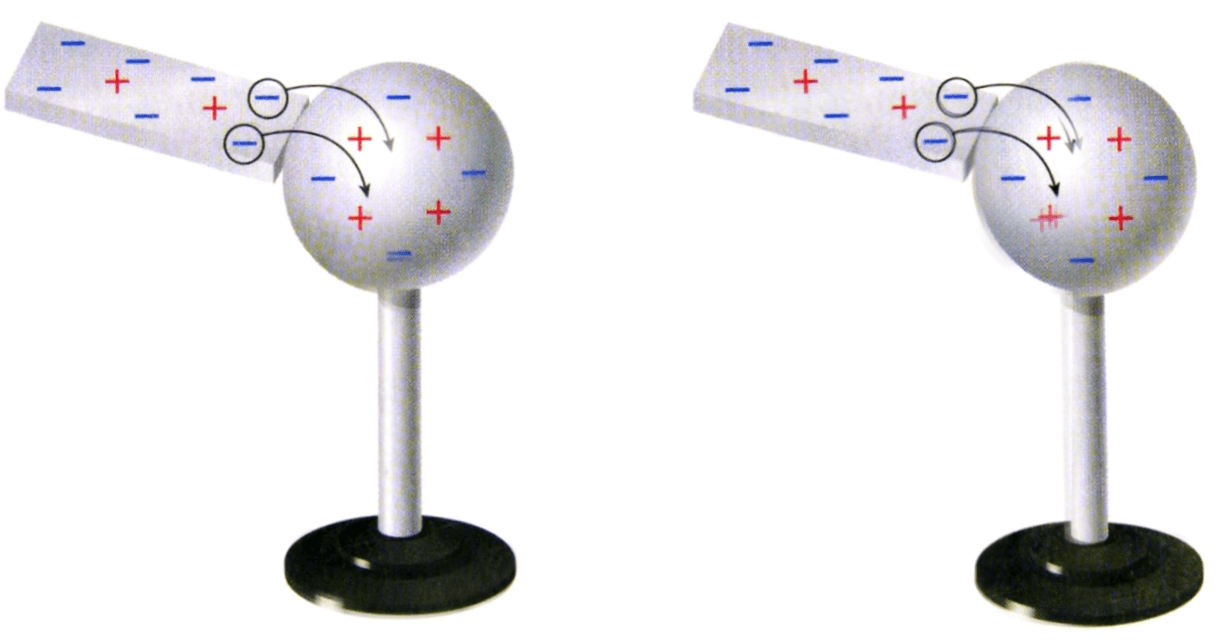
Charging by contact results in both objects having the same charge.
a)
True
b)
False
12.

Charging by Friction results in two objects with the same charge.
a)
True
b)
False
13.

This is the symbol for a _____?
a)
switch
b)
light
c)
battery
d)
wires
14.

This is the symbol for a _____?
a)
an AC current source
b)
a DC current source
c)
a battery
d)
a single cell
15.

This is the symbol for a _____?
a)
an AC current source
b)
a DC current source
c)
a battery
d)
a single cell
16.

This is the symbol for a _____?
a)
Lamp
b)
Water wheel
c)
Loudspeaker
d)
Motor
17.

a)
Closed push switch
b)
Pressure pad
c)
Weighing scales
d)
Fuse
18.

a)
Motor
b)
Milliammeter
c)
Machine
d)
Microphone
19.

The picture shows an electrical circuit. This circuit is a series circuit because:
a)
It has 3 light bulbs.
b)
The same current flows through all three light bulbs.
c)
It uses a single battery.
d)
The electrical current is divided between the three light bulbs.
20.
Which best describes a parallel circuit?
a)
Electricity flows along one pathway.
b)
The flow of electricity comes from one source.
c)
Electricity flows along more than one pathway.
d)
The flow of electricity comes from more than one source.
21.
What is one problem with using a series circuit?
a)
It has a lot of series.
b)
If one goes down, they all go down!
c)
It doesn't work properly.
d)
There are no problems.
22.

What kind of circuit is this?
a)
Series
b)
Consecutive
c)
Parallel
d)
Training
23.
Which is NOT an insulator.
a)
Wool
b)
Plastic
c)
Copper
d)
Glass
24.
Something electricity can't move through is called a(n) ______.
a)
conductor
b)
wire
c)
shoe
d)
insulator
25.
What is a example of a insulator?
a)
metal
b)
rubber
c)
water
26.
Water
a)
Insulator
b)
Conductor
27.

This is the symbol for a ...
a)
Bulb
b)
Battery
c)
Horn
d)
Fuse
28.

This is the circuit symbol for ...
a)
an AC current source
b)
a DC current source
c)
an ammeter
d)
a voltmeter
29.

This is the circuit symbol for ...
a)
an AC current source
b)
a DC current source
c)
an ammeter
d)
a voltmeter
30.
The picture shows an electrical circuit. This circuit is a series circuit because:
a)
It has 3 light bulbs.
b)
The same current flows through all three light bulbs.
c)
It uses a single battery.
d)
The electrical current is divided between the three light bulbs.
31.
The current has only has one loop to flow through in this circuit.
a)
Series Circuit
b)
Parallel Circuit
32.
Does this statement best describe a parallel or a series circuit.
When more light bulbs are added they all remain bright.
When more light bulbs are added they all remain bright.
a)
Parallel circuit
b)
Series circuit
33.
How many different types of circuits are there?
a)
1
b)
3
c)
2
d)
4
34.
A term used to describe the number of electrons moving past a fixed point in a conductor in one second is called________.
a)
Amperage
b)
Molecule
c)
Current
d)
Ohms
35.
The actual flow of electrons is called _______.
a)
Molecule
b)
Magnetism
c)
Current
d)
Electrica
36.
What is current measured in?
a)
Inches
b)
Amperes
c)
Centimeters
d)
Newtons
37.
Current is...
a)
moving protons
b)
moving electrons
c)
measured in volts
d)
measured in ohms
38.

What is the current reading at the two question marks in the diagram?
a)
12 A
b)
8 A
c)
4 A
d)
1 A
39.

Assuming the lamps are identical, what is the current running though each lamp?
a)
3 A
b)
2 A
c)
1 A
d)
0 A
40.

What would the current reading be on the ammeter returning to the cell?
a)
1 A
b)
2 A
c)
3 A
d)
6 A
41.
Voltage is measured in __.
a)
volts.
b)
watts.
c)
coulombs.
42.
What is the rule for voltage in a parallel circuit?
a)
stays the same
b)
adds up
c)
inverse of the sum of the reciprocals
43.
The difference in electrical potential energy between two places is called
a)
resistance
b)
friction
c)
induction
d)
voltage
44.
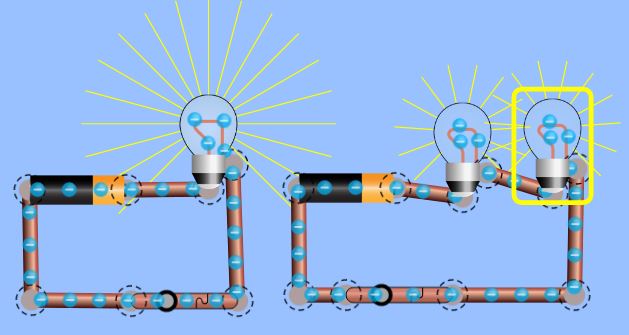
Adding more bulbs to a series circuit will make each bulb burn less brightly.
a)
True
b)
False
45.
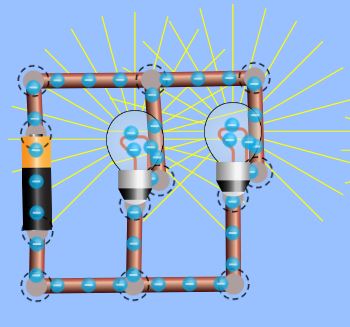
Adding more bulbs to a parallel circuit will make each bulb burn less brightly.
a)
True
b)
False
46.
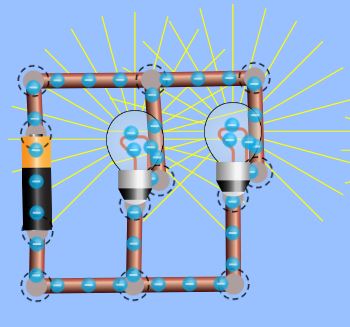
The voltage across each bulb is 9V. What is the voltage across the cell?
a)
4.5
b)
9
c)
18
d)
27
100 %

