wayground logo

Free Printable Worksheets

NEW

Font size

S
M
L
XL
Worksheets

Fast Revision (Physics)

Total questions: 43

Worksheet time: 15mins

Name
Class
Date
1.

Which of these is a good insulator?

a)

tap water

b)

steel

c)

plastic

d)

gold

2.

Which of these is a good conductor?

a)

plastic

b)

wood

c)

glass

d)

copper

3.

Which of these is a unit of electrical energy?

a)

volt

b)

kilogram

c)

tonne

d)

metre

4.

In what units is force measured in?

a)

kilograms

b)

watts

c)

newtons

d)

kilometres per second

5.

1 newton is approximately equal to:

a)

10 grams

b)

100 grams

c)

1 kilogram

d)

1 tonne

6.

This ball has:

a)

electrical energy

b)

heat energy

c)

kinetic energy

d)

nuclear energy

7.

The stationary car on the hill has:

a)

gravitational potential energy

b)

maximum kinetic energy

c)

elastic potential energy

d)

sound energy

8.

In this clip gravitational potential can be seen ____________ into kinetic energy.

a)

transferring

b)

transforming

9.

Friction is...

a)

a force that acts to slow down movement

b)

a force that acts to speed up movement

c)

increased by lubrication

d)

always a problem in our lives

10.

True or false: The light in this circuit will not go on.

a)

True

b)

False

11.

Inertia is...

a)

the property of laziness (or not moving unless a force is acted upon it).

b)

the tendency of an object to stay moving until stopped by a force.

c)

both the tendency to keep moving or not to move unless acted on by a force.

d)

a force rather than a property.

12.

True or false: In a vacuum, a feather will fall slower than a bowling ball.

a)

True

b)

False

13.
the tendency of an object to resist a change in its motion
a)
acceleration
b)
inertia
c)
mass
d)
frame of reference
14.
push or pull acting on an object
a)
speed
b)
force
c)
position
d)
mass
15.
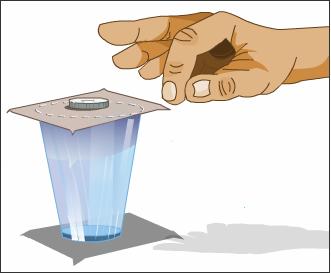
True of False?
An object's inertia is effected by its mass.
a)
False
b)
True
16.
What is the tendency of an object to resist a change in motion?
a)
coffee
b)
motion
c)
inertia
d)
gravity
17.
If you increase the force on an object, its acceleration
a)
decreases
b)
stays the same
c)
also increases
d)
stops
18.
push or pull acting on an object
a)
speed
b)
force
c)
position
d)
mass
19.
What is the unit of measurement for force?
a)
AMP
b)
Seconds
c)
Newtons
d)
Miles
20.
Newton's 1st law is also called....
a)
friction 
b)
inertia
c)
unbalanced forces
d)
Newtons
21.
Because of inertia, a moving object will keep ________.
a)
at rest
b)
moving
c)
in one spot
d)
inertia 
22.

Which of the following is NOT a unit of momentum?

a)

kg*m/s

b)

N*s

c)

kg*mph

d)

kg*m/s2

23.
Most modern vehicles have padded dashboards. This reduces collision injuries by...
a)
reducing the driver's change in momentum
b)
increasing the driver's change in momentum
c)
increasing the force of impact
d)
increasing the time of impact
24.
In a perfectly inelastic collision, ______ is conserved. 
a)
Momentum only
b)
Kinetic Energy only
c)
Both momentum and kinetic energy
25.
What pressure does a 4000N horse exert on the ground if each foot is 10cm2?
a)
40 N/cm2
b)
100 N/cm2
c)
400 N/cm2
d)
10 N/cm2
26.
Which of these animals would probably cause the greatest pressure on the ground?
a)
A fat cow with big feet
b)
A fat cow with small feet
c)
 A calf with big feet
d)
A calf with small feet
27.
Where would you find the largest pressure?
a)
At the bottom of the ocean
b)
At the top of Mt Everest
c)
Close to ground on the Scotch oval
d)
In a rockpool on the Great Barrier Reef
28.
What is the difference between particles in a gas and a solid?
a)
gas particles are closer together
b)
solid particles move faster than gas particles
c)
solid particles expand on heating
d)
gas particles have more kinetic energy than solid particles
29.
Where is pressure the greatest on the dam?
a)
D
b)
C
c)
B
d)
A
30.
Pressure is measured in what units
a)
Newtons
b)
m/s
c)
Pascals
d)
Moles
31.

Velocity is defined as __________

a)

Speed and inertia

b)

Speed and direction

c)

Distance and direction

d)

Direction and inertia

32.

Acceleration is the rate of change in ___________.

a)

Speed

b)

Distance

c)

Velocity

d)

Displacement

33.

_______ is the force that slows an object in free fall.

a)

Gravity

b)

Friction

c)

Air resistance

d)

None of the above

34.

What kind of quantity has both a magnitude and a direction?

a)

Scalar

b)

Vector

c)

Direction

d)

Time

35.

Which of the following is NOT a scalar quantity?

a)

Time

b)

Distance

c)

Displacement

d)

Speed

36.

If an object is not moving the forces acting upon it are _____________

a)

Unbalanced

b)

Weak

c)

Balanced

d)

Incomplete

37.

_______ is the tendency of an object to resist a change in its motion.

a)

Acceleration

b)

Inertia

c)

Mass

d)

Force

38.

"For every action, there is an equal and opposite reaction" is the definition of which law?

a)

Newton's 1st Law

b)

Newton's 2nd Law

c)

Newton's 3rd Law

d)

None of these

39.
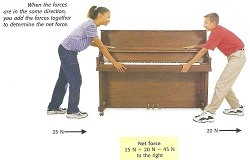
What is the net force?
a)
5 N
b)
45 N to the left
c)
5 N to the right
d)
45 N to the right
40.
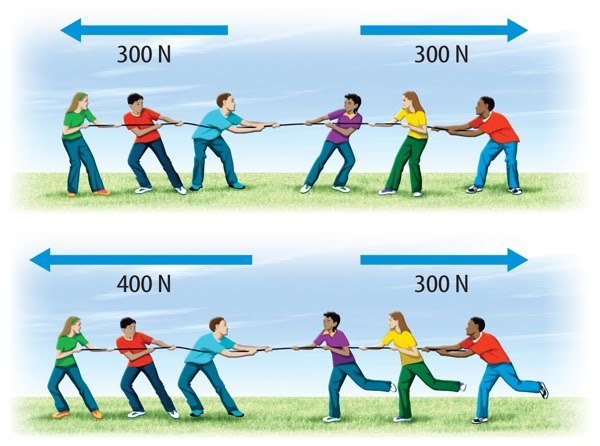
Which one is balanced?
a)
top
b)
bottom
c)
both
41.

What two subatomic particles are found in an atom's nucleus?

a)

Protons and neutrons

b)

neutrons and electrons

c)

electrons and protons

42.

Beta radiation is ____________________

a)

an electron from an electron shell.

b)

an electron from the nucleus.

c)

two protons and two neutrons.

d)

a high frequency electromagnetic wave.

43.

______ is used to determine the age of once-living artifacts.

a)

iodine-131

b)

phosphorus-32

c)

carbon-14

d)

americium-241