wayground logo

Free Printable Worksheets

NEW

Font size

S
M
L
XL
Worksheets

DNA and RNA Test Review

Total questions: 41

Worksheet time: 49mins

Name
Class
Date
1.
In a strand of DNA, if it contains 20% of Thymine, then how much Guanine would be present?
a)
30%
b)
20%
c)
80%
d)
10%
2.
Which sequence of DNA bases would pair with this partial strand
ATG TGA CAG
a)
ATG TGA CAG
b)
TAC ACT GTC
c)
GTA AGT GAC
d)
CAT TCA CTG
3.
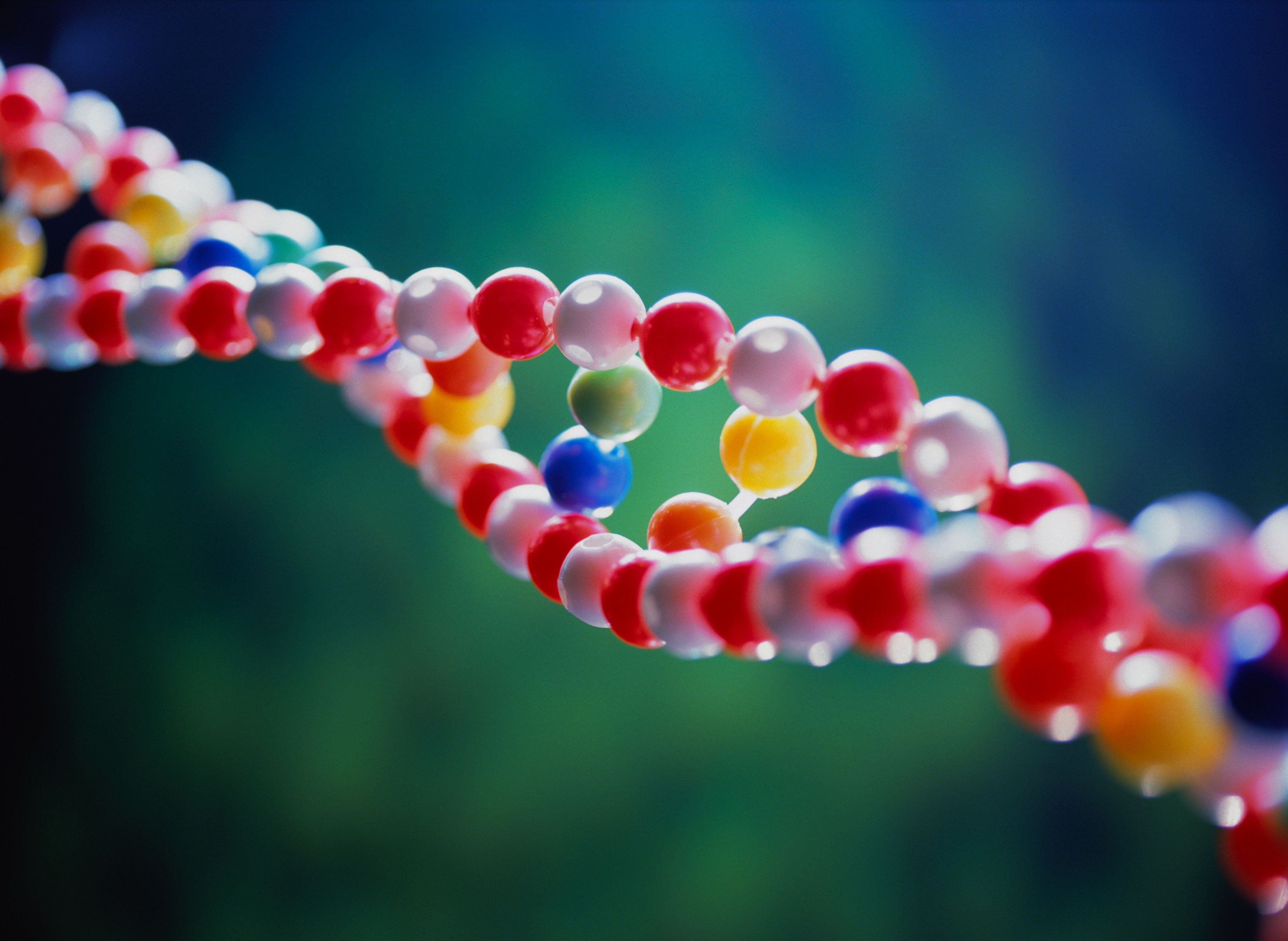
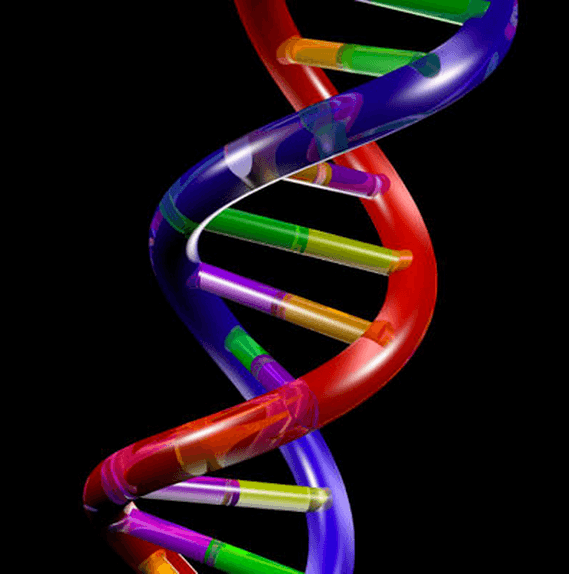
Which of the following best describes a DNA molecule?
a)
double helix
b)
contains ribose
c)
made of amino acids
d)
contains Uracil
4.
Which of the following units are repeatedly joined together to form a strand of DNA?
a)
amino acids
b)
nucleotides
c)
fatty acids
d)
polysaccharides
5.
Guanine bonds with ______________.
a)
Adenine
b)
Guanine
c)
Cytosine
d)
Thymine
6.
In a molecule of double-stranded DNA, the amount of Adenine present is always equal to the amount of
a)
cytosine
b)
guanine
c)
thymine
d)
uracil
7.
Why is DNA important?
a)
it is very small and very complicated
b)
it's in everything
c)
it serves as the blueprint for traits of all living things
d)
because we eat it every day for energy
8.
What determines the code, or information, of a DNA molecule?
a)
the shape (structure) of the nitrogen bases
b)
the order (sequence) of the nitrogen bases
c)
the color of the nitrogen bases
d)
the frequency (number) of nitrogen bases
9.
Which 2 molecules form the sides (backbone) of the DNA ladder?
a)
deoxyribose sugar and adenine
b)
deoxyribose sugar and a hydrogen bond
c)
deoxyribose sugar and the nucleus
d)
deoxyribose sugar and phosphate
10.
What are the three components of a nucleotide?
a)
sugar, hydrogen, nitrogen base
b)
sugar, oxygen, nitrogen base
c)
sugar, phosphate, nitrogen base
d)
sugar, phosphate, protein
11.
A process in which DNA has the unique ability to make an exact copy of itself.
a)
Replication
b)
Translation
c)
Transcription
12.
Nitrogenous bases are joined by which type of bond?
a)
polar bonds
b)
ionic bonds
c)
covalent bonds
d)
hydrogen bonds
13.
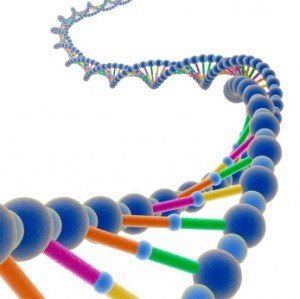
The following picture must be
a)
DNA because it's double stranded
b)
RNA because it's single stranded
c)
DNA because it's single stranded
d)
RNA because it's double stranded
14.
Which two scientists are accredited with correctly deducing the double helix model of DNA?
a)
Watson and Crick
b)
Wilkins and Franklin
c)
Wilkins and Crick
d)
Watson and Franklin
15.
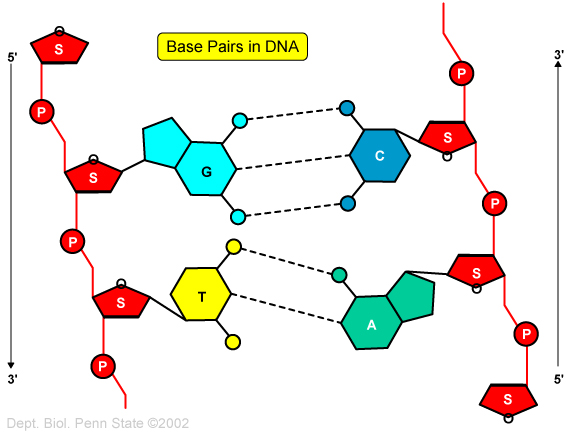
What does this picture represent?
a)
amino acid
b)
base pairing
c)
nucleotide
d)
the DNA molecule
16.

In RNA, Adenine bonds with ______________.

a)

Guanine

b)

Thymine

c)

Cytosine

d)

Uracil

17.
Which 2 molecules form the sides (backbone) of the DNA ladder?
a)
deoxyribose sugar and adenine
b)
deoxyribose sugar and a hydrogen bond
c)
deoxyribose sugar and the nucleus
d)
deoxyribose sugar and phosphate
18.
The enzyme that unzips the DNA to prepare for replication
a)
helicase
b)
replicase
c)
polymerase
d)
synthase
19.
A process in which DNA has the unique ability to make an exact copy of itself.
a)
Replication
b)
Translation
c)
Transcription
20.
What is the correct complimentary strand for the following DNA?ATCGAG
a)
TACGAG
b)
ATCGAG
c)
TAGCTG
d)
TAGCTC
21.
What are the nucleotides made of?
a)
Sugar, Phosphate, nitrogen base
b)
Phosphate, Adenine, nitrogen base
c)
Thymine, Adenine, Cytomine
d)
Phosphate, Nitrogen, Adenine
22.
The correct spelling of DNA is....
a)
deoxiribonucleic acid
b)
deoxyribosenucleic acid
c)
deoxyribonucleic acid
d)
deoxyribonucliec acid
23.
RNA contains the sugar
a)
ribose
b)
deoxyribose
c)
glucose
d)
lactose
24.
What is the difference between DNA and RNA in terms of bases?
a)
RNA contains uracil in place of thymine
b)
RNA contains uracil in place of adenine
c)
RNA contains uracil in place of guanine
d)
RNA contains uracil in place of  cytosine
25.
Which type of RNA takes the instructions from the nucleus to the cytoplasm?
a)
mRNA
b)
tRNA
c)
rRNA
d)
RNA polymerase
26.
What is the template for mRNA?
a)
DNA
b)
tRNA
c)
rRNA
d)
proteins
27.
How many nucleotides make a codon?
a)
1
b)
2
c)
3
d)
6
28.
What is the product of transcription?
a)
DNA
b)
mRNA
c)
tRNA
d)
proteins
29.
A mutation that affect one specific location is called
a)
a mutagen
b)
a chromosomal mutation
c)
a point mutation
d)
translocation
30.
What is the central dogma of molecular biology?
a)
RNA-protein-DNA
b)
RNA-DNA-protein
c)
DNA-protein-RNA
d)
DNA-RNA-prtein
31.

Swapping DNA segments with non-homologous chromosomes is known as which type of mutation?

a)

Point

b)

Frameshift

c)

Nondisjunction

d)

Gene Translocation

32.

What is the term that refers to changes in the DNA sequence of a single gene?

a)

Mutagen

b)

Mutation

c)

Diversity

d)

Replication

33.

Which of the following is not mutagen?

a)

UV Rays

b)

Processed Food

c)

Viruses

d)

Adenine

34.

Mutation that occur in _________ cells are passed from parents to offspring.

a)

Somatic

b)

Germ

c)

Brain

d)

Genotypic

35.

A point mutation that does not change the amino acid sequence is known as a(n) ____________ mutation.

a)

Frameshift

b)

Nondisjunction

c)

Inversion

d)

Silent

36.

A point mutation that does not change the amino acid sequence is known as a(n) ____________ mutation.

a)

Frameshift

b)

Nondisjunction

c)

Inversion

d)

Silent

37.

A parent that has a mutation to their skin cells can pass this mutation to their offspring

a)

True

b)

False

38.

What is the following image show?

a)

Natural Selection

b)

Genotypic Ratios

c)

Chromosomal Mutations

d)

Sickle Cell

39.

What type of mutation is shown in the image?

a)

Nondisjunction

b)

Gene Translocation

c)

Trinucleotide Repeat Expansion

d)

Frameshift

40.
What mutation has occurred here? 
T-G-A-C-C-A
T-G-A-G-C-A
a)
Substitution
b)
Deletion
c)
Insertion
d)
Frameshift 
41.
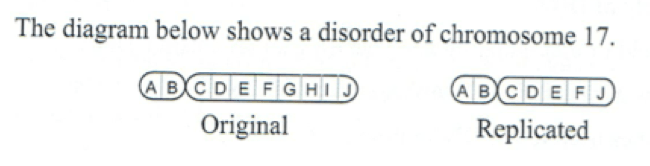
What type of chromosomal mutation has occurred?
a)
substitution
b)
insertion
c)
deletion
d)
nondisjunction