wayground logo

Free Printable Worksheets

Font size

S
M
L
XL
Worksheets

Introduction to Economics

Total questions: 91

Worksheet time: 1hrs 9mins

Name
Class
Date
1.
The total value of goods and services produced within the borders of a country during a specific time period, usually one year.
a)
GDP
b)
GNI
c)
GDP per capita
d)
HDI
2.
There are 4 _______________. They are land, labour, capital and entrepreneurship.
a)
Factors of Production 
b)
Market Economy 
c)
Profit 
d)
Economics 
3.
Goods or services that are not necessary, but that we desire or wish for. Examples: video games, toys, concert tickets, etc.
a)
Demand
b)
Needs
c)
Wants
d)
Presents
4.
The reason why you can't have everything you want is because of ___________________.
a)
Opportunity Cost
b)
Scarcity
c)
Incentive 
d)
Choice
5.
How do you satisfy your unlimited wants in a world of limited resources?
a)
by making more money
b)
by making choices
c)
by stealing
d)
by setting a budget
6.
Man-made resources used in the production process i.e. machines in a factory.
a)
Labor 
b)
Capital
c)
Household
d)
Revenue 
7.
The study of how people seek ways to meet their wants and needs by making choices is called?
a)
Economics
b)
Scarcity
c)
Capitalism
d)
Entrepreneurs
8.
What economic system is based upon consumers and producers independent decisions determining which products will be successful (sell)?
a)
Traditional Economy
b)
Control or Command Economy
c)
Free Market (Capitalist) Economy
d)
Socialist Economy
9.
In traditional economies what is the term for exchanging goods and services without using currency (money)?
a)
Trade off
b)
Bartering
c)
Stealing
d)
Tariff
10.
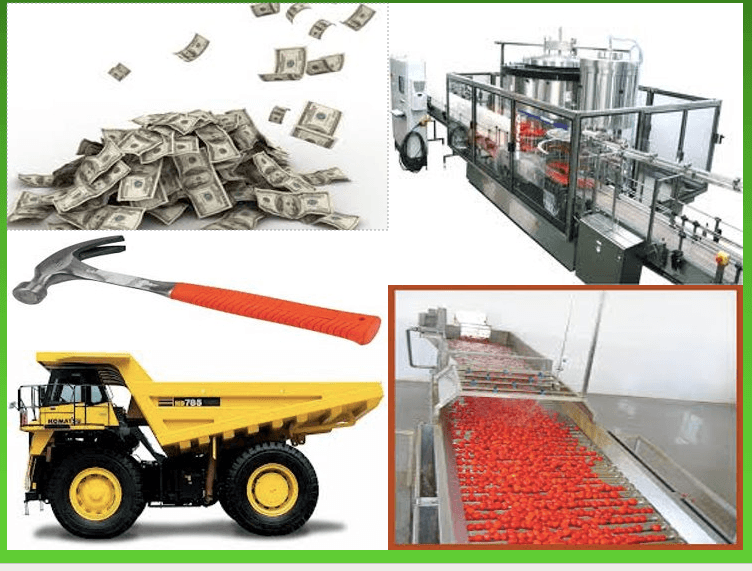
What factor of production does this picture represent?
a)
Land
b)
Capital
c)
Labor
d)
Entrenprenour
11.
If you were invited by friends to go to the movies but you instead to stayed in and watched Netflix what is the opportunity cost of your choice?
a)
Watching Netflix
b)
Going to the movies with your friends
c)
Taking a nap
d)
Ordering takeout
12.

The decisions which are made by firms, individuals, and or governments regarding which needs and wants to satisfy, and what types of products and services should be produced and bought.

a)

Choices

b)

Opportunity Cost

c)

Scarcity

d)

Shortage

13.

The natural resources that people use: Forests, pasture land, minerals, water, etc. are products used in the production of goods and services, come from the earth.

a)

Labor

b)

Land

c)

Capital

d)

Entrepreneurship

14.

Goods made by people to be used specifically to produce goods and services: Tools, office equipment, roads, factories, etc.

a)

Labor

b)

Land

c)

Entrepreneurship

d)

Capital

15.

The human ability to produce a good or service: Talents, skills, physical labor, etc. the work that goes into the production of a good or service.

a)

Human resources or Labor

b)

Land

c)

Capital

d)

Entrepreneurship

16.

This is basically the ideas that go into the process of creating a good or providing a service.

a)

Capital

b)

Entrepreneurship

c)

Land

d)

Labor

17.

An unemployed factory worker is under what factor of production?

a)

Labor

b)

Capital

c)

Natural resource

d)

Land

18.

An untapped deposit of natural gas is under what factor of production?

a)

Natural Resource

b)

Capital

c)

Labor

d)

Land

19.

Economics is the study of how people make choices about ways to use _______________ resources to fulfill their unlimited wants and needs.

a)

Limited

b)

Unlimited

c)

Natural

d)

Man-made

20.

What are the factors of production?

a)

Land, Technology, Dirt, Resources

b)

Land, Labor, Capital, Entrepreneurship

c)

Land, Labor, Entrepreneurship

d)

Resources used in the production of only services

21.

The factor of production that includes natural resources is known as:

a)

Land

b)

Labor

c)

Capital

d)

Entrepreneurship

22.

Which of the following is NOT a basic question of economic systems?

a)

What should be produced?

b)

For whom should it be produced?

c)

How long should it be produced?

d)

How should it be produced?

23.

Clearly defined and enforced property rights are elements of which type of economic system?

a)

command

b)

traditional

c)

market

d)

socialist

24.

Which type of economy has the MOST government involvement?

a)

communism

b)

free-market

c)

capitalism

d)

socialism

25.

An economic system that decides what to produce, how to produce, and for whom to produce according to long-standing customs is?

a)

mixed

b)

free-market

c)

traditional

d)

command

26.
Which of the following best describes the Law of Demand?
a)
As price goes down, demand goes down. (and vice versa).
b)
As price goes down, demand goes up (and vice versa).
c)
As demand goes down, supply goes up.
d)
As demand goes up, price becomes elastic.
27.
The following is a factor that will not cause the demand curve to shift:
a)
Advertising
b)
Population
c)
Price
d)
Consumer expectations
28.
If a consumer knows that a product will be going on sale this week, how will his/her CURRENT demand be affected?
a)
it will go up
b)
it will go down
c)
it will stay the same
d)
what does this have to do with the price of tea in China?
29.
In a market economy, who decides on the prices of goods and services?
a)
government
b)
buyers and sellers
c)
firms
d)
local leaders
30.
The following is a factor that will not cause the demand curve to shift:
a)
Advertising
b)
Population
c)
Price
d)
Consumer expectations
31.
Labor is a type of human resource.
a)
True
b)
False
32.
Tutoring is an example of a service, not a good.
a)
True
b)
False
33.
What is an entrepreneur? A person who....
a)
develops a new product
b)
tries to earn a profit
c)
improves an existing product
d)
all of the above
34.
Which is NOT a productive resource?
a)
Human resources
b)
Capital resources
c)
Unnatural resources
d)
Natural resources
35.
Consumer goods and services are bought in which of the following markets?
a)
goods markets
b)
service markets
c)
product markets
d)
resource markets
36.

Economic growth is measured by...

a)

Gross International Product

b)

Gross Domestic Product

c)

Gross International Export

d)

Gross Domestic Export

37.

Economic growth is featured by ...

a)

Producing more goods & services in this month compared last month

b)

Producing more goods & services this quarter compared to last quarter

c)

Producing more goods & services within last 6 months compared to previous 6 months

d)

Producing more goods & services this year compared to last year

38.
What type of economic system allows the government to decide what to produce, how to produce and for whom to produce?
a)
Market
b)
Mixed
c)
Command
d)
Traditional
39.
What type of economic system is based on customs and beliefs?
a)
Market
b)
Mixed
c)
Traditional
d)
command
40.
The four types of economic systems are: 
a)
Traditional, Command, Mixed, & Market
b)
Traditional, Command, Combined, & Market
c)
Communism, Capitalism, Free Market, and Macroeconomics
d)
Microeconomics, Macroeconomics, Individual, and Traditional.
41.
In the economy of the Bushmen of the Kalahari Desert the people follow the examples of their ancestors.  This is what kind of economy? 
a)
Traditional 
b)
Market 
c)
Command 
d)
Centrally planned 
42.
The Country of North Korea has a dictator that makes all of the economic decisions. What type of economy is this?
a)
Traditional 
b)
Market 
c)
Command 
d)
Centrally Planned 
43.
A person who comes up with a product or service, and finds the money and time to produce this new product.
a)
Entrepreneur
b)
Incentive
c)
Specialization
d)
Barter
44.
What type of economy do most countries in the world have?
a)
Market economy
b)
Command economy
c)
Traditional economy
d)
Mixed economy
45.
Sam loves science and wants to become a doctor but he is learning how to make clay bricks like his father and grandfather.
a)
Free Market
b)
Traditional
c)
Mixed
d)
Command
46.
Katia is an accountant in a government run business where she was placed after graduation.
a)
Command
b)
Traditional
c)
Free Market
d)
Mixed
47.
Mary Ann runs a car dealership selling only government produced cars.  At the end of the month Mary Ann must give all of the money she made back to the government.
a)
Traditional 
b)
Free Market
c)
Mixed
d)
Command
48.
Joe owns a shoe store.  At the end of the month Joe decides what to do with his profits.
a)
Command
b)
Free Market
c)
Traditional
49.
Sarah would like to become a doctor when she grows up.  Unfortunately, she lives in a country where her job will be decided for her by the government.
a)
Traditional
b)
Free Market
c)
Mixed
d)
Command
50.

In my country, central planners decide when we should expand old factories and build new ones.

a)

Traditional

b)

Command

c)

Market

d)

Mixed

51.

In my country my job is the same one that my family has done over the past 200 years.

a)

Traditional

b)

Command

c)

Market

d)

Mixed

52.

In my country, the government makes all the economic decisions.

a)

Traditional

b)

Command

c)

Market

d)

Mixed

53.

A _____________ economy is completely determined and controlled by a central planning authority or the government

a)

Traditional

b)

Planned/Command

c)

Mixed

d)

Free Market

54.

A ______________ economy is guided primarily by custom, habit, and ritual.

a)

Traditional

b)

Planned/command

c)

Mixed

d)

Free Market

55.

A _________ economy is a market-based system in which the government is involved to some extent.

a)

Traditional

b)

Planned/command

c)

Mixed

d)

Free Market

56.

The vast majority of the world's economies are mixed - they are market based economies with some extent of government involvement.

a)

True

b)

False

57.

A 100% free market without government involvement doesn't really exist in the modern world.

a)

True

b)

False

58.
Money, equipment, and supplies needed in production.
a)
Land
b)
Labor
c)
Capital
d)
Entrepreneur
59.
•Government controls major national resources •Some private ownership and small businesses
a)
Market
b)
Command
c)
Social
d)
Traditional
60.
Customs and traditions determine who controls the factors of production.
a)
Market
b)
Command
c)
Social
d)
Traditional
61.
•No economic freedom •No private ownership •No profit motive
a)
Market
b)
Command
c)
Social
d)
Traditional
62.
A nation with a high literacy rate and high GDP would be considered...
a)
Developed
b)
Developing
63.
A nation with a high infant mortality rate would be considered...
a)
Developed
b)
Developing
64.
The individual or group that invents what is produced.
a)
Land
b)
Labor
c)
Capital
d)
Entrepreneur
65.
A garbage truck driver is an example of which Factor of Production?
a)
labor
b)
land
c)
entrepreneurship
d)
capital
66.
Iron, minerals, coal and plants are examples of which productive resource?
a)
land
b)
labor
c)
entrepreneurship
d)
capital
67.
a farmer
a)
Natural
b)
Labor
c)
Capital
d)
????????
68.
Which factor of production would you consider a lawn mower?
a)
Land
b)
Labor
c)
Capital
d)
Entrepreneur
69.
Which factor of production would you consider a lawn mower?
a)
Land
b)
Labor
c)
Capital
d)
Entrepreneur
70.
fish
a)
Natural
b)
Labor
c)
Capital
d)
????????
71.
gold
a)
Natural
b)
Labor
c)
Capital
d)
????????
72.
Name the natural resource(s).
a)
wheat
b)
combine
c)
truck
d)
combine and truck
73.
Which factor of production would you consider a cow?
a)
Land
b)
Labor
c)
Capital
d)
Entrepreneur
74.
The people who decide to buy.
a)
Producers
b)
Consumers
c)
Economist
d)
Entreprenuers
75.
What is this resource?
a)
human resource
b)
capital resource
c)
natural resource
d)
human and capital resource
76.
What is an entrepreneur?
a)
A person who starts a new business.
b)
A leader of a country.
c)
A worker in a factory.
d)
A student in college.
77.

Land includes...

a)

The "gifts of nature" or natural resources not created by human effort.

b)

the tools, equipment, and factories used in production of goods and services

c)

people with all their efforts and abilities

d)

individuals who start a new business or bring a product to market.

78.

Capital refers to...

a)

The "gifts of nature" or natural resources not created by human effort.

b)

people with all their efforts and abilities

c)

the tools, equipment, and factories used in production of goods and services

d)

individuals who start a new business or bring a product to market.

79.
A bulldozer is an example of...
a)
Land
b)
Labor
c)
Entrepreneurs
d)
Capital
80.
Your garbage man is an example of
a)
Land
b)
Labor
c)
Entrepreneurs
d)
Capital
81.
Your Mail lady is an example of...
a)
Land
b)
Labor
c)
Entrepreneurs
d)
Capital
82.
Cashiers at McDonalds are examples of ….
a)
Land
b)
Labor
c)
Entrepreneurs
d)
Capital
83.

Bill Gates is an example of...

a)

Land (seriously though, come on)

b)

Labor

c)

An Entrepreneurs

d)

Capital

84.

Which of the factors of production is this?

a)

capital

b)

entrepreneur

c)

land

d)

labor

85.

Which one is a need and not a want?

a)

going out to eat

b)

drinking a glass of water

c)

going to the movies

d)

luxury sports car

86.

Which one of the factors of production is this?

a)

capital

b)

entrepreneur

c)

land

d)

labor

87.

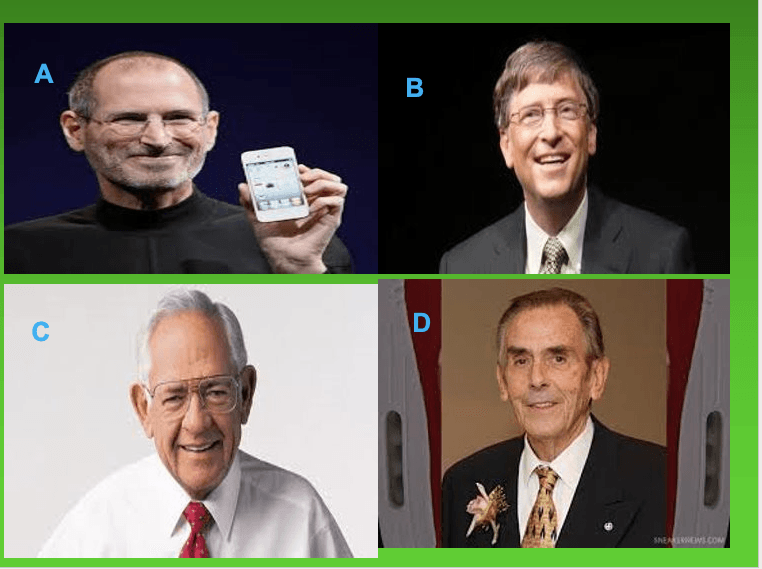
Steve Jobs the founder of Apple is holding up an I-phone. What is another name for someone who starts a business?

a)

capital

b)

entrepreneur

c)

land

d)

labor

88.

This factor involves money, equipment, and tools and any items to produce goods and services?

a)

capital

b)

entrepreneur

c)

land

d)

labor

89.
What is an entrepreneur?
a)
A person who starts a new business.
b)
A leader of a country.
c)
A worker in a factory.
d)
A student in college.
90.
Name the natural resource(s).
a)
wheat
b)
combine
c)
truck
d)
combine and truck
91.
The people who decide to buy.
a)
Producers
b)
Consumers
c)
Economist
d)
Entreprenuers