wayground logo

Free Printable Worksheets

NEW

Font size

S
M
L
XL
Worksheets

Unit 03 Atomic Structure Review Pt.2

Total questions: 45

Worksheet time: 42mins

Name
Class
Date
1.
This particle is found in the nucleus and has no charge
a)
Neutron
b)
Proton
c)
Electron
d)
Orbital
2.
The first person to propose a theory about an atom was
a)
Democritus
b)
Rutherford
c)
Dalton
d)
Aristotle
3.
Rutherford's gold foil experiment provided evidence that...
a)
Negative and positive charges are spread evenly throughout the atom.
b)
Alpha particles have a positive charge.
c)
Gold is not a dense as previously thought.
d)
There is a dense positively charged nucleus at the center of an atom.
4.
This is a negatively charged particle found outside the nucleus
a)
Electron
b)
Proton
c)
Neutron
d)
Orbital
5.
What contribution did John Dalton make to atomic theory? 
a)
He discovered that every atom was positively charged. 
b)
He discovered that every element consisted of one type of atom.  
c)
He discovered that atoms had nuclei. 
d)
He discovered that atoms could be divided into smaller parts. 
6.
What scientist is best known for his "Plum Pudding" model of the atom?
a)
J.J. Tomson
b)
Ernest Rutherford
c)
John Dalton
d)
Democritus
7.
How did Rutherford discover the proton?
a)
Cathode tube ray experiment
b)
Gold Foil Experiment
c)
Planetary Model
d)
Plum Pudding Model
8.
The central region of an atom where its neutrons and protons are is its 
a)
Nucleus 
b)
Electron Cloud
c)
Core 
d)
Center 
9.
Niels Bohr suggested that electrons.......
a)
are found in specific orbits
b)
electrons are scattered throughout the atom
c)
electrons move according to their energy level
d)
electrons are positive
10.
Atoms are made up of three basic parts, which are -
a)
Protons, neutrons, electrons
b)
neutrinos, protons, neutrons
c)
quarks, protons, electrons
d)
electrons, neutrons, and quarks
11.
Place the following scientists in order, from earliest to latest: 
A) Ernest Rutherford
B) J.J. Thomson
C) John Dalton
a)
B,C,A
b)
C,A,B
c)
A,C,B
d)
C,B,A
12.
J.J. Thomson provided evidence that an atom...
a)
is the smallest particle of matter
b)
contains negatively charged particles
c)
has an overall negative charge
d)
has an overall positive charge
13.
Rutherford's gold foil experiment provided evidence that...
a)
negative and positive charges are spread evenly throughout the atom.
b)
alpha particles have a positive charge.
c)
gold is not a dense as previously thought.
d)
there is a dense positively charged nucleus at the center of an atom.
14.
How many neutrons would Fe-56 have?
a)
56
b)
26
c)
30
d)
33
15.
How many neutrons would V-49 have?
a)
26
b)
49
c)
23
d)
50.94
16.
How many protons does Pb-209 have?
a)
127
b)
209
c)
82
d)
291
17.
What is the mass number of an atom of gold with 117 neutrons?
a)
117
b)
196
c)
196.97
d)
197
18.
A neutral atom of the isotope 2612Mg would consist of
a)
12 protons, 26 neutrons, 26 electrons
b)
26 protons, 12 neutrons, 26 electrons
c)
26 protons, 14 neutrons, 14 electrons
d)
12 protons, 14 neutrons, 12 electrons
19.
An atom is electrically neutral when
a)
protons and neutrons are the same
b)
protons and electrons are the same
c)
neutrons and electrons are the same
d)
neutrons balance the protons and electrons
20.
Isotopes of the same element have the same number of 
a)
protons
b)
neutrons
c)
electrons
d)
not enough information
21.
Iron-60 (atomic number 26) is an isotope that is often used to study meteorites.  How many neutrons does iron-60 have?
a)
26
b)
60
c)
34
d)
86
22.
All of the following are characteristics of electrons except:
a)
Has the same charge as the proton, but opposite.
b)
Is 1800 times less massive than a proton.
c)
Has the same charge as a neutron.
d)
Is 1800 times less massive than a neutron.
23.
What is the neutron's role in the nucleus?
a)
To counteract the repulsive forces between the protons.
b)
To counteract the repulsive force between electrons.
c)
To increase the mass of the atom, allowing it to react properly with other elements.
d)
To determine the type of element the atom is.
24.
Why is the relative atomic mass not a whole number?
a)
Nuclei can contain partial neutrons.
b)
Nuclei can contain varying number of electrons.
c)
Nuclei can contain partial protons.
d)
Nuclei can contain different numbers of neutrons and be the same element.
25.
The atomic number of Uranium is:
a)
110
b)
16
c)
53
d)
92
26.
Silicon-30 has an atomic mass of:
a)
14
b)
15
c)
16
d)
30
27.
The number of neutrons in Beryllium-8 is:
a)
4
b)
7
c)
8
d)
3
28.
Can an atom of Hydrogen have 2 protons?
a)
Yes, because it can be an ion
b)
No, because protons identify the atom
c)
Yes, because it can be an isotope
d)
No, because only neutral atoms exist
29.
Can an atom of Helium have 3 neutrons?
a)
Yes, because it can be an ion
b)
No, because protons identify the atom
c)
Yes, because it can be an isotope
d)
No, because only neutral atoms exist
30.
Which type of model is shown?
a)
Plum Pudding
b)
Bohr / Orbits
c)
Electron Cloud
d)
Billiard Ball
31.
Which type of model is shown?
a)
Plum Pudding
b)
Bohr / Orbits
c)
Electron Cloud
d)
Billiard Ball
32.

How many protons are in the isotope pictured above?

a)

29

b)

34

c)

63

d)

92

33.

How many neutrons are in the isotope pictured above?

a)

29

b)

34

c)

63

d)

92

34.

What is the number of protons in phosphorus-31?

a)

15

b)

16

c)

31

d)

46

35.
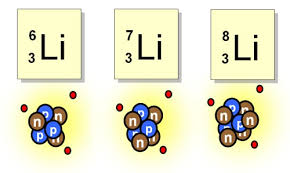
How many neutrons does the isotope of lithium have?
a)
8
b)
3
c)
4
d)
5
36.
which atom has  4 neutrons?
a)
Li-6
b)
Li-7
c)
Li-8
d)
they have the same # of neutrons
37.
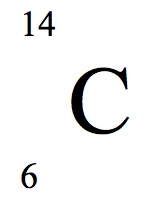
The photo above shows the isotopic notation for which isotope?
a)
Carbon 12
b)
Carbon 13
c)
Carbon 14
d)
Carbon 15
38.
Fluorine has an atomic number of 9. What can you conclude about an atom of fluorine from this fact?
a)
it has 9 protons
b)
it weighs 9 grams
c)
it has 9 electron shells
d)
it has a boiling point of 9 degree celsius
39.
How many neutrons does uranium-235 have?
a)
238
b)
92
c)
146
d)
143
40.
How many neutrons does the isotope below have?     89 36Kr
a)
53
b)
36
c)
89
d)
125
41.

How does a neutral atom become a positively charged cation?

a)

The atom gains protons.

b)

The atom loses protons.

c)

The atom gains electrons.

d)

The atom loses electrons.

42.

How many protons, neutrons, and electrons, does Te-2 have?

a)

Protons 52 , Neutrons 76, Electrons 52

b)

Protons 52 , Neutrons 76, Electrons 54

c)

Protons 52 , Neutrons 75, Electrons 54

d)

Protons 52 , Neutrons 76, Electrons 50

43.

How many protons, neutrons, and electrons, does Cs+1 have?

a)

Protons 55 , Neutrons 55, Electrons 55

b)

Protons 55 , Neutrons 78, Electrons 56

c)

Protons 55 , Neutrons 77, Electrons 54

d)

Protons 55 , Neutrons 78, Electrons 54

e)

Protons 55 , Neutrons 77, Electrons 55

44.

What is the correct symbol for an atom with 7 protons and 10 electrons?

a)

N

b)

N+3

c)

N-3

d)

Ne-3

e)

Ne+3

45.
An atom becomes _________ when it gains electrons.
a)
Positive
b)
Negative
c)
Neutral
d)
Invinsible