wayground logo

Free Printable Worksheets

NEW

Font size

S
M
L
XL
Worksheets

Science Lab Assessment

Total questions: 50

Worksheet time: 2hrs 40mins

Name
Class
Date
1.
What tool is used to measure temperature?
a)
meter stick
b)
thermometer
c)
balance
d)
spring scale
2.
What tool is used to measure the volume of a liquid?
a)
thermometer
b)
hand lens
c)
graduated cylinder
d)
ruler
3.
Name the tool.
a)
balance
b)
spring scale
c)
thermometer
d)
hand lens
4.

Name the tool.

a)

hand lens

b)

graduated cylinder

c)

meter stick

d)

pan balance

5.
Name the tool.
a)
spring scale
b)
graduated cylinder
c)
hand lens
d)
ruler
6.

What is the first step in the scientific method?

a)

draw conclusions

b)

ask a question/make an observation

c)

make a hypothesis

d)

test the experiment

7.

Performing a test or experiment allows you to test your ___________.

a)

draw conclusions

b)

hypothesis

c)

senses

d)

battery

8.
What are the states of matter?
a)
solid, liquid, and juice
b)
solid and liquid
c)
solid and gas
d)
solid, liquid, and gas
9.
State of matter with no definite shape or volume.
a)
solid
b)
liquid
c)
gas
d)
Mississippi
10.
How is a gas defined?
a)
no shape, no volume
b)
Definite shape, definite volume
c)
Found in stars
d)
Definite volume, no shape
11.
Molecules are closest together in a 
a)
Solid
b)
Liquid
c)
Gas
d)
plasma
12.
Water can be a solid, liquid, and a gas.
a)
True
b)
False
liquid
13.
Define a liquid
a)
no shape, no volume
b)
Definite shape, definite volume
c)
Found in stars
d)
Definite volume, no shape
14.

What is matter?

a)

Anything that takes up space

b)

Anything that has mass

c)

Anything that has mass and takes up space

d)

I don't know Ms. Northcutt, I wasn't listening

15.
The amount of space something takes up.
a)
matter
b)
mass
c)
volume
d)
element
16.
a)

green rectangle

b)

blue rectangle

c)

They have the same density

17.
 Which is true?
a)
Oil is more dense than water
b)
the crayon is more dense than the pasta
c)
the paperclip is less dense than oil
d)
the popsicle stick is the least dense item
18.
Which is true?
a)
Material A is a liquid
b)
Material C is a solid
c)
Material B is a gas
d)
Material B is  a liquid
19.
Adding HEAT to matter causes its particles to:
a)
move faster and farther apart
b)
Move slower and farther apart
c)
Move faster and closer together
d)
Move slower and closer together
20.

What is this science tool?

a)

jar

b)

beaker

c)

thermometer

d)

ruler

21.

What is a hypothesis?

a)

results of an experiment

b)

an educated guess that you can test

c)

things you notice in the world around you

22.

What are variables?

a)

an educated guess

b)

things you notice around you

c)

things you change during an experiment

23.

What are your senses used for?

a)

making observations

b)

making results

c)

making a conclusion

24.
What tool is used to measure length?
a)
balance
b)
ruler
c)
thermometer
d)
graduated cylinder
25.
Name the tool.
a)
spring scale
b)
hand lens
c)
graduated cylinder
d)
ruler
26.
A Microscope is a 
a)
tool to help you see objects that are far away
b)
tool to make objects appear much larger
c)
tool to help you weigh an object
d)
tool to protect your eyes
27.
Name the tool.
a)
tape measure
b)
hand lens
c)
meter stick
d)
spring scale
spring scale
28.
What is this science tool?
a)
beaker
b)
microscope
c)
hand lenses
d)
thermometer
29.

What is the name of this tool and what is it used for?

a)

clock, to measure mass

b)

stopwatch, to measure distance

c)

clock, to measure volume

d)

stopwatch, to measure time

30.

What is a conclusion?

a)

a summary of your experiment

b)

things you notice in the world around you

31.

What are observations?

a)

an educated guess

b)

things you notice in the world around you

c)

things that happen after an experiment

32.
If a box of crayons is left in a hot car on a summer afternoon, what change would you expect to observe in the crayons?
a)
gas changed to liquid
b)
liquid changed to solid
c)
solid changed to liquid
d)
liquid changed to gas
33.
What causes water to freeze solid when placed in freezer? The freezer....
a)
adds heat to the water
b)
takes heat away from the water
c)
does not let light shine on the water
34.
When you melt a solid, do you add heat or take heat away?
a)
Add heat
b)
Take heat away
35.
The diagram shows the process of
a)
melting
b)
boiling
c)
freezing
d)
condensing
36.

What state of matter is this?

a)

Solid

b)

Liquid

c)

Gas

37.

What state of matter is this?

a)

Solid

b)

Liquid

c)

Gas

38.

What state of matter is this?

a)

Solid

b)

Liquid

c)

Gas

39.

This state of matter keeps its shape.

a)

Solid

b)

Liquid

c)

Gas

40.
Why do ice cubes float in a  glass of water?
a)
the ice cubes are more dense than the water
b)
the water is more dense than the ice cubes
c)
the water is more dense than the glass
d)
the ice is more dense than the glass
41.
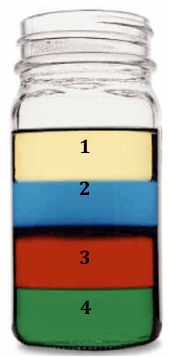
Put the liquids in order from most dense to least dense?
a)
4, 3, 2, 1
b)
1, 2, 3, 4
c)
3, 4, 2, 1, 
d)
4, 3, 1, 2
42.
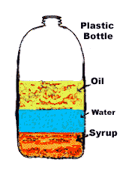
Which liquid is the least dense?
a)
oil
b)
water
c)
syrup 
d)
plastic bottle
43.
Where can matter be found?
a)
Everywhere
b)
On Earth only
c)
In a solid and liquid only
44.

What is Absolute Zero?

a)

Molecules stop completely

b)

Molecules move slowly.

c)

Molecules move quickly.

45.

Is it possible to reach Absolute Zero?

a)

Yes

b)

No

46.

Will your hypothesis always be right?

a)

Yes

b)

No

47.

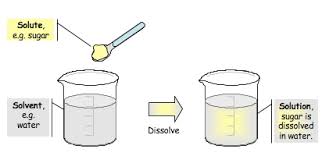
The ability of sugar to dissolve in water is called

a)

malleability

b)

Density

c)

State

d)

solubility

48.

True or False. Corn syrup will float on vegetable oil.

a)

True

b)

False

49.

What can be claimed about the tomato?

a)

It has less mass than the orange.

b)

It has more mass than the orange.

c)

It has the same mass as the orange.

50.

Why does a marble sink when placed in water?

a)

It has more density than the water.

b)

It has less density than the water.

c)

It can't swim.