wayground logo

Free Printable Worksheets

Font size

S
M
L
XL
Worksheets

Plate Tectonics

Total questions: 60

Worksheet time: 1hrs 21mins
Name
Class
Date
1.
A break in Earth's crust along which rocks move is called a ________.
a)
plate
b)
rift
c)
fault
d)
breach
2.
What is the name of the single landmass that began to break apart 200 million years ago?
a)
Panthalassa
b)
Laurasia
c)
Gondwanna
d)
Pangaea
3.
The process by which molten material adds new oceanic crust to the ocean floor is called ___________.
a)
Divergent boundary
b)
Sea-floor spreading
c)
Convergent boundary
d)
Renovating 
4.
What is an undersea mountain chain where new ocean floor is produced?
a)
Rift valley
b)
Deep-ocean trench
c)
Mid-ocean ridge
d)
Transform bounda
5.
What is the process by which oceanic crust sinks beneath a deep-ocean trench and back into the mantle at a convergent plate boundary?
a)
Subduction
b)
Induction
c)
Abduction 
d)
Reduction
6.
_____________ is a plate boundary where two plates move away from each other.
a)
Convergent boundary
b)
Transform boundary
c)
Divergent boundary
d)
Insurgent boundary
7.
_____________ is when two plates move toward each other.
a)
Convergent boundary
b)
Allegiant boundary
c)
Transform boundary
d)
Sliding boundary
8.
A _________ is a valley that forms where two plates move apart.
a)
Fissure
b)
Rift valley
c)
Sea-floor spreading
d)
Fault
9.
___________ is the theory that pieces of Earth's lithosphere are in constant motion, driven by convection currents in the mantle.
a)
Seismic waves
b)
Convection current
c)
Divergent boundary
d)
Plate tectonics
10.

In sea-floor spreading, molten material rises from the mantle and erupts

a)

along the edges of all the continents.

b)

along mid-ocean ridges.

c)

in deep-ocean trenches.

d)

at the north and south poles.

11.

The process by which the ocean floor sinks beneath a deep-ocean trench and back into the mantle is known as _______

a)

convection.

b)

continental drift.

c)

subduction.

d)

conduction.

12.

Most geologists think that the movement of Earth’s plates is caused by _______

a)

convection.

b)

continental drift.

c)

subduction.

d)

conduction.

13.

A place where two plates slip past each other, moving in opposite directions, is known as a _______

a)

transform boundary

b)

divergent boundary.

c)

convergent boundary.

d)

rift valley.

14.

The place where two plates come together is known as a _______

a)

transform boundary.

b)

divergent boundary.

c)

convergent boundary.

d)

rift valley.

15.

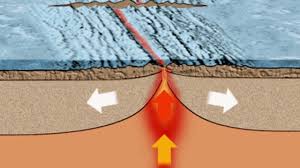
Below is a picture of sea-floor spreading. How are the ocean crusts moving?

a)

Converging

b)

Diverging

c)

Sliding

d)

No movement

16.

The San Andreas Fault in California is known as an active earthquake area. What type of

boundary is it?

a)

Converging

b)

Diverging

c)

Transform

d)

Sea Floor Spreading

17.
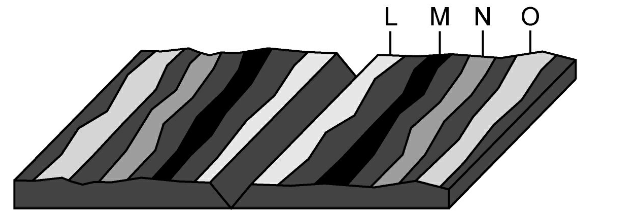
Where would the oldest rock be found?
a)
L
b)
M
c)
N
d)
O
18.
How is it possible for new crust to be formed without increasing the surface area of the Earth?
a)
Crust is destroyed at the same time it is created
b)
New crust is underwater where it sinks
c)
New crust breaks more easily than old crust
19.
What are the two types of crust
a)
continental and oceanic
b)
ocean and upper
c)
lower and upper
d)
pizza and subway
20.
The Himalayas in Asia are an example of what type of plate boundary?
a)
divergent
b)
continent-to-continent convergent
c)
ocean-to-continent convergent
d)
transform
21.
What is Pangaea?
a)
the name of a German scientist
b)
the name of the super-continent that existed millions of years ago
c)
another name for continental drift
d)
the name of an ancient fossil
22.
Mountains form from ...
a)
plates sliding past one another
b)
collision of plates
c)
plates moving away from each other
23.
The mechanism that moves continents is based on heat energy moving by
a)
Radiation in the core
b)
Conduction in the lithosphere
c)
Convection in the Asthenosphere
d)
None of these options is true
24.

What type of event will occur at this boundary?

a)

Earthquake

b)

Volcano Eruption

c)

Tornado

d)

Mountain Building

25.

A divergent boundary occurs when plates ....

a)

Pull apart

b)

Come together

c)

Slide past each other

d)

subducting

26.

The Great Rift Valley in Africa and the Mid-Ocean Ridge were all created by this boundary

a)

Divergent

b)

Convergent

c)

Reform

d)

Transform

27.

Which of these events can ONLY happen on a DIVERGENT BOUNDARY?

a)

Rift Valley

b)

Mountain

c)

A peninsula

d)

An Insanely complex, long answer that you will click out of instinct.

28.

The tectonic plates float on the

a)

lithosphere

b)

lower mantle

c)

outer core

d)

asthenosphere

29.

What occurs when two plates come together and the denser one is forced under back into the mantle?

a)

reduction

b)

conduction

c)

subduction

d)

convection

30.

Most geologists rejected Alfred Wegener's idea of continental drift because...

a)

it did not agree with their current theory

b)

Wegener was interested in what Earth was like millions of years ago

c)

Wegener used several different types of evidence to support his hypothesis

d)

Wegener could not identify the force that moved the continents

31.

The youngest rocks on the seafloor are most likely found...

a)

closest to a mid-ocean ridge

b)

farthest from a mid-ocean ridge

c)

near the coastlines

d)

closest to a deep sea trench

32.

Rising magma that results from subduction may produce...

a)

fossil layers

b)

volcanic island arcs

c)

deep-sea sediment

d)

seafloor spreading

33.
The Andes Mountains are a volcanic mountain range located on the western coast of South America. The plate boundary located in this region is most likely an area of-
a)
subduction because the plates are colliding
b)
folded mountains because the plates are colliding
c)
mid-ocean ridges because the plates are pulling apart
d)
ocean-floor spreading because the plates are spreading apart
34.
Which type of crust is more dense?
a)
oceanic
b)
continental
c)
divergent
d)
pizza
35.
A trench forms at a _________ boundary.
a)
convergent
b)
divergent
c)
transform
d)
vertical
36.
What type of boundary is shown at A?
a)
transform
b)
convergent
c)
divergent
d)
subduction
37.
What is happening at point B?
a)
subduction
b)
a divergent boundary
c)
convection
d)
an earthquake
38.
What type of plate boundary is this?
a)
Plate
b)
Divergent
c)
Convergent
d)
Transform
39.
Islands can from from magma which is pushed up at a __________ plate boundary
a)
Divergent
b)
Convergent
c)
Transform
40.

Which of the following causes Earth's tectonic plates to move?

a)

Energy from the Sun

b)

Magnetic Pole Reversal

c)

Convection currents in the mantle

d)

Faults in Mountain Ranges

41.

Oceanic Trenches are formed by either _______ or _______ plate boundaries

a)

Convergent Oceanic / Continental

b)

Convergent Continental / Continental

c)

Convergent Oceanic / Oceanic

d)

Divergent

42.

Ocean Ridges are formed by _______ plate boundaries

a)

Convergent Oceanic / Continental

b)

Convergent Continental / Continental

c)

Convergent Oceanic / Oceanic

d)

Divergent

43.

The upper part of the mantle that is semisolid where convection pushes the tectonic plates

a)

Mantle

b)

Asthenosphere

c)

Lithosphere

d)

Crust

44.

What causes convection currents?

a)

Hot magma rises while cool magma sinks

b)

The rotation of the Earth

c)

Ocean currents pulling plates apart

d)

The spinning of the Earth's core

45.

Why does oceanic crust subduct under continental crust?

a)

Oceanic crust is thin

b)

Oceanic crust is dense

c)

Continental crust is thin

d)

Continental crust is dense

46.
What boundary creates mountains?
a)
convergent
b)
divergent
c)
transform
d)
fast
47.
Which ocean is expanding due to a mid-ocean ridge?
a)
Indian
b)
Dead Sea
c)
Atlantic
d)
Artic
48.
This land formation occurs at a divergent continental/ continental boundary.
a)
mid ocean ridge
b)
deep ocean trench
c)
pacific hot spot
d)
rift valley
49.
This area contains over 70 percent of volcanoes and 90 percent of earthquakes in the world.
a)
North American plate
b)
ring of fire
c)
fiery rings 
d)
African plate
50.
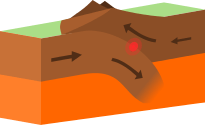
The model shows a plate boundary.  Arrows have been added to indicate the movement of the plates.  What plate boundary feature is shown?
a)
A fault formed at an active transform 
b)
A volcano formed at an active   transform boundary
c)
A valley formed at an active   divergent boundary 
d)
A ridge formed by an inactive   convergent boundary
51.
The map above shows the location of the Andes Mountains on the western coast of South America. Which of the following best describes the geologic processes responsible for the formation of the Andes Mountains?
a)
The Nazca and South American plates have spaces where magma is erupting from the sea floor.
b)
The Nazca and South American plates are diverging.
c)
The Nazca and South American plates are transforming.
d)
The Nazca and South American plates are converging.
52.

What is the process that breaks down rocks?

a)

Erosion

b)

Weathering

c)

Convection current

d)

Equilibrium

53.

Magma is melted rock that is _______ the earth.

a)

inside

b)

outside

54.

This is the layer that the earth's plates are made up of.

a)

lithosphere

b)

inner core

c)

mantle

d)

crust

55.

The image shows a plate boundary. Arrows have been added to indicate the movement of the plates.What plate boundary feature is also shown?

a)

A ridge formed by an inactive convergent boundary

b)

A valley forming at an active divergent boundary

c)

A fault forming at an active transform boundary

d)

A volcano formed by an active transform boundary

56.
According to the theory of seafloor spreading, hot less dense material rises toward the surface at____________.
a)
magnetic poles
b)
south pole
c)
mid-ocean ridges
d)
asthenospheres
57.
Earth's crust and part of the upper mantle are broken into sections called__________.
a)
plates
b)
mantle
c)
core
d)
inner core
58.
The upper rigid part of Earth that contains the crust and part of the upper mantle is called the _________.
a)
asthensosphere
b)
inner core
c)
lithosphere
d)
glossoposphere
59.
Who came up with the theory of sea floor spreading?
a)
Alfred Wegener
b)
Al Capone
c)
Harry Hess
d)
Harry Haas
60.
Who is known as the "Father of Continental Drift"?
a)
Harry Hess
b)
Abraham Ortelius
c)
Alfred Wegner
d)
John Tuzo Wilson