wayground logo

Free Printable Worksheets

NEW

Font size

S
M
L
XL
Worksheets

Unit 2 review (Economics)

Total questions: 78

Worksheet time: 1hrs 4mins

Name
Class
Date
1.
Quanitity Demanded = Quantity Supplied you have a 
a)
Equilibrium
b)
Disequilibrium
c)
Surplus
d)
Shortage
2.
Which market has no competition?
a)
perfect competition
b)
oligopoly
c)
monopoly
d)
monopolistic competition
3.
Why is a demand curve downward sloping?
a)
because it reflects the desire, ability, and willingness of consumers
b)
because of the natural elasticity of the market
c)
because quantity demanded increases as price decreses
d)
because it shows how increasing incentives changes demand
4.
For which product is demand likely to be the most elastic?
a)
a product with no substitutes
b)
a product with inadequate substitutes
c)
a product with many inadequate substitutes
d)
it is impossible to tell
5.
Which of these describes an effect of increased government regulation on producers?
a)
It shifts their market supply curve to the right.
b)
 It prompts them to increase output at all possible prices.
c)
It encourages production by requiring the use of new technology.
d)
It shifts their market supply curve to the left.
6.

Under perfect competition,

a)

products are similar but not identical.

b)

numerous restrictions prevent firms from entering the market.

c)

no seller can sell a product above the prevailing market price and products are identical

d)

a single seller can affect price and their is a small number of buyers and sellers

7.

Which market structure is BEST indicated by the cell phone market?

a)

monopoly

b)

pure competition

c)

oligopoly

d)

natural monopoly

8.

A market where brand-name loyalty is more important than product differentiation.

a)

Perfect Competition

b)

Pure Monopoly

c)

Monopolistic Competition

d)

Oligopoly

9.

A barrier to entry is

a)

an economic term for economies of scale

b)

illegal in most markets

c)

anything that prevents new firms from entering the market

d)

a factor that increases competition

10.

A monopoly is a market with

a)

many suppliers

b)

no barriers to entry

c)

many substitutes

d)

one supplier

11.
An Oligopoly is a market that has many producers and relatively low barriers. 
a)
True
b)
False
12.
In which market structure is there the LEAST competition?
a)
Monopoly
b)
Oligopoly
c)
Monopolistic Competition
d)
Perfect Competition
13.
In which market structure is there the MOST competition?
a)
Monopoly
b)
Oligopoly
c)
Monopolistic Competition
d)
Perfect Competition
14.

What is an example of a monopoly?

a)

McDonalds

b)

National Hockey League (NHL)

c)

Levi Jeans

d)

Marriott Hotel

15.

What is an example of a monopoly?

a)

McDonalds

b)

National Hockey League (NHL)

c)

Levi Jeans

d)

Marriott Hotel

16.
This is the easiest market structure to enter because of low barriers to entry and the number of producers. 
a)
Monopoly
b)
Monopolistic Competition
c)
Perfect Competition
d)
Oligopoly 
17.
Define collusion
a)
When two cars collide on the road
b)
a secret agreement between two competing firms to sell their similar products at the same price
c)
a secret meeting
d)
when one business buys another one that sells similar products
18.
The diagram represents a
a)
increase in demand
b)
decrease in demand
19.
Consider the market for cars in Hong Kong. If the price of gasoline increases then the Demand for cars will
a)
increase
b)
decrease
20.
The law of demand refers to how
a)
demand changes when people's incomes change
b)
demand changes when the prices of substitutes and complements change
c)
the quantity demanded changes when the price of the good changes
d)
the price of the good changes when people's demand for the good changes
21.
Iceberg & romaine are two different types of lettuce. For most consumers, iceberg and romaine are 
a)
complements
b)
substitutes
c)
inferior goods
d)
resources
22.
If Mary used to buy 10 units at $4 each and now buys 15 units when the price is $4, her
a)
quantity demanded has increased
b)
quantity demanded has decreased 
c)
demand has increased
d)
demand has decreased
23.
The law of demand states that 
a)
price and quantity demanded are inversely related
b)
the larger the number of buyers in a market, the lower will be product price
c)
price and quantity demanded are directly related
d)
consumers will buy more of a product at high prices than at low prices
24.
When the price of a product increases, a consumer is able to buy less of it with a given money income. This describes: 
a)
the cost effect
b)
the inflationary effect
c)
the income effect
d)
the substitution effect
25.
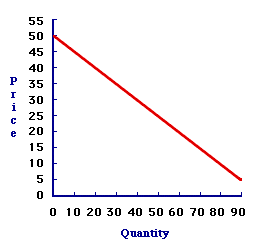
What does this curve represent?
a)
supply
b)
equilibrium
c)
demand
d)
surplus
26.

If the price of a good or service increases what will happen to the demand for it?

a)

increase

b)

decrease

c)

stay the same

d)

who knows

27.

If the price of a good or service decreases what will happen to the demand for it?

a)

increase

b)

decrease

c)

stay the same

d)

who knows

28.
This part of the market determines DEMAND
a)
buyers
b)
sellers
c)
suppliers
d)
store owners
29.
This part of the market determines SUPPLY
a)
buyers
b)
sellers
c)
consumers
d)
us
30.
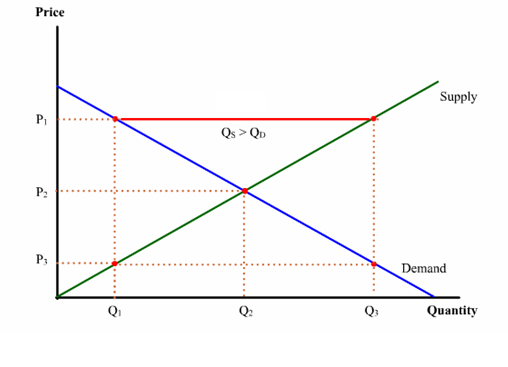
What does this graph show?
a)
Shortage
b)
Surplus
c)
Supply Table
d)
Equilibrium
31.
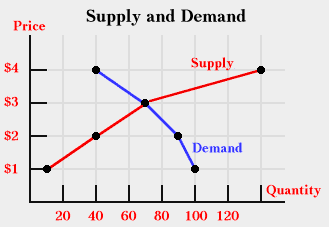
What is the Equilibrium Price?
a)
1
b)
2
c)
3
d)
4
32.
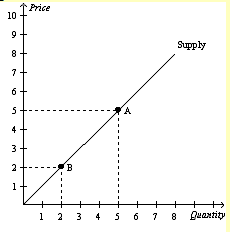
The movement from Point A to Point B represents a(n)
a)
increase in the price.
b)
decrease in the quantity supplied.
c)
shift in the supply curve.
d)
Both Orange and Blue are correct.
33.
When there is a shortage the price will usually? 
a)
rise
b)
fall
c)
remain the same
d)
equilibrium
34.
An effective price floor must be set above equilibrium, resulting in:
a)
a shortage
b)
a surplus
c)
limited choices
d)
None of the above
35.
3. Price floors and price ceilings prevent items from obtaining their equilibrium price.
a)
True
b)
False
36.
4. The minimum wage is an example of a government price control.
a)
True
b)
False
37.
A price ceiling is the highest price the government will allow to be charged for a product. 
a)
True
b)
False
38.
Price ceilings tend to result in...
a)
shortages.
b)
surpluses.
c)
equilibrium.
d)
higher prices.
39.
Price floors tend to result in...
a)
shortages.
b)
rationing.
c)
surpluses.
d)
equilibrium.
40.
Which of these is NOT a characteristic of equilibrium?
a)
Where Supply and Demand Intersect.
b)
Where there is little surplus or shortage.
c)
Where QD = QS.
d)
Where all markets strive to be.
41.
Based on the demand curve for good X, it can be determined that good x has:
a)
Many substitutes
b)
A few substitutes
c)
No substitutes
d)
Only one substitute
42.

According to the graph, when a 22% increase in price leads to a 67% increase in quantity supplied, you know that supply is

a)

elastic

b)

inelastic

c)

unit elastic

d)

perfectly elastic

43.

What is elasticity?

a)

the means by which total revenue is measured

b)

a measure in the responsiveness to a change is price

c)

the stretchy-ness of a rubber band

44.
What is the supply with a price floor of $60?
a)
50
b)
100
c)
150
d)
200
45.
What is the result of the government implementing a price floor of $60
a)
There would be a shortage of 100 since it is cheaper for consumers 
b)
There would be a surplus of 100 because it is more expensive for consumers 
c)
There would be a shortage of 100 because it is assisting the suppliers
d)
There would be a surplus of 100 because it is beneficial to consumers 
46.
If the price of butter increases, then we would expect that the demand for margarine would fall.
a)
True
b)
False
47.

Which of the following is NOT a Market Structure?

a)

Perfect Competition

b)

Oligopoly

c)

Monopoly

d)

Corporation

48.
Which law bans monopolies?
a)
Tea Act
b)
Anti-Trust Act
c)
Townsend Act
d)
Monopoly Act
49.
Costs that do not change when the quanity of output produced changes?
a)
Fixed Costs
b)
Variable Costs
c)
Explicit Costs
d)
Implicit Costs
50.
The amount a firm receives after all costs have been paid.
a)
Revenue
b)
Marginal Profit
c)
Profit
d)
Marginal Revenue
51.
Additional cost associated by producing one additional unit of product.
a)
Fixed Costs
b)
Average Costs
c)
Marginal Costs
d)
Emplicit Costs
52.
The amount a firm receives for the sale of its output.
P x Q = _____
a)
Profit
b)
Total Revenue
c)
Marginal Revenue
d)
Average Profit
53.
Costs that change as the quantity of outputs changes.
a)
Fixed Costs
b)
Variable Costs
54.
Occurs when each addition of an input results in declining quantity of the output
a)
Diminishing Marginal Utility
b)
Diminishing Marginal Costs
c)
Diminishing Marginal Returns
d)
Diminishing Marginal Profits
55.
Which of the following is a source of monopoly power?
a)
Scarcity
b)
Elasticity of demand
c)
Barriers to entry
d)
Low Profits
56.

What is the shape of the MC curve typically?

a)

L-shaped

b)

Straight line

c)

U-shaped

d)

Flat

57.

What does diminishing returns refer to?

a)

Decreasing additional output

b)

No output

c)

Increasing additional output

d)

Constant output

58.

In the short run, what is the relationship between MC and ATC at optimum output?

a)

MC > ATC

b)

MC = ATC

c)

MC ≠ ATC

d)

MC < ATC

59.

Which curve typically intersects the ATC curve at its lowest point?

a)

Price curve

b)

Supply curve

c)

Demand curve

d)

MC curve

60.

What is the graphical representation of costs and output called?

a)

Cost curves

b)

Supply curves

c)

Demand curves

d)

Profit curves

61.

What is the effect of increasing output on marginal cost initially?

a)

Fluctuates

b)

Remains constant

c)

Increases

d)

Decreases

62.

What economics law or principle states that at some point adding new workers will lead to negative returns?

a)

Law of diminishing marginal utility

b)

Law of demand

c)

Law of diminishing returns

d)

Factors of Production

63.

If the TVC is $10,000 and 5,000 units are produced, what is the AVC per unit?

a)

2 dollars

b)

2,000 dollars

c)

5,000 dollars

d)

there isn't enough information available to answer the question

64.

If the TFC is $350 and the TVC is $700, what is the total cost?

a)

$350

b)

$950

c)

$1050

d)

$1150

65.

If one worker can make 7 t-shirts an hour and two workers can make 20 t-shirts per hour, what is the marginal product of labor?

a)

7

b)

13

c)

20

d)

27

66.

How do you find AFC?

a)

Divide fixed costs by the output

b)

Multiply fixed costs by the output

c)

Add fixed costs and variable costs

d)

Subtract fixed costs from total costs

67.

What curve is this showing?

a)

Variable cost

b)

marginal cost

c)

total cost

d)

Fixed cost

68.

refers to the total quantity of goods produced by a firm during a given period of time with the given number of inputs

a)

Total Product

b)

Marginal Product

c)

Average product

d)

Average fixed cost

69.

With which employee do negative returns occur?

a)

employee #3

b)

employee #2

c)

employee #9

d)

employee #10

70.

Which of the following is a fixed cost for a restaurant?

a)

Cheese

b)

2,000 dollar a month rent

c)

Meat

d)

tortillas

71.
The level of profit-maximizing output is reached when marginal cost is
a)
double marginal revenue
b)
one-half of marginal revenue
c)
less than marginal revenue
d)
equal to marginal revenue
72.
The marginal cost curve typically does which of the following?
a)
Increases at a fixed rate.
b)
Decreases and eventually increases.
c)
Decreases at a decreasing rate.
d)
Increases and eventually decreases.
73.

The image above shows a firm making

a)

Economic Profit

b)

Economic loss

c)

Breaking even

d)

Shutting down

74.

What is TVC at 10 units?

a)

$2

b)

$20

c)

$0

d)

$50

e)

$5

75.

AFC will:

a)

continuously decrease as more units are produced

b)

continuously increase as more units are produced

c)

be a U shape

d)

be horizontal

e)

be vertical

76.

What is the primary focus of game theory?

a)

Designing visually appealing games

b)

Understanding player psychology

c)

Analyzing strategic decision-making

d)

Developing immersive narratives

77.

Coca-Cola & Pepsi

If both keep prices high, profits for each company increase by $500 million (because of normal growth in demand).

If one drops prices (i.e. defects) but the other does not (cooperates), profits increase by $750 million for the former because of greater market share, and are unchanged for the latter.

If both companies reduce prices, the increase in soft drink consumption offsets the lower price, and profits for each company increase by $250 million.

a)

Coca-Cola Cooperates

b)

PepsiCo

Cooperates

c)

Coca-Cola

Defects

d)

PepsiCo

Defects

78.

Where would the equilibrium of this game be?

a)

1, 4

b)

6, 5

c)

4, 2

d)

3, 3