wayground logo

Free Printable Worksheets

Font size

S
M
L
XL
Worksheets

Plate Tectonics

Total questions: 52

Worksheet time: 44mins

Name
Class
Date
1.
A ______ is a section of the lithosphere that slowly moves over the asthenosphere, carrying large slabs of continental and oceanic crust.
a)
wedge
b)
plate
c)
chunk
d)
fault
2.
A break in Earth's crust along which rocks move is called a ________.
a)
plate
b)
rift
c)
fault
d)
breach
3.
_________ are vibrations that travel through Earth carrying the energy released during an earthquake.
a)
Seismic Waves
b)
Rumbles
c)
Plate Tectonics
d)
Convection Currents
4.
What is the name of the single landmass that began to break apart 200 million years ago?
a)
Panthalassa
b)
Laurasia
c)
Gondwanna
d)
Pangaea
5.
The movement of fluid, caused by differences in temperature, that transfers heat from one part of the fluid to another is _____________.
a)
Convection current
b)
Seismic waves
c)
Sea-floor spreading
d)
Conduction current
6.
The process by which molten material adds new oceanic crust to the ocean floor is called ___________.
a)
Divergent boundary
b)
Sea-floor spreading
c)
Convergent boundary
d)
Renovating 
7.
What is an undersea mountain chain where new ocean floor is produced?
a)
Rift valley
b)
Deep-ocean trench
c)
Mid-ocean ridge
d)
Transform bounda
8.
A __________ is a deep valley along the ocean floor beneath which oceanic crust slowly sinks toward the mantle.
a)
deep-ocean trench
b)
rift valley
c)
sea-floor spreading
d)
mid-ocean ridge
9.
What is the process by which oceanic crust sinks beneath a deep-ocean trench and back into the mantle at a convergent plate boundary?
a)
Subduction
b)
Induction
c)
Abduction 
d)
Reduction
10.
_____________ is a plate boundary where two plates move away from each other.
a)
Convergent boundary
b)
Transform boundary
c)
Divergent boundary
d)
Insurgent boundary
11.
_____________ is when two plates move toward each other.
a)
Convergent boundary
b)
Allegiant boundary
c)
Transform boundary
d)
Sliding boundary
12.
A _____________ is when two plates move past each other in opposite directions.
a)
emergent boundary
b)
divergent boundary
c)
transform boundary
d)
convergent boundary
13.
A _________ is a valley that forms where two plates move apart.
a)
Fissure
b)
Rift valley
c)
Sea-floor spreading
d)
Fault
14.
___________ is the theory that pieces of Earth's lithosphere are in constant motion, driven by convection currents in the mantle.
a)
Seismic waves
b)
Convection current
c)
Divergent boundary
d)
Plate tectonics
15.

Which of the following causes Earth's tectonic plates to move?

a)

Energy from the Sun

b)

Magnetic Pole Reversal

c)

Convection currents in the mantle

d)

Faults in Mountain Ranges

16.

What type of event will occur at this boundary?

a)

Earthquake

b)

Volcano Eruption

c)

Tornado

d)

Mountain Building

17.

The Great Rift Valley in Africa and the Mid-Ocean Ridge were all created by this boundary

a)

Divergent

b)

Convergent

c)

Reform

d)

Transform

18.

The tectonic plates float on the

a)

lithosphere

b)

lower mantle

c)

outer core

d)

asthenosphere

19.

Most geologists rejected Alfred Wegener's idea of continental drift because...

a)

it did not agree with their current theory

b)

Wegener was interested in what Earth was like millions of years ago

c)

Wegener used several different types of evidence to support his hypothesis

d)

Wegener could not identify the force that moved the continents

20.

The youngest rocks on the seafloor are most likely found...

a)

closest to a mid-ocean ridge

b)

farthest from a mid-ocean ridge

c)

near the coastlines

d)

closest to a deep sea trench

21.

What geologic process formed the Himalayas?

a)

two continental plates converging

b)

an earthquake in a subduction zone

c)

a tectonic plate moving over a hot spot

d)

movement at a transform fault boundary

22.
The Andes Mountains are a volcanic mountain range located on the western coast of South America. The plate boundary located in this region is most likely an area of-
a)
subduction because the plates are colliding
b)
folded mountains because the plates are colliding
c)
mid-ocean ridges because the plates are pulling apart
d)
ocean-floor spreading because the plates are spreading apart
23.
The San Andreas Fault is a crack in the Earth's crust that runs the length of California. What plate boundary feature caused this?
a)
an inactive convergent boundary
b)
an active convergent boundary
c)
an active transform boundary
d)
a volcanic eruption
24.
A German scientist Alfred Wegener was the first to hypothesize that ...........
a)
Continents were once joined
b)
The sea floor is spreading
c)
Continents are moving
d)
The Earth's magnetic pole flips
25.
Evidence used by Wegener to supported his idea of continental drift included
a)
Ocean rocks and sediments
b)
Ocean floor topography
c)
Magnetic isochron patterns
d)
Climatic data
26.
Wegener suggested that coal beds discovered in Antarctica indicated that this continent was
a)
once under water
b)
always  frozen
c)
once near the equator
d)
part of Africa
27.
Peer scientists reviewing Wegener’s hypothesis of continental drift rejected his notion because
a)
His evidence was too few to make a valid conclusion 
b)
He did not explain how continents move and what moves them
c)
His evidence was not clear in showing  how continents were joined
d)
He lied by including false evidence
28.
Where are most divergent boundaries located?
a)
Along the middle of most ocean floors
b)
Along the margins of most continents
c)
Across the middle of many continents
d)
All the above options are correct
29.
What type of rock makes most of the oceanic crust
a)
Sedimentary
b)
Basalt
c)
Metamorphic
d)
Limestone
30.
Los Angeles and San Francisco are cities on opposite sides of the San Andreas transform boundary. Suggest how both cities will be like at some point in future
a)
Furthest north and south apart than now
b)
At the same positions as today
c)
Drift apart away from the fault line
d)
Side by side somewhere between them now
31.
What two mechanisms do scientists think help convection currents in mantel move plates?
a)
Ridge push and Slab pull
b)
Normal and Reversed magnetism
c)
Action and Reaction tectonic forces 
d)
Gravitational and Rotational pull
32.
Which of the following changes would end Earth's tectonic activity?
a)
Earth's crust becomes a cooler solid
b)
Earth's mantles becomes a warmer semiliquid
c)
Earth's mantle becomes cooler and solid.
d)
Earth's outer core becomes warmer
33.
What is the heat source for convection in the mantle?
a)
the Crust
b)
the Mantle
c)
the Core
34.
The part of the Earth that is a solid ball of iron and nickel
a)
inner core
b)
outer core
c)
mantle
d)
crust
35.
Fossils of a particular animal species have been found in both southern Africa and South America but nowhere else.  Which of the following is MOST LIKELY the reason why?
a)
The fossils evolved into different organisms
b)
The climate changed and became much colder.
c)
In the past, Africa and South America were part of the same continent
d)
In the future, Africa and South America will be part of the same continent.
36.
What is the difference between magma and lava? 
a)
Where it is found (above or below the surface)
b)
How hot the molten rock is (lava is hotter than magma)
c)
 The type of boundary where it forms
d)
The viscosity of the molten rock (lava has a lower viscosity)
37.
Which ingredient in magma determines whether an eruption is explosive or quiet?
a)
Amount of rock.
b)
Amount of magma.
c)
Amount of obsidian rock.
d)
Amount of silica.
38.
The deepest part of the ocean is
a)
at trenches where plates are moving apart
b)
at trenches in subduction zones
c)
in the rift valleys of subduction zones
d)
at the mid-Atlantic ridges
39.
What is the area where two tectonic plates meet called?
a)
collision
b)
mid-ocean ridge
c)
a boundry
d)
a rift zone
40.
thicker but less dense plates
a)
Oceanic Plates
b)
Continental Drift
c)
Continental Plates
d)
Convergent
41.
Mesosaurus fossils are found between where?
a)
India
b)
Africa and South America
c)
Antartica
d)
Australia
42.

Viscous/thick magma tends to_______________

a)

Be fluid and runny

b)

Have a very low silica content

c)

Flow great distances and have low gas content

d)

Readily trap gases and cause explosive eruptions

43.

The San Andreas fault is a transform fault. The map below shows a student's approximation of where the fault line crosses through the United States. Students were asked to make maps predicting which way land would most likely move over thousands of years.

a)
b)
c)
d)
44.

A mid- ocean ridge separates the Pacific plate and the Nazca plate off the western coast of South America. Which statement best describes the relative motions of the Pacific and Nazca plates?

a)

The Pacific and Nazca plates are moth moving to the east.

b)

The Pacific and Nazca plates are both moving to the west

c)

The Pacific plate is moving to the west, and the Nazca plate is moving to the east.

d)

The Pacific plate is moving to the east, and the Nazca plate is moving to the west.
45.
Which type of wave arrives first during an earthquake?
a)
Primary (p-wave) waves
b)
Secondary (s-wave) waves
c)
Rayleigh Waves
d)
Love Waves
46.
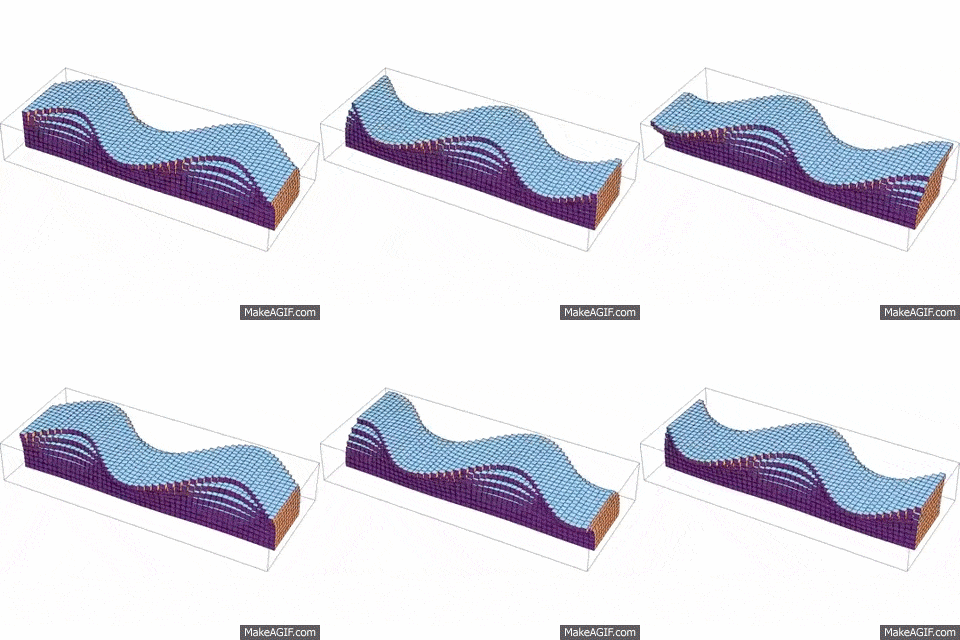
Which body wave is pictured?
a)
P-Wave
b)
S-Wave
c)
Rayleigh Wave
d)
Love Wave
47.
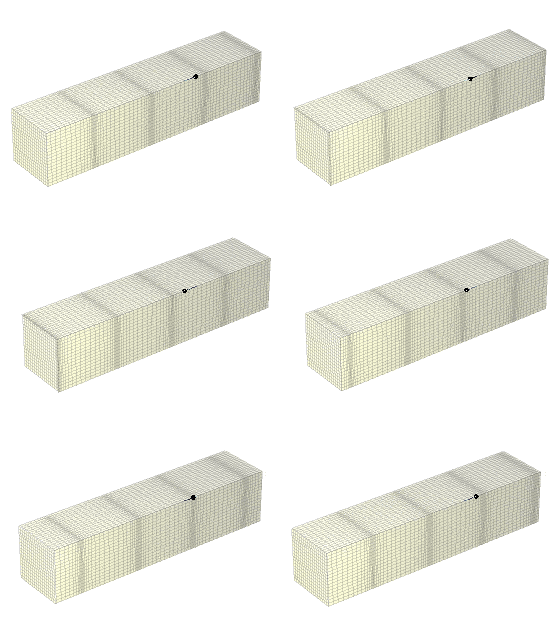
Which surface wave is pictured?
a)
P-Wave
b)
S-Wave
c)
Rayleigh Wave
d)
Love Wave
48.

New oceanic crust (sea floor) is created at this boundary.

a)

Divergent Oceanic

b)

Divergent Continental

c)

Convergent Oceanic

d)

Transform

49.

The process where oceanic crust slides under another plate and is melted is called ___________.

a)

seafloor spreading

b)

subduction

c)

continental drift

d)

recycling

50.

A divergent boundary on land creates what feature?

a)

Mid Ocean Ridge

b)

Rift Valley

c)

Subduction Zone

d)

Deep Ocean Trench

51.

When two continental plates converge (collide) what type of crustal feature is formed?

a)

Mid Ocean Ridge

b)

Subduction Zone

c)

Rift Valley

d)

Folded Mountains

52.

Tsunamis are formed from what two types of convergent boundaries?

a)

Continental-Continental

b)

Oceanic-Continental

c)

Oceanic-Oceanic