wayground logo

Free Printable Worksheets

NEW

Font size

S
M
L
XL
Worksheets

Q2 REVIEWER

Total questions: 55

Worksheet time: 1hrs 17mins
Name
Class
Date
1.
Compared to the object in front the lens, its image is.....
a)
inverted and smaller
b)
inverted and larger
c)
not inverted and smaller
d)
not inverted and larger
2.
What type of image is formed when rays of light actually intersect?
a)
real
b)
virtual
c)
projected
d)
curved
3.
An image that you can see , but does not really exist is called which of the following?
a)
Real Image
b)
Fake Image
c)
Virtual Image
d)
Digital Image
4.
A real image...
a)
is produced by virtual rays and can be projected on a screen
b)
is produced by real rays and cannot be projected on a screen
c)
is produced by virtual images and cannot be projected on a screen
d)
is produced by real rays and can be projected on a screen
5.
Which one is a convex lens?
a)
A
b)
B
6.
What type of image is formed in a plane mirror?
a)
Real
b)
Virtual
c)
Enlarged
d)
Small
7.
If an image formed by a convex lens is inverted, it is most likely what type of image?
a)
Real
b)
Virtual
c)
None of the above
8.
As you move an object further away from a convex lens, its image would become which of the following?
a)
Larger and virtual
b)
Larger, only
c)
Smaller, only
d)
Smaller and virtual
9.
Which of the following does not refract light?
a)
prism
b)
convex lens
c)
concave lens
d)
mirror
10.
What kind of image will you get if you put an object right at F, the focal point of this lens?
a)
Virtual, larger
b)
Real, smaller
c)
Real, larger
d)
No image
11.

The process of light bouncing off a surface

a)

refraction

b)

reflection

c)

diffraction

d)

diffusion

12.
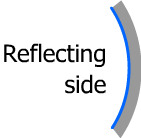
The following is a picture of what type of mirror? 
a)
Convex Mirror
b)
Concave Mirror
c)
Plane Mirror
d)
Flat Mirror
13.
The following is a picture of what type of mirror? 
a)
Convex Mirror
b)
Concave Mirror
c)
Plane Mirror
d)
Flat Mirror
14.
Which type of mirror magnifies a close up image, like a make-up mirror.
a)
Concave
b)
Convex
c)
Specular
d)
Plane
15.
Which type of mirror is shown.
a)
Concave
b)
Convex
c)
Specular
d)
Plane
16.
Individuals that are farsighted need to have prescription lenses that are _________. 
a)
convex
b)
concave
c)
plane
d)
flat
17.
Individuals that are nearsighted need to have prescription lenses that are ___________. 
a)
convex
b)
concave
c)
plane 
d)
flat
18.
Concave lenses, like the ones found in the peepholes of a door, always produce images that are .....
a)
Virtual, upright, smaller
b)
Real, inverted, larger
c)
Real, inverted, smaller
d)
Virtual, upright, larger
19.
Convex mirrors, like those found on the side of a car, produce images that are always _________________. 
a)
Real, larger and inverted
b)
Virtual, larger, and inverted
c)
Virtual, smaller and upright
d)
Of equal size and position as the original object
20.
The point where the rays meet is known as....
a)
Fire
b)
the focal point
c)
refraction
d)
Plane of the lens
21.
This image is...
a)
Inverted and smaller
b)
Inverted and larger
c)
not inverted and smaller
d)
not inverted and larger
22.
What is Nearsightedness? 
a)
condition that has difficulty seeing things that are close 
b)
condition that has difficulty seeing things that are far away
23.
What is an Astigmatism?
a)
a very contagious condition caused by a bacterial infection 
b)
a substance that hardens your teeth 
c)
 a hard substance that gives nails their strength 
d)
persons vision is distorted due to a irregular shaped eye 
24.
A real image having a size of 10 cm is formed by a concave mirror. The size of the object is 5 cm.The magnification of the object is
a)
-5
b)
5
c)
2
d)
-2
25.
An object is placed 10 cm from a convex mirror. Its image is formed 5 cm behind the mirror.The focal length of the given convex mirror is
a)
-5 cm
b)
5 cm
c)
10 cm
d)
-10cm
26.

Select the correct order of waves on the EM Spectrum from low to high energy

a)

Radio, Micro, Infra, Visible, Ultra, X-ray, Gamma

b)

Gamma, X-ray, Ultra, Vis, Infra, Micro, Radio

c)

Vis, Micro, Infra, Ultra, X-ray, Gamma, Radio

d)

Micro, Radio, Vis, Infra, Ultra, X-ray, Gamma

27.

Which has the LONGEST wavelength and, therefore, the LOWEST frequency/energy

a)

Gamma Rays

b)

Ultraviolet

c)

Visible Light

d)

Infrared rays

28.

How are Electromagnetic waves different from Mechanical waves?

a)

EM waves have very short wavelengths

b)

EM waves transmit energy instead of matter

c)

EM waves can travel through the vacuum of space (without particles)

d)

EM waves can change direction by reflection

29.

Which is true about the speed of radio waves compared to light waves? They are...

a)

less energy & frequency, but still the SAME speed as the speed of light (300,000,000 m/s)

b)

less energy & frequency, so LESS than the speed of light (300,000,000 m/s)
c)

smaller wavelength, so LESS than the speed of light (300,000,000 m/s)

d)

more energy & frequency, so MORE than the speed of light (300,000,000 m/s)

30.

Wavelength and Frequency are related in that...

a)

they are always the same

b)

when one increases, the other decreases (inversely proportional)

c)

there is no correlation

d)

they both vary in an irregular pattern
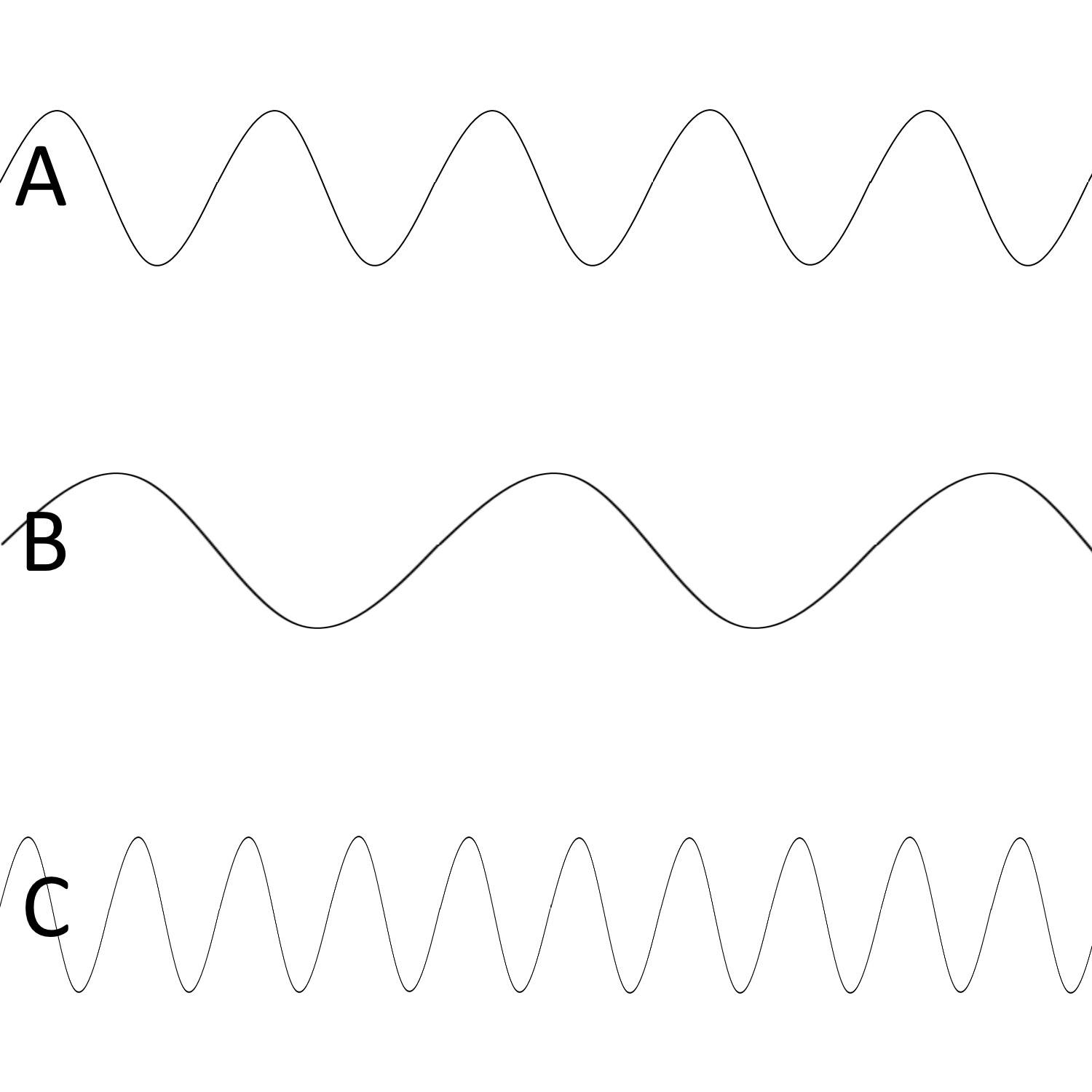
31.
Which wave has the largest wavelength?
a)
A
b)
B
c)
C
d)
None (same wavelength)
32.
Which wave has the largest frequency?
a)
A
b)
B
c)
C
d)
None (same frequency)
33.
If all three are waves of light, which wave has the largest speed?
a)
A
b)
B
c)
C
d)
None (same speed)
34.

An electromagnetic wave in a vacuum has a wavelength of 0.07 m. What is its frequency in Hz?

a)

4.3 x 10¹⁸ Hz

b)

2.1 x 10¹⁶ Hz

c)

2.1 x 10⁶ Hz

d)

4.3 x 10⁹ Hz

35.

An electromagnetic wave in a vacuum has a frequency of 1.3 x 10⁵ Hz, what is it's wavelength in meters?

a)

2.3 x 10³ m

b)

3.9 x 10¹³ m

c)

3.9 x 10³ m

d)

2.3 x 10¹³ m

36.
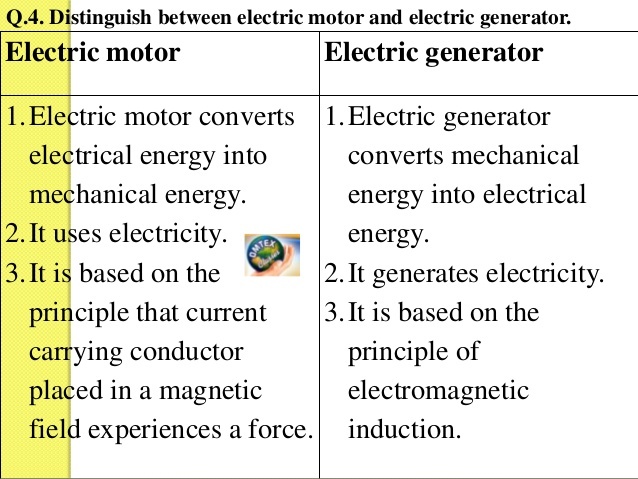
What is the purpose of a generator?
a)
to convert electrical energy to mechanical energy
b)
to convert chemical energy to electrical energy
c)
to convert mechanical energy to electrical energy
d)
to convert mechanical energy to heat energy
37.
A student is investigating how changing the size of the core of an electromagnet affects its strength.  Which of these is most likely the dependent variable in the student's investigation?
a)
the number of wire coils wrapped around the core
b)
the number of paper clips picked up by the electromagnet
c)
the voltage of the battery used in the circuit
d)
the size of the piece of iron used as the core
38.

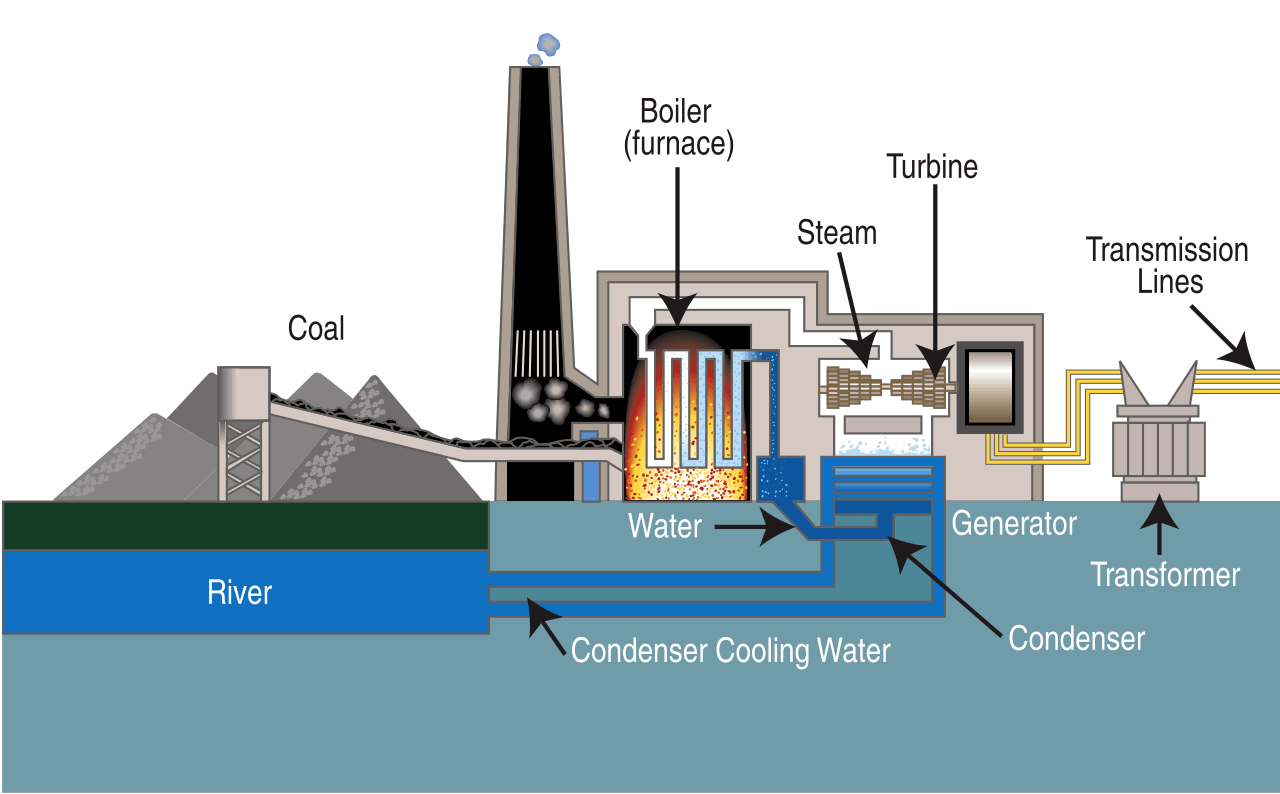
How are fossil fuels used to generate electrical energy?

a)

Heat from burning fuel creates steam that spins a turbine.

b)

Heat from burning fuel spins magnets inside an electric motor.

c)

Heat from burning fuel causes an electric motor to produce a current.

d)

Heat from burning fuel creates steam that turns a transformer.
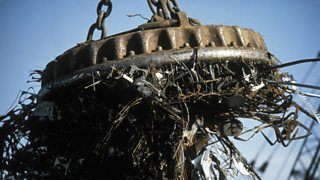
39.

A temporary magnet that only works when electricity is passed through wires surrounding an iron core is called:

a)

electromagnet

b)

galvanometer

c)

induction

d)

super conductor magnet

40.
What two forces are required for generators and electric motors to work? 
a)
magnetism and thermal 
b)
electricity and thermal 
c)
electricity and magnetism 
d)
magnetism and radiant 
41.
Generators are devices that convert _____ energy into _____ energy.
a)
chemical; mechanical
b)
mechanical; electrical
c)
electrical; mechanical
d)
potential; kinetic
42.

What is the transfer of energy in when you plug in a motor and it spins?

a)

chemical to mechanical

b)

electrical to mechanical

c)

mechanical to electrical

d)

physical to potential

43.

Voltage is

a)

the potential electrical energy or push that makes electrons flow

b)

causes a short circuit with electrical energy

c)

is the term used for rate of charge flow

d)

Wastes energy by allowing current to flow

44.

You can increase the strength of an electromagnet are increasing the current, adding iron to the core, and .....

a)

increasing the number of coils on the magnet

b)

Decreasing the number of coils on the magnet

c)

Dividing the number of coil

45.
While electric current is flowing through a wire, what surrounds the wire?
a)
a magnetic field
b)
a glowing light
c)
neutrons
d)
protons
46.

What would happen if you broke a bar magnet into 8 pieces?

a)

You would have 8 half magnets

b)

You would have 4 complete magnets

c)

You would have 8 complete magnets

d)

They wouldn't be magnets anymore

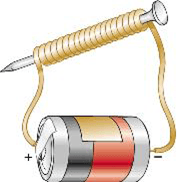
47.

Why did this simple electric motor work?

a)

The current from the battery induces a magnetic field in the copper loop, turning it into an electromagnet that repels from/attracts to the permanent magnet
b)

The electromagnet on top of the battery pulls on the magnetic copper wire

c)

The magnet induces a current in the copper loop which makes it rotate.

d)

The magnetic field from the battery induces an electric current in the copper loop, turning it into an electromagnet that repels from/attracts to the permanent magnet

48.
An electric motor changes electrical energy to _________ energy. 
a)
mechanical 
b)
chemical
c)
potential
d)
free
49.
What is the device seen here?
a)
generator
b)
electric motor
c)
electromagnet
d)
magnet
50.

Which device can be used to determine the polarity of an unmarked magnet?

a)

a charged glass stirring rod

b)

a gold-leaf electroscope

c)

a sprinkle of iron filings

d)

an improvised compass

51.

How will you describe the magnetic field around a straight current-carrying wire?

a)

The magnetic field is strongest near and around the wire.

b)

The magnetic field consists of straight lines parallel to the wire.

c)

The magnetic field does not vary with the distance from the wire.

52.

What basic principle enables ALL electric motors to operate?

a)

Iron is the only element that is magnetic.

b)

Opposite electric charges attract and like charges repel.

c)

A moving conductor within a magnetic field will experience an electromotive force.

d)

a current-carrying conductor placed within a magnetic field will experience a magnetic force.

53.
How could the experimenter increase the amount of electricity being induced by this experiment?
a)
Increase the number of coils
b)
Decrease the number of coils
c)
Flip the magnet around
d)
Nothing, the amount of electricity cannot be increased
54.

The metal detectors that people walk through at airports operate via

a)

Coulomb’s law

b)

Faraday’s law

c)

Ohm’s law

d)

Newton’s law

55.

A magnetic substance becomes a magnet when placed near a real magnet because of,

a)

magnetic effect

b)

magnetic phenomenon

c)

magnetic induction

d)

electromagnetic induction