wayground logo

Free Printable Worksheets

NEW

Font size

S
M
L
XL
Worksheets

Spring Final Review 1: Biotech, Evolution, Bacteria, Viruses

Total questions: 50

Worksheet time: 2hrs 30mins

Name
Class
Date
1.
What applications can gel electrophoresis be used for?
a)
Parental Testing
b)
Criminal Investigations
c)
Sequence Endangered Species DNA
d)
All of the above
2.
Which DNA fragment bands move faster and farther in a gel electrophoresis? 
a)
there is no way to tell 
b)
the largest ones
c)
the smallest ones
d)
none of these
3.

This laboratory procedure is known as

a)

cloning

b)

gel electrophoresis

c)

genetic modification

d)

use of a dichotomous key

4.
 This diagram shows the DNA fingerprints of a common ancestor of Deer Species. Which deer species is most related to the common ancestor
a)
2
b)
3
c)
4
5.
Where the better adapted organisms survive to pass traits along to offspring.
a)
Evolution
b)
Natural Selection
c)
Extinction
d)
Artifical Selection
6.
Why are advantageous traits more likely to be passed onto offspring?
a)
Because they are more likely to survive and reproduce.
b)
Because they come from dominant alleles.
c)
Because they come from recessive alleles.
d)
Because the trait is an acquired phenotype.
7.

What word describes a trait that helps an organism survive in its environment?

a)

natural selection

b)

mutation

c)

camouflage

d)

adaptation

8.

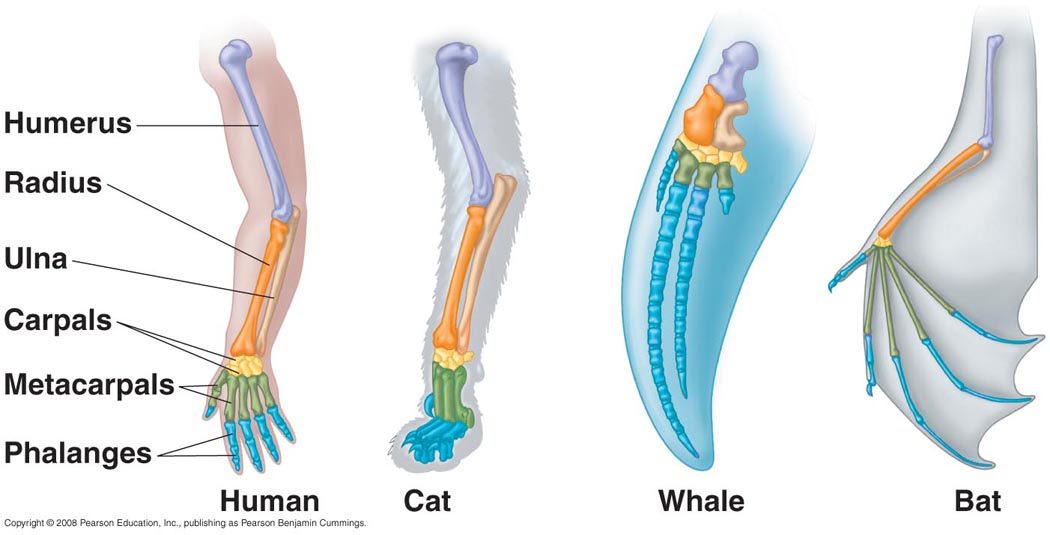
Structures with the same parts but have different functions, suggesting that organisms with a backbone share common ancestry is called…

a)

Not related

b)

Not homologous

c)

Homologous

d)

Young in origin

9.

Structures with no function that are remnants of an organism’s evolutionary past are

a)

Not visible organisms

b)

Young in origin

c)

Vestigial

d)

Useful to the organism

10.
The fossil record provides evidence that 
a)
Fossils cannot be dated.
b)
All species were formed during Earth’s formation and have changed little since then.
c)
The fossilized species have no connection to today’s species.
d)
Older species gave rise to more-recent species.
11.
European rabbits were introduced to Australia in 1859. The rabbits reproduced rapidly in their new habitat, displaced other animals, and overgrazed vegetation. In an attempt to reduce the rabbit population, a virus was introduced in 1951. This virus is usually deadly to European rabbits. When the virus was first introduced, the rabbits died in large numbers, but the death rate decreased over time. Which of the following best explains the decrease in the rabbit death rate? 
a)
Young rabbits learned to avoid being infected with the virus.
b)
The lifespan of the virus was too short to affect rabbits over a long period of time.
c)
Natural selection favored rabbits that were resistant to the virus. 
d)
No correct choices.
12.

Endosymbiotic Theory is the idea that ______ cells could have evolved from_____cells

a)

prokaryotic, eukaryotic

b)

eukaryotic, animal

c)

prokaryotic, plant

d)

eukaryotic, prokaryotic

13.

Prokaryotic cells do not have

a)

cell wall

b)

nucleus

c)

cytoplasm

d)

ribosomes

14.

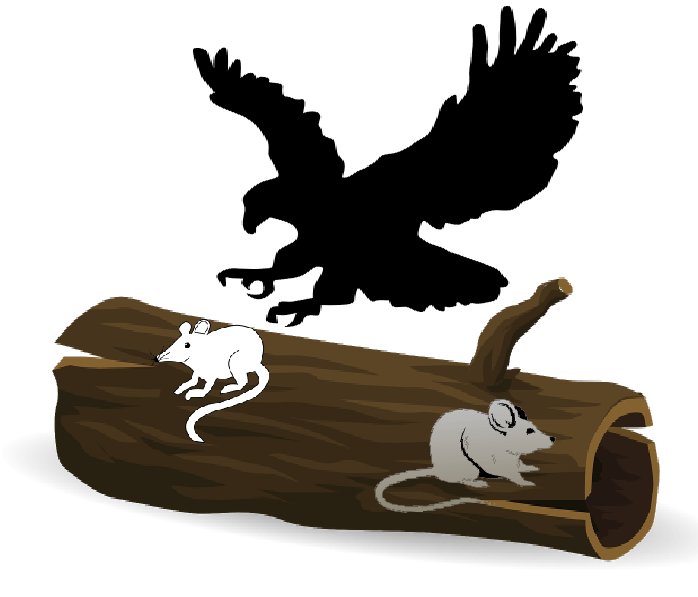
Over the years, white mice became extinct and darker mice survived. This is

a)

stabilizing selection

b)

directional selection

c)

disruptive selection

d)

due to exercise

15.

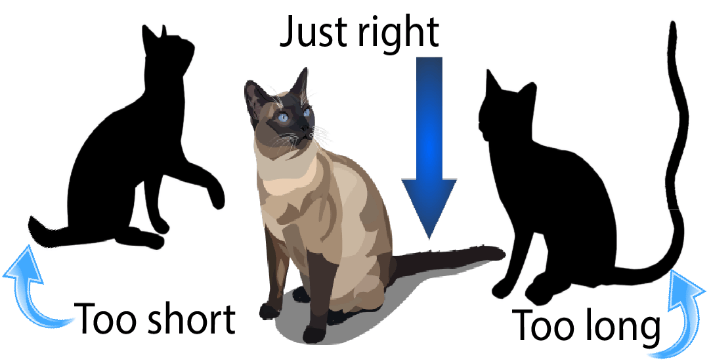
Average phenotypes are favored in the environment, while extremes have lower survival rates.

a)

seasonal selection

b)

distruptive selection

c)

directional selection

d)

stabilizing selection

16.

The extreme population phenotypes are favored by the environment.

a)

Disruptional (Diversifying) Selection

b)

Directional Selection

c)

Stabilizing Selection

d)

All of the above

17.

What

type

of structure?

a)

Homologous

b)

Analogous

c)

Embryological

d)

Vestigial

18.

What

type

of structure?

a)

Homologous

b)

Analogous

c)

Embryological

d)

Vestigial

19.

What

type

of structure?

a)

Homologous

b)

Analogous

c)

Embryological

d)

Vestigial

20.
Choose the correct way to write the scientific name for humans:
a)
homo sapiens
b)
Homosapiens
c)
Homo sapiens
d)
Homo Sapiens
21.

What is Binomial Nomenclature

a)

The Genus and Species names

b)

Family and Kingdom

c)

Domain and Kingdom

d)

Kingdom and Order

22.
In a properly written scientific name, which part is capitalized?
a)
species
b)
genus
23.

The LARGEST classification group (at the top) is:

a)

Very exclusive

b)

Very inclusive

c)

Very small

d)

Very specific

24.

The smallest classification group consists of:

a)

Organisms that are very different

b)

Organisms that do not look the same

c)

Organisms that are very similar

25.

Why is the most specific taxonomy category?

a)

Kingdom

b)

Domain

c)

Species

d)

Order

26.

Which taxon comes next? Domain... Kingdom... Phylum

a)

Order

b)

Genus

c)

Class

d)

Family

27.
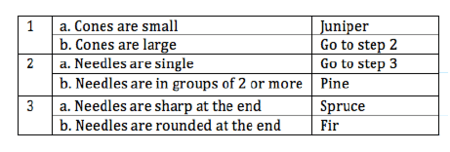
A dichotomous key for trees is provided. Hikers found a tree that has large brown cones and single sharp needles. What species of tree have the hikers found?
a)
Juniper
b)
Pine
c)
Spruce
d)
Fir
28.

Which of the following best describes transgenic organism? 

a)

Changing bacterial DNA by adding genes to it

b)

Any organism that has DNA from a different species

c)

Any organism that has DNA from the same species

d)

A tool used by scientists to separate chunks of DNA

29.

What part of a virus is the protein coat that houses the genetic material (DNA/RNA)?

a)

tail

b)

nucleus

c)

capsid

d)

glycoprotein

30.
Which viral life cycle allows viral genetic material to lay dormant while the host cell reproduces?
a)
lytic
b)
mitosis
c)
lysogenic
d)
S phase
31.
Is a virus considered living or non-living?
a)
Living
b)
Non-Living
c)
Neither
32.

Which can be treated with antibiotics?

a)

Virus

b)

Bacteria

c)

Any pathogen

d)

Parasite

33.
What do viruses have in common with living cells? They both...
a)
store genetic information
b)
have chloroplasts
c)
use glucose for cellular respiration
d)
have endoplasmic reticulum
34.
Antibiotics kill viruses
a)
True
b)
False
35.
What part of the virus is number 1?
a)
Capsid
b)
DNA
c)

Glycoproteins

d)
Envelope
36.

What is the purpose of glycoproteins on a virus?

a)

As defense.

b)

They provide structural support.

c)

To allow the virus to move.

d)

To attach to the host cell.

37.

How do bacteria reproduce?

a)

Sexual Reproduction

b)

Division

c)

Binary Fission

d)

Pollination

38.

Archea differ from Bacteria in that archaea

a)

live in extreme environments

b)

live in coastal environments

c)

always can do photosynthesis

d)

are immortal

39.

What enzyme do retroviruses use to transcribe DNA from RNA?

a)

Reverse Transcriptase

b)

Transcriptase

c)

Integrase

d)

Helicase

40.

HIV attacks a certain kind of cell in the immune system. Which is it?

a)

Red blood cells

b)

Platelets

c)

White blood cells called T cells

d)

Epithelial cells

41.
A Pathogen is a
a)
disease causing agent
b)
endospore
c)
bacteria
d)
virus
42.

This image shows a ___.

a)

Bacteria

b)

Eukaryote

c)

Virus

d)

Fungus

43.
The top arrow is pointing to...
a)
Capsid
b)
Cell Wall
c)
DNA
d)
Flagellum
44.

What is NOT a role of bacteria?

a)

Nitrogen Fixing

b)

Decomposing

c)

Bioremediation

d)

Vaccines

45.
What cycle involves newly formed viruses being released from a bursting host cell?
a)
Lytic Cycle
b)
Lysogenic Cycle
c)
Bacterial Cycle
d)
Nitrogen Cycle 
46.

Which statement is true about viruses?

a)

Viruses can eat and metabolize food.

b)

Viruses can reproduce only using a host cell.

c)

Viruses can reproduce on their own at any time.

d)

Viruses contain DNA, so they are alive.

47.

All answers listed below are true about bacteria except

a)

all bacteria are prokaryotes

b)

all bacteria are harmful

c)

all bacteria are unicellular

d)

bacteria do not have nucleus

48.
What is not a reason why bacteria are necessary for life on Earth?
a)
They decompose dead matter
b)
They help plants get needed nitrogen
c)
They clean the atmosphere of harmful CO2
d)
They are necessary for human digestion
49.
A virus killed most of the seals in the North Sea (e.g. dropped the population from    8000 to 800).  In an effort to help preserve the species, scientists caught 20 of the   remaining seals and used them to start a new population in the northwest Pacific   Ocean.  Which of the following statements would accurately describe the new   population?  
a)
The new seal population is genetically less diverse than the original population 
b)
The new seal population is genetically more diverse than the original population
c)
There is equal genetic variety compared  to the original population 
d)
None of the answers
50.
Organisms with traits that are favorable to their survival and reproduction are ________ likely to pass on their genes to the next generation, and thus ________ common in the population
a)
more, less
b)
more, more
c)
less, less
d)
less, more