wayground logo

Free Printable Worksheets

Font size

S
M
L
XL
Worksheets

AG REVIEW DAY UNIT 2 OMG WTFANNY

Total questions: 91

Worksheet time: 4hrs 31mins

Name
Class
Date
1.
According to John Locke, which agreement did individuals enter into to form their own society?
a)
constitution
b)
social contract
c)
Mayflower Compact
d)
English Bill of Rights
2.
According to John Locke, which rights were guaranteed by natural law?
a)
trial by jury and no cruel punishments
b)
freedom of speech and the press
c)
life, liberty, and property
d)
freedom of worship and the right to petition
3.
"No freeman shall be taken or imprisoned or disseised or exiled or any way destroyed, nor will we go upon him nor send upon him, except by the lawful judgement of his peers or by the law of the land."
Which right was guaranteed in this excerpt from Magna Carta?
a)
trial by jury
b)
no taxation without representation
c)
freedom of the press
d)
freedom of religion
4.
Which thinker introduced the idea of separation of powers for effective government?
a)
John Locke
b)
Baron de Montesquieu
c)
Thomas Paine
d)
Thomas Jefferson
5.
How was Locke's social contract theory related to his belief in natural law?
a)
He argued subjects had the right to rebel against a  ruler who acted against natural law.
b)
He argued that whatever the king did was good according to natural law.
c)
He argued that natural law required colonists to be given their independence.
d)
He argued that God had especially chosen kings to rule over their subjects as part of nature.
6.
Which describes an impact of Magna Carta on the American colonists in the 1770's?
a)
They believed they could not be taxed without their consent.
b)
They believed they could not be governed by a far-away island.
c)
They thought they had the right to overthrow a king who did not protect their rights.
d)
They favored a separation of the powers of government into different branches.
7.
What most attracted the Founding Fathers to Montesquieu's views on the separation of powers?
a)
It could help prevent the central government from becoming tyrannical and oppressive.
b)
It could protect the rights of the nobility from the actions of the king.
c)
It could preserve the privileges of the monarch and nobles from popular attack.
d)
It raised judicial power to a level of equality with legislative and executive power.
8.
Which right was established by Magna Carta in 1215?
a)
The right to vote in elections.
b)
The right to choose the monarch
c)
The right to freedom of speech
d)
the right to trial by jury
9.
Which document confirmed the rights of English subjects after the overthrow of James II in the Glorious Revelution?
a)
Magna Carta
b)
Mayflower Compact
c)
English Bill of Rights
d)
Montesquieu's "Spirit of the laws"
10.
Which of the following were most similar?
a)
The Mayflower Compact and John Locke's social contract theory.
b)
The English Bill of Rights and Thomas Paine's "Common Sense"
c)
Magna Carta and Montesquieu's separation of powers
d)
The Mayflower Compact and Montesquie's separation of powers
11.

Which document, signed in 1215 limited the king's power for the first time?

a)

Mayflower Compact

b)

Magna Carta

c)

Declaration of Independence

d)

English Bill of Rights

12.

How are the English Bill of Rights and American Bill of Rights similar?

a)

They both limit the government by ensuring people's rights.

b)

They both give people the power in government.

c)

They both are a bill of rights for the king.

d)

Neither one gives rights to citizens.

13.

What was the first social contract/forma framework for gov't in North America?

a)

Magna Carta

b)

Constituion

c)

Articles of Confderation

d)

Mayflower Compact

14.

Overall, why did the colonists want to break away from King George and England?

a)

They/He had abused their rights and the colonists were not given representation in government.

b)

They/He were perfect angels and gave the colonists everything that they wanted.

c)

The King was a dictator that imprisoned all colonists.

d)

England was an island and it made no sense for them to rule a continent.

15.

Which document encouraged/convinced the colonists to break away from Britain.

a)

Declaration of Independence

b)

Common Sense

c)

Articles of Confderation

d)

Intolerable Acts

16.

Think to your blackout poems, which is the largest section of the Declaration of Independence?

a)

Preamble

b)

List of Rights

c)

List of Grievances

d)

Arguments for revolt

17.

Who did Thomas Jefferson borrow heavily from when writing the Declaration of Independence?

a)

Montesquieu

b)

John Locke

c)

Thomas Hobbes

d)

John Adams

18.

The Articles of Confederation FAILED b/c they were too:

a)

Strong.

b)

Weak.

c)

Instable.

d)

Stupid.

19.

Which of these is a WEAKness of the Articles of Confederation? Select all that apply.

a)

1 Branch of Gov't

b)

1 Vote/State

c)

Military could not put down Shays' Rebellion

d)

There was no national judicial system

20.

Which even showed the need for a stronger central/national government in the United States?

a)

Shays' Revolution

b)

Shays' Rebellion

c)

Revolutionary War

d)

Intolerable Acts

21.

A fundamental principle of American government, guaranteed by the Constitution, whereby each branch of the government (executive, judicial, and legislative) has some measure of influence over the other branches and may choose to block procedures of the other branches

a)

Separation of Powers

b)

Checks and Balances

c)

Limited Government

d)

Popular Sovereignty

22.

Which of the following best represents the Virginia Plan?

a)

Representation in Congress based on the physical size of a state.

b)

Representation in Congress to be based on a state's population.

c)

Equal representation in Congress for all states.

d)

The population of each state votes for the President.

23.

What did the Federalists agree to add to the Constitution in order to get the Anti-Federalists to ratify?

a)

Bill of Wrongs

b)

Bill of Rights

c)

3/5 Compromise

d)

Great Compromise

24.

The governmental principle that the authority of a state and its government are created and sustained by the consent of its people, through their elected representatives (Rule by the People), who are the source of all political power.

a)

Checks and Balances

b)

Limited Government

c)

Popular Sovereignty

d)

Separation of Powers

25.

What did the Federalists agree to add to the Constitution in order to get the Anti-Federalists to ratify?

a)

Bill of Wrongs

b)

Bill of Rights

c)

3/5 Compromise

d)

Great Compromise

26.

Which of the following is most accurate for the New Jersey Plan?

a)

Population determines representation in Congress.

b)

Size of state determeines representation in Congress.

c)

Each state should received two members in Congress regardless of population.

d)

Each state should join with New Jersey to defeat Canada in the Canada-NJ War of 1791.

27.

Three Branches of Gov; Bicameral; House of Representatives based on population; Senate with 2 reps/state

a)

Virginia Plan

b)

New Jersey Plan

c)

Connecticut/Great Compromise

d)

3/5 Compromise

28.

The government cannot take away life, liberty, or property of citizens without first following the rules.

a)

Limited Government

b)

Due Process

c)

Checks and Balances

d)

Rule of Law

29.

Elected gov't officials should serve the will of the people that elected them.

a)

Direct Democracy

b)

Representative Government

c)

Ordered Government

d)

Limited Government

30.

Agreement at the Constitutional Convention on how to count slaves when determine the population and representation of the states.

a)

Great Compromise

b)

Commerce & Slave Trade Compromise

c)

Bill of Rights

d)

3/5 Compromise

31.
What ended the French and Indian War?
a)
Treaty of Paris 1763
b)
Proclamation of 1763
c)
Treaty of Versialle
d)
Proclamation of France defeat 1763
32.
Which tax was imposed first?
a)
Sugar
b)
Tea
c)
Quartering
d)
Townshend
33.
Who won the French and Indian War?
a)
France
b)
England
34.
What did the Stamp Act tax?
a)
legal documents
b)
inns
c)
farm animals
d)
imports
35.
Which phrase became popular after passage of the Stamp Act?
a)
“The rights of Englishmen”
b)
“Give me liberty or give me death”
c)
“Life, liberty, and the pursuit of happiness”
d)
“No taxation without representation“
36.
Why did Britain seek to tax the colonists in the 1760s?
a)
The colonists were wealthier than most British citizens.
b)
Britain needed money to pay for the French and Indian War.
c)
The British wanted to punish the colonists for rebelling against the Proclamation.
d)
Britain needed money to protect the colonists from the French.
37.
What was this poster's meaning?
a)
The Colonies needed to be united
b)
Serpents can grow back together
c)
Colonies need to be independent
d)
Ben Franklin didn't know why he made this
38.
Which was the punishment for the Boston Tea Party?
a)
Intolerable Acts
b)
Sugar Acts
c)
Quartering Acts
d)
Stamp Acts
39.
Declaration of Independence was created July 4th of what year?
a)
1607
b)
1773
c)
1781
d)
1776
40.
Who was the main author of the Declaration of Independence?
a)
Benjamin Franklin
b)
Samuel Adams
c)
Thomas Jefferson
d)
Paul Revere
41.
According to the Declaration of Independence, what truth was "self-evident"?
a)
All men are created equal
b)
Rights are given by good kings
c)
Government exists to protect us from ourselves
d)
Only a democracy can protect our rights
42.
What are our natural rights according to Jefferson?  (He got the idea from John Locke, but he changed the last right.)
a)
Freedom of speech, religion, and press
b)
Life, liberty, and property
c)
Life, liberty, and the pursuit of happiness
d)
Voting, rebelling, and health
43.
Why was the Declaration of Independence written?
a)
To stop taxes from the British Empire.
b)
To make a United States army.
c)
To gain independence from the British Empire
d)
To install their own king in America
44.
To Great Britain, the signing of the Declaration of Independence was
a)
an act of loyalty.
b)
an act of treason.
c)
an act of bravery.
d)
an act of insanity.
45.
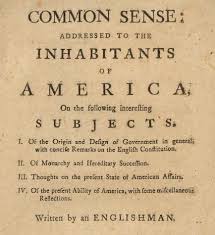
Who wrote a pamphlet called "Common Sense"?
a)
George Washington
b)
Thomas Paine
c)
Thomas Jefferson
d)
Patrick Henry
46.
Under the Articles of Confederation, most of the power was where?
a)
Legislative branch
b)
the president
c)
the states
d)
national government
47.
How many branches of government were there under the Articles of Confederation?
a)
One
b)
Zero
c)
Two
d)
Three
48.
Under the Articles of Confederation, how many votes did each state get when voting on a new law?
a)
Zero
b)
One
c)
Two 
d)
Three
49.
Which is a weakness of the Articles of Confederation?
a)
Congress couldn't collect taxes
b)
Weak central government
c)
Provided for no common currency
d)
All of the these
50.
Congress could ______ the states for money and troops but the states could say ____
a)
talk; no
b)
bargin; yes
c)
demand; yes
d)
ask; no
51.
One weakness of the Articles of the Confederation was ____________. 
a)
The ability of Congress to tax.
b)
The inability of Congress to tax.
c)
The ability of Congress to declare war.
d)
The ability of Congress to create courts.
52.
In order to change (amend) the Articles of Confederation,  __________ out of 13 states had to agree. 
a)
9
b)
10
c)
13
d)
15
53.

One weakness of the Articles Of Confederation was that it lacked which 2 branches of government?

a)

Legislative & Executive

b)

Executive & Judicial

c)

Judicial & Legislative

d)

Executive & Congress

54.
What did Shays' Rebellion help Americans realize they needed?
a)
A strong national government
b)
A stronger militia
c)
A common currency
d)
The ability to sign peace treaties
55.
Because of the Articles the government could NOT regulate ______ among the states.
a)
food quality
b)
laws
c)
travel
d)
commerce (trade)
56.
Which of the following events lead to a decision by the colonies to meet and revise the Articles of Confederation?
a)
The Boston Tea Party
b)
Shay’s Rebellion
c)
The Revolutionary War
d)
The Civil War
57.
When creating the legislative branch there were two proposed plans.  Which plan wanted states to have more votes based on population? 
a)
Connecticut Plan 
b)
New Jersey Plan
c)
Virginia Plan
d)
3/5th's Plan 
58.
The Great Compromise accomplished which of the following? 
a)
Created a one house legislature
b)
Postponed the conversation about slavery
c)
Added the Bill of Rights 
d)
Created a two house legislature
59.
In what house of our national legislature, called Congress, does each state have equal representation? 
a)
Senate 
b)
House of Representatives 
c)
General Assembly 
d)
House of Commons 
60.
What document replaced the Articles of Confederation and established a new national government? 
a)
The Declaration of Independence 
b)
The Constitution 
c)
The Magna Carta 
d)
The English Bill of Rights 
61.
Americans were afraid that a __?__ would lead to tyranny, or oppressive rule.
a)
strong state government
b)
weak government
c)
strong central government
d)
legslature
62.
Who was happy with the Virginia plan?
a)
Small States
b)
Large States
63.
How many houses are in the Great Compromise?
a)
1 (unicameral)
b)
2 (bicameral)
64.
How many slaves were counted for representation and taxation?
a)
Every slave was counted.
b)
Out of 4 slaves, only 3 were counted.
c)
Out of 100 slaves, only 3 were counted.
d)
Out of 5 slaves, only 3 were counted.
65.
What was the result of the Great Compromise?
a)
Representation in Congress was based upon population.
b)
Two houses were created, one with equal representation and the other with representation based on population
c)
Representation in Congress was equal.
d)
Two houses were created, both with representation based on population.
66.
The Great Compromise was a compromise between--
a)
Mass. Plan and New Jersey Plan
b)
Virginia Plan and New Jersey Plan
c)
Virginia Plan and New York Plan
d)
Virginia Plan and Delaware Plan
67.
The _______________ Plan proposed a strong federal government with two branches.
a)
Virginia
b)
New Jersey
c)
Connecticut
d)
Three-fifths
68.
Which part of the legislative branch has representation based on population?
a)
Senate
b)
Judicial
c)
House of 
Representatives
d)
House of Congress
69.
Which part of the legislative branch has the same number of representatives for each state?
a)
House of Representatives
b)
Judicial
c)
Executive
d)
Senate
70.
The best definition for Federalism is...
a)
power split between states and federal government
b)
all power in one place
c)
a loose alliance of states
d)
Ms. Snyder made this word up...
71.
How many houses would be in Congress under the New Jersey Plan?
a)
Two
b)
Five
c)
One
d)
Three
72.
Who would support a STRONG central government?
a)
Federalists
b)
Anti-Federalists
73.
Who demanded that a Bill of Rights be added to the Constitution?
a)
Federalists
b)
Anti-Federalists
74.
Who is known as the "father" of the Constitution?
a)
George Washington
b)
George Mason
c)
John Adams
d)
James Madison
75.
Where was the Constitutional Convention?
a)
Washington D.C
b)
New York
c)
Philly
d)
Vermont
76.

Besides Slavery, what other issue were Southern delegates concerned with entering the Constitutional Convention?

a)

Export Tax

b)

Republicanism

c)

Revolutionary War Debt

d)

Majority Rule

77.

Slaves were counted as three-fifths of a person for what two reasons?

a)

Tax Purposes

b)

War debt

c)

Representation

d)

Statehood

78.

How many years could people still buy for slaves after the Commerce and Slave Trade Compromise?

a)

10 years

b)

20 years

c)

50 years

79.

Ratified means

a)

organized

b)

shallow

c)

infested with rodents

d)

approved

80.

What position did Federalist take on the Constitution?

a)

opposed the Constitution

b)

supported English rule

c)

supported the Constitution

d)

didn't care either way

81.

Anti-Federalists feared the President would abuse his power. What is another word for abuse of power?

a)

transmission

b)

tyrannosaurus

c)

Torquemada

d)

tyranny

82.

Hamilton, Madison and Jay wrote these to gain support.

a)

Children's stories

b)

essays in support of Constitution

c)

Nasty letters to their girlfriends

d)

Texts that bullied the Anti-Federalists

83.

What were the essays called written by Hamilton, Jay and Madison?

a)

Fortnite fever

b)

Federalist Manifesto

c)

Flippin' Federalists

d)

Federalist Papers

84.

In the charter colonies, most governmental matters were handled by

a)

British monarch

b)

Parliament

c)

a proprietor

d)

the colonists

85.

Which feature did the State constitutions and the Articles of Confederation have in common?

a)

Royal governors

b)

a bill of rights

c)

the principle of self-rule

d)

a strong executive elected by popular vote

86.

First President/Vice President

a)

Madison/Hamilton

b)

Washington/Adams

c)

Jefferson/Monroe

d)

Washington/Madison

87.

Which was an achievement of the Second Continental Congress?

a)

preparing a Declaration of Rights

b)

raising an American army

c)

establishing a strong central government

d)

passing the Intolerable Acts

88.

Delegates met at Mount Vernon and Annapolis to

a)

recommend a federal plan for regulating commerce

b)

recommend a way to start a national army

c)

recommend ways to end slavery

d)

attend a social gathering in honor of George Washington

89.

The largest section of the Declaration of Independence consists of

a)

statements of the desire to separate from England

b)

lists of the rights of all people

c)

complaints of the wrongs done to the colonists

d)

threats of revenge for English mistreatment

90.

The relationship among the States during the Critical Period can be BEST compared to

a)

A choir singing in unison

b)

a traffic jam

c)

children arguing at the playground

d)

a baseball team in the playoffs

91.

Both the Connecticut Compromise and the Three-Fifths Compromise were crucial to the small States because

a)

they aided the economy of the small States

b)

without them, the small States would have had too much responsibility in the new government.

c)

they convinced James Madison to support the small States.

d)

without them, the small States would have carried little weight in the new government.