

wayground logo

Free Printable Worksheets

Font size

S
M
L
XL
Worksheets

Ohio AHCS 15

Total questions: 86

Worksheet time: 1hrs 1mins

Name
Class
Date
1.
 Yellow journalism was used by newspapers in the 1890s to
a)
influence public opinion
b)
promote peace in Cuba
c)
overturn a presidential election
d)
support an isolationist foreign policy
2.
By 1900 the United States was committed to a foreign policy of
a)
containment
b)
imperialism
c)
isolationism
d)
neutrality
3.
A major reason the United States wanted to build the Panama Canal was to
a)
improve United States relations with Latin America
b)
increase trade with England
c)
protect United States citizens living in South America
d)
shorten the sea route between the Atlantic and Pacific coasts
4.
The Monroe Doctrine, the Roosevelt Corollary, and the Good Neighbor policy all shaped United States relations with
a)
Latin America
b)
the Middle East
c)
Asia
d)
Africa
5.
The practice of using U.S. businesses and economic aid to influence foreign governments and achieve U.S. goals in Latin America is known as 
a)
imperialism.
b)
dollar diplomacy.
c)
isolationism.
d)
the big stick.
6.
7. This cartoon was most likely inspired by the
a)
signing of the Treaty of Versailles
b)
construction of the Panama Canal
c)
Spanish-American War
d)
start of World War II
7.
In 1899–1900, what was the goal of the United States when it began its Open Door policy toward China?
a)
defending its new Asian territories
b)
protecting China from a Japanese invasion
c)
assuring equal trading rights for itself
d)
stopping importation of inexpensive goods from China
8.

Which of the following best explains why the United States entered the First World War?

a)
German submarines engaged in unrestricted warfare
b)
Austria's Archduke Franz Ferdinand was 
assassinated
c)
Germany invaded the neutral nation of Belgium
d)
Britain enforced a defense treaty the United States signed
9.

Which U.S. acquisition INCREASED the military might of the U.S. by providing a strategic naval base?

a)
Philippines
b)
Cuba
c)
Hawaii
d)
China
10.
What was the cause of the Spanish American War?
a)
Imperialism
b)
Cuba's drive for independance
c)
Yellow Journalism
d)
    All the above
11.
Which event most influenced President Wilson to enter WWI?
a)
a communist revolution to overthrow the Russian government
b)
the assassination of Archduke Franz Ferdinand in Europe
c)
the renewal of unrestricted submarine warfare by Germany
d)
the invasion of Belgium by German infantry soldiers
12.
How did the participation of the United States in WWI contribute to its becoming a world power?
a)
The U.S. lost over 100,000 soldiers in WWI
b)
the ability to influence the war's outcome by fielding over a million soldiers.
c)
President Wilson's issuance of the Fourteen points before the end of WWI.
d)
President Wilson's opposition to treating Germany harshly after the end of the war.
13.
Who was responsible for organizing a volunteer cavalry unit, he became a national hero at the Battle of San Juan Hill and quickly became president. 
a)
Leonard Wood
b)
Teddy Roosevelt 
c)
Pancho Villa 
d)
John Pershing
14.
An international organization to promote world peace and cooperation 
a)
United Nations
b)
UFAW
c)
U.S Marine Corps
d)
League of Nations
15.
What effect did World War 1 have on women?
a)
More women entered the work for force to replace the men leaving for the war. 
b)
Women were made into slaves
c)
Women were not allowed to marry
d)
Women were not affected by WWI
16.
What was the goal of Wilson's 14 Points? 
a)
Start WWII 
b)
Punish Germany
c)
Create lasting world peace
d)
Put military restrictions on Germany
17.
U.S. Foreign Policy stance declared by President Wilson at the outset of the War
a)
Interventionism
b)
Massive Retaliation
c)
Neutrality
d)
Containment
18.
Phrase used by Pres. Wilson that describes why the US would join in the fight against Germany on April 2, 1917
a)
"There is such a thing as being too proud to fight"
b)
"The world must be made safe for democracy"
c)
"He kept us out of war"
d)
"Wilson has the will, son!"
19.
Law which required men ages 21-30 to register to be drafted
a)
Conscription Act
b)
"I Want You Act"
c)
Selective Service Act
d)
Required Service Act
20.
What was used to stir up nationalist feelings in America and cause dislike for the central powers:
a)
Mobilization
b)
Rationing
c)
Propaganda
d)
Militarism
21.
All of the following were ways in which the US raised money to finance the war except:
a)
Selling Liberty Bonds
b)
Increasing Income Taxes
c)
Hiring “4 minute men” to make fundraising speeches
d)
Forcing people to donate money
22.
Imperialism is __________.
a)
when a powerful nation uses its resources to help a weaker nation
b)
when a weaker nation invites a powerful nation to help it industrialize
c)
when a powerful nation takes control of the economy and government of a weaker nation
d)
when weak nations join together to fight a strong nation
23.
Why did United States business interests favor overseas expansion in the late 1800's? 
a)
to establish a commonwealth of colonies 
b)
to establish military bases around the world
c)
to acquire new markets and sources of raw materials 
d)
to spread democratic ideals to other areas of the world
24.
The U.S. declared war on Spain after
a)
the Maine exploded in Havana Harbor
b)
an attempted assasination of President Cleveland
c)
the Spanish invaded Puerto Rico
d)
the failed rebellion of José Martí
25.
As a result of the Spanish- American War, the US became a political power in -- 
a)
the Hawaiian islands 
b)
the Panama Canal Zone 
c)
the Central Powers Alliance 
d)
the Philippines, Guam, and Puerto Rico 
26.
The USS Main exploded while it was in Havana, _____. This was a leading cause to the start of the Spanish American War.
a)
Cuba
b)
Guam
c)
Mexico
d)
Panama
27.
The United States defeated which former mighty empire in the Spanish American War?
a)
England
b)
France
c)
Spain
d)
Russia
28.
He was part of the Rough Riders during the Spanish American war. He was also the assistant Secretary of the Navy and a president during the progressive era. 
a)
Alfred T Mahan 
b)
Rough Riders 
c)
Theodore Roosevelt 
d)
Henry Cabot Lodge 
29.
1898- It lasted only 4 months. This was the end of Spain's colonial empire and the emergence of the US as a world power,
a)
Sinking of the USS Maine 
b)
Boxer Rebellion 
c)
Dollar Diplomacy 
d)
Spanish American War 
30.
______________ is a name for false or exaggerated reporting.
a)
Red-top
b)
Government
c)
Newspaper lying
d)
Yellow Journalism
31.

This person, along with William Randolph Hearst, competed to sell the most newspapers in New York.

a)

Joseph Pulitzer

b)

Nellie Bly

c)

Charles Foster Kane

d)

William Henderson

32.

What became the rallying cry for people that wanted a war with Spain in Cuba?

a)

"Fight, Fight, Fight!"

b)

"Remember the Maine!"

c)

"Remember the Titanic!"

d)

"Beat Spain!"

33.

What happened to the United States after the Spanish-American War?

a)

The United States joined forces with Cuba and controlled all of the island countries in the Caribbean.

b)

The United States began a war with Mexico.

c)

The United States became a world power.

d)

The United States began a war with Canada.

34.

What did the Platt Amendment say? (select all that apply)

a)

Cuba had to sell land to build the naval base (Guantonamo Bay)

b)

The U.S. could send the military in to keep things in order

c)

Cuba became a U.S. state

d)

Cuba could trade freely with the U.S.

35.

What is yellow journalism?

a)

A kind of news writing that readers believe to be lies

b)

A kind of news writing that readers blame for starting wars

c)

A kind of writing that tells the truth to attract readers

d)

A kind of writing that exaggerates the news to shock and attract readers

36.

How did American newspapers report on the treatment of Cuba by Spain?

a)

Cuba was treated cruelly.

b)

Cuba was treated fairly.

c)

Cuba was treated kindly.

d)

Cuba was treated no different.

37.

What caused the Spanish-American War?

a)

Americans blaming Spain for the United States Navy ship, U.S.S. Mississippi, exploding in a Cuban harbor.

b)

Americans blaming Spain for the United States Navy ship, U.S.S. Maine, exploding in a Cuban harbor.

c)

Americans blaming Spain for the United States Navy ship, U.S.S. Missouri, exploding in a Cuban harbor.

d)

Americans blaming Spain for the United States Navy ship, U.S.S. Massachusetts, exploding in a Cuban harbor.

38.

Who led the Rough Riders?

a)

Franklin D. Roosevelt

b)

John D. Rockefeller

c)

Theodore Roosevelt

d)

Cornelius Vanderbilt

39.

What happened to Cuba after the Spanish-American War?

a)

Cuba became an independent country.

b)

Cuba remained a Spanish colony.

c)

Cuba became a United States colony.

d)

Cuba became European Country.

40.

Who were the Rough Riders?

a)

A Cuban calvary regiment that cleared Kettle Hill for Cuban soldiers to advance during the Spanish-American War.

b)

A United States calvary regiment that cleared Kettle Hill for American soldiers to advance during the Spanish-American War.

c)

A Spanish calvary regiment that cleared Kettle Hill for Spanish soldiers to advance during the Spanish-American War.

d)

A Guam calvary regiment that cleared Kettle Hill for Guamanian soldiers to advance during the Spanish-American War.

41.

What did Spain surrender to the United States after the Spanish-American War?

a)

Puerto Rico, Philippines, and Guam

b)

Cuba, Philippines, and Guam

c)

Puerto Rico, Portugal, and Guam

d)

Puerto Rico, Philippines, and Hawaii

42.

Teddy Roosevelt and the Rough Riders had an important victory in Cuba at-

a)

Pebble Beech

b)

San Juan Hill

c)

Normandy

d)

Havana Harbor

43.
What US President was most influential in starting the Panama Canal?
a)
FDR
b)
JFK
c)
Teddy Roosevelt
d)
Taft
44.
What 2 oceans does the Panama Canal connect?
a)
Atlantic Ocean and Indian Ocean
b)
Pacific Ocean and Indian Ocean
c)
Atlantic Ocean and Pacific Ocean
d)
Lake Michigan and Mississippi River
45.
What was the cause of the conflict between Cuba and Spain?
a)
Cuba wanted to enslave Spain
b)
Spain wanted to convert the Cuban government to communism
c)
Spain wanted to turn Cuba into a sugar can colony
d)
Cuba wanted independence from Spain 
46.
Which territory did the United States NOT take as a territory and gave them independence? 
a)
Puerto Rico
b)
Guam
c)
Philippines
d)
Cuba
47.
What term describes building an empire by conquering other nations?
a)
Isolationism
b)
Repubicanism
c)
Militarism
d)
Imperialism
48.
Why did the U.S build the Panama Canal?
a)
to reduce travel time
b)
to speed up trade
c)
to protect from invaders
d)
for fishing
49.
Why did the US want to build a canal in Panama?
a)
to help the Panamanian people in their Revolution.
b)
to provide jobs for people
c)
to make it easier to move ships around the world
d)
to stop the invasion of South America
50.
Made America the world's policeman
a)
Monroe Doctrine
b)
Roosevelt Corollary
c)
Domestic Policy
d)
Imperialism
51.
Why did we care about Cuba?
a)
We had businesses there
b)
Cuba belonged to us
52.
Threatening use of force in Latin America if need be
a)
Dollar Diplomacy
b)
Moral Diplomacy
c)
Big Stick Diplomacy
d)
Shuttle Diplomacy
53.
As a result of the Spanish American war, the US became  _______ ___________
a)
A world power
b)
Isolationist
54.

Which of the following was primarily responsible for the change depicted in this illustration?

a)

New immigrant screening procedures at Ellis Island

b)

A crackdown on anarchism after the assassination of President McKinley

c)

Overseas expansion associated with the Spanish American War

d)

An increase in circulating currency after the discovery of gold in Alaska
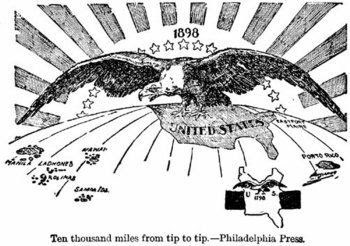
55.

This political cartoon best supports the idea that, after the Spanish American War, the United States became a...

a)

World Power

b)

"Woke" Power

c)

Head of the United Nations

d)

Conquered Nation

56.

American anger grew after the release of a letter written by the Spanish Minister to the U.S. that insulted president McKinley. What was it called?

a)

de Lome Letter

b)

Open Door Notes

c)

Roosevelt Corollary

d)

Letters from Birmingham

57.
How did newspaper headlines like this help start the Spanish-American war?
a)
They created a fear of war.
b)
They only reached those that could read.
c)
They created a desire to go to war.
d)
They accurately informed the news of the world.
58.
What were former slaves, freemen and Black Civil War soldiers called during the Spanish-American War?
a)
rough riders
b)
cubans
c)
soldiers
d)
buffalo soldiers
59.

The adding of a region to the territory of an existing political unit.

a)

Imperialism

b)

Annexation

c)

Diplomacy

d)

Nationalism

60.

An example of a strategic military reason for expanding to Hawaii would be:

a)

Converting natives to Christianity

b)

Adding a naval base

c)

Gaining new resources such as sugar and pineapple farms.

61.

An example of expanding for reasons of cultural superiority is:

a)

Believing the American plantation owners could rule Hawaii better.

b)

Gaining naval bases in the Pacific.

c)

Adding a fuel station for merchant ships.

62.

An example of an economic reason for expanding to Hawaii is:

a)

Adding naval bases

b)

Converting natives to Christianity

c)

Gaining access to trade routes with Asia

63.

True or False. Americans had interest in Hawaii because of the wealth brought from Hawaiian Sugar and Pineapple plantations.

a)

True

b)

False

64.

True or False. The King and later Queen of Hawaii wanted to be annexed by the United States.

a)

True

b)

False

65.

The U.S. annexation of Hawaii is an example of U.S. (a)  

66.

Allowed national government to draft men to serve in war.

a)

Treaty of Versailles

b)

Selective Service Act

c)

Draft Law of 1916

d)

Fourteen Points

67.

Policy of not taking sides in the conflict in Europe.

a)

Neutrality

b)

Alliance

c)

American Expeditionary Force

d)

Armistice

68.
International peacekeeping organization.  U.S. did not join.
a)
United Nations
b)
League of Superheroes
c)
League of Nations
d)
United Governmental Agency
69.

Germany promised not to sink any more ocean liners without prior warning or providing help to passengers.

a)

Superior Pledge

b)

Reparations

c)

Sussex Pledge

d)

Lusitania Pledge

70.

Ended WWI with provisions that were considered very harsh on Germany and other defeated countries.

a)

Treaty of Paris

b)

Treaty of Versailles

c)

Treat of Ghent

d)

Treaty of Nanking

71.

Secret message from German foreign Minister to Mexico, promising to return lost territories to Mexico in exchange for alliance.

a)

DeLome Letter

b)

Zimmerman Telegram

c)

Wilhelm Message

d)

Franz Communication

72.

Made it a crime to criticize American involvement in European conflict.

a)

Espionage Act of 1917

b)

Schenck v. US

c)

Sussex Pledge

d)

Anti-spying Law of 1910

73.

Attempted to remain neutral, but eventually he was forced to ask Congress for a declaration of war on Europe.

a)

Theodore Roosvelt

b)

William Howard Taft

c)

Woodrow Wilson

d)

Warren G. Harding

74.

British passenger ship was sunk by German submarine killing over 1000 people including 128 Americans.

a)

Lusitania

b)

Titanic

c)

White Star

d)

Concordia

75.

Proposed by Wilson before the end of WWI as the basis for the peace in Europe include a plan for the League of Nations.

a)

Fourteen Points

b)

Treaty of Versailles

c)

United Nations

d)

Treaty of Paris

76.

Policy after WWI of separating from affairs of other countries and turning their backs to Europe.

a)

Apartheid

b)

Isolationism

c)

Interventionism

d)

Protectionism

77.

What idea was the basis for American isolationism?

a)

Roosevelt Corrolary

b)

Taft Diplomacy

c)

Wilson's Fourteen Points

d)

Monroe Doctrine

78.

Why did the US want to stay neutral? (Select all that apply)

a)

Americans came from all the countries fighting.

b)

Many Americans thought that America was too weak to join the war.

c)

They wanted to stay out of European problems.

d)

Britain and Germany asked America to stay out.

79.

How was the US still involved in WWI even if they were not fighting?

a)

They sold supplies to many of the countries fighting.

b)

They sent letters to world leaders asking them to stop fighting

c)

American men joined the French army to fight.

d)

The American army trained with many of the countries to prepare to go to war.

80.

Why did Germany sink American ships?

a)

Because they thought the US was a secret member of the Triple Entente.

b)

They wanted to stop supplies from reach Britain and France.

c)

They saw America as a natural enemy.

d)

They were not very good at telling American ships from British ones.

81.

Why were Americans so upset about the sinking of the Lusitania?

a)

It made America look bad, since we were trading with Britain.

b)

Many innocent civilians were killed.

c)

The Lusitania was very expensive and many people had invested in it.

d)

Most Americans actually did not care about the sinking.

82.

What does this political cartoon tell us about the Zimmerman Telegram.

a)

German-Americans sent bombs in the mail to discourage America joining the war.

b)

The Germans did not mean to send the telegram.

c)

Instead of keeping America out of the war, it back-fired and got America to join faster.

d)

Americans wanted to bomb Germany afterwards.

83.

What part of the Zimmerman Telegram is this political cartoon talking about?

a)

Unrestricted Submarine Warfare

b)

Germany's hope that America won't join the war.

c)

Germany's promise of land if Mexico joins their side.

d)

Plans to convince Russia to fight on their side.

84.

After WWI, many Americans wanted...?

a)

to become more involved in global issues.

b)

go back to isolationism and neutrality.

c)

conquer parts of Europe

d)

adopt French customs

85.

The U.S. government passed the ______________ to allow a draft to recruit soldiers for the war.

a)

Conscription Act

b)

Selective Service Act

c)

Indenture Servant Act

d)

War Powers Act

86.

The Treaty of Versailles helped create the League of Nations to do what?

a)

punish Germany

b)

help nations solve their problems peafully

c)

to help fight the Central Powers

d)

None of these
