wayground logo

Free Printable Worksheets

NEW

Font size

S
M
L
XL
Worksheets

Physical Science - Module 1 Review

Total questions: 20

Worksheet time: 40mins

Name
Class
Date
1.
What two measurements are necessary for calculating speed?
a)
Mass and time
b)
Temperature and mass
c)
Mass and distance
d)
Distance and time
2.
What does this graph represent?
a)
Constant speed
b)
Acceleration
c)
Not moving
3.
What is happening at D?
a)
Stationary
b)
Accelerating
c)
Fast steady speed; moving away from the starting position
d)
Slower steady speed; moving away from the starting position
4.
What is the formula to calculate speed?
a)
S = t/d
b)
S = d/t
c)
S = d x t
d)
S = t x d
5.
Marta rides her bike 10 miles in 5 hours. Joel rides his bike 11 miles in 5 hours. Avery rides her bike 15 miles in 5 hours. Which child rides her bike faster?
a)
Marta
b)
Avery 
c)
Joel
6.

Iron filings and bar magnets are placed on a piece of paper. Explain the pattern on the diagram below. Where is the magnetic field the strongest?

a)

The magnetic field is only strong at the north pole

b)

The magnetic field is only strong at the south pole

c)

The magnetic field is strongest at the magnet’s poles.

7.

How can you increase the strength of this electromagnet?

a)

Get a larger nail.

b)

Add more loops of wire.

c)

decrease the loops of wire.

d)

Get a smaller nail.

8.

Whenever an object is moving, there is always this force opposing the motion:

a)

inertia

b)

momentum

c)

friction

d)

applied force

9.

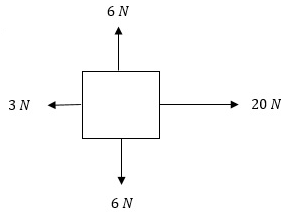
What is the NET FORCE of this diagram?

a)

17 N, right

b)

17 N, left

c)

23 N, right

d)

12 N, up

10.

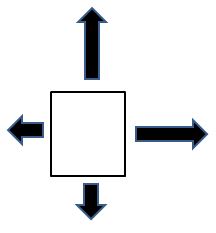
If this object were moving right, the left-arrow in this diagram is most-likely:

a)

gravity

b)

normal

c)

a push or pull

d)

friction

11.

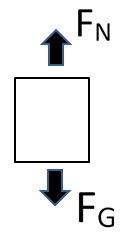
Which of the following is true about this free-body diagram?

a)

the forces are are balanced

b)

the object is free-falling

c)

the object is moving upward

d)

the forces are unbalanced

12.
You give a shopping cart a shove down the isle. The cart is full of groceries and has a mass of 18 kg. The cart accelerates at a rate of 3 m/s2. How much force did you exert on the cart?
a)
6N
b)
54N
c)
21N
d)
18N
13.
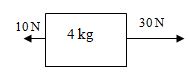
Calculate the Acceleration.
a)
20
b)
5
c)
.2
d)
80
14.
A 50 kg skater pushed by a friend accelerates 5 m/sec2.  How much force did the friend apply?
a)
45 N
b)
15 N 
c)
10 N
d)
250 N
15.
A 50 kg ball rolls down the street at 5 m/s. Calculate the momentum of the ball. 
a)
55 kg*m/s
b)
100 kg*m/s
c)
250 kg*m/s
d)
500 kg*m/s
16.
An object with a mass of 2000 kg at rest has what momentum?
a)
2000 kg m/sec
b)
0 kg m/sec
c)
2000 kg
d)
2000 m/sec
17.

If you double the velocity of an object, then its momentum will ______________.

a)

will double

b)

will half

c)

will quadruple (x4)

d)

will be quartered (x 1/4)

18.
A student attaches a meter to a wire coil. Next, the student moves a magnet back and forth through the wire coil, as shown in the picture. As the magnet moves back and forth, the meter indicates? 
a)
volume
b)
temperature
c)
current
d)
conductivity
19.
Generators are devices that convert _____ energy into _____ energy.
a)
chemical; mechanical
b)
mechanical; electrical
c)
electrical; mechanical
d)
potential; kinetic
20.
What device turns electrical energy into mechanical energy?
a)
a solenoid
b)
a motor
c)
an electromagnet
d)
an electric generator