
 Worksheets
Periodic Table and Trends Review 2024
Total questions: 32
Worksheet time: 46mins
As you move from left to right on the periodic table, the number of valence electrons.......
Increases
Decreases
Remains the same
As you move down a group on the periodic table, the number of valence electrons....
Increases
Decreases
Remains the same
Which of the following is the term for a substance in which all the atoms have the same number of protons
a compound
An element
a molecule
a solid
a gas


What is the name of the family that is highlighted?
Alkali Metal Family
Halogen Family
Noble Gas Family
Transition Metal Family


Which element has 3 valence electrons?
A
B
E
C


As you move across a period (row) on the periodic table, why is there a decrease in atomic radius as the atomic number increases?
the number of protons increases, and the number of electron shells/energy levels increases
the number of protons increases, and the number of electron shells/energy levels remains the same
the number of protons decreases, the number of shells of electrons increases.
number of protons decreases, and the number of electron shells remains the same.
Vertical columns of elements (these are also known as a "family") - they also have the same number of valence electrons and are known as ________________.
groups
periods
quadrants
rows
Most noble gases have _______ valence electrons.
1
2
7
8


Which element has the highest electronegativity?
An element is found to react violently with alkali metals, easily form anions by accepting electrons, and exists naturally as a diatomic gas. What family (group) does it belong to?
Halogens
Noble Gases
Alkaline Earth Metals
Transition Metals
Which sequence of atomic numbers represents elements that have similar chemical properties? Select ALL that apply!
1,2,3,4,5,6
4,12,20,38,56
9,17,35,53,85
55,72,75,78,81,84
Find Cesium and Radium on the periodic table. Which TWO answers below would accurately describe these elements?
They are both metals
They are both nonmetals
They are both metalloids
They belong in groups one and two
Atomic Radius ______________ from left to right across a period.
increases
decreases
Metal reactivity _____________ from right to left across a period.
increases
decreases
Atomic Radius ____________ moving down a group from top to bottom.
increases
decreases
Metal Reactivity ______________ moving down a group from top to bottom
increases
decreases
Electronegativity _________________ with increasing atomic number within a group.
increases
decreases
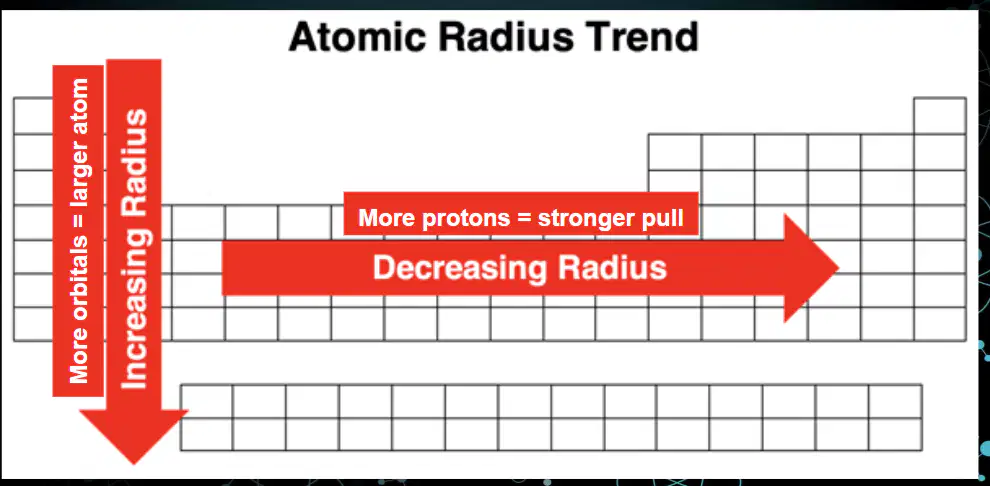
Why does atomic radius decrease as you move from left to right across a period (row) on the periodic table?
The number of protons decreases, resulting in a weaker pull of the electrons
The number of protons increases, resulting in a stronger pull of the electrons to the nucleus
The metallic properties of the elements increase
The number of energy levels increases as you go across a period
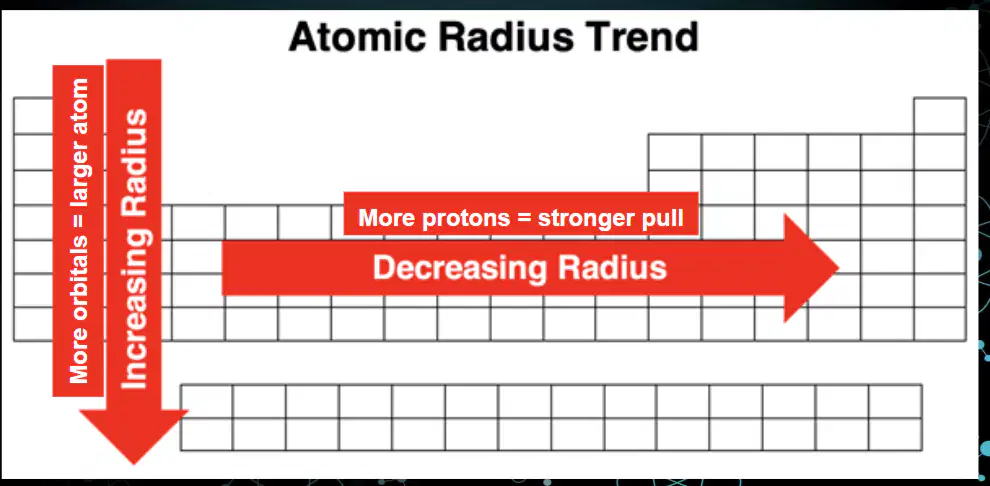
Why does atomic radius increase as you move down a group (column) on the periodic table?
The atoms have more orbitals (energy levels), which results in a larger atom
The atoms have fewer orbitals (energy levels), which results in a smaller atom
The number of valence electrons increases as you go down a group
The atomic number increases

