

Wayground logo

Free Printable Worksheets

Font size

S
M
L
XL
Worksheets

Cell test review

Total questions: 29

Worksheet time: 36mins

Name
Class
Date
1.
These structures contain chlorophyll that give plants their green color.  This is also where plants make their food.
a)
vacuole
b)
mitochondrion
c)
chloroplast
d)
bacteria
2.
What is the name of the organelle number 9?
a)
chloroplast
b)
cell membrane
c)
mitochondria
d)
vacuole
3.
Which one of the following scientists did NOT create the cell theory?
a)
Schleiden
b)
Virchow
c)
Leeuwenhoek
d)
Schwann
4.
What is the function of organelle #2?
a)
Controls all cell functions
b)
Makes proteins
c)
Controls what enters and exits cell
d)
Transports materials throughout the cel
5.
Which structures below are found only in plant cells?
a)
cell wall and chloroplasts
b)
vacuoles and cell membrane
c)
cell wall and mitochondria
d)
nucleolus and nucleus
6.
Identify the function of the cell part that is labeled G. (hint: outer covering)
a)
controls what enters and exits
b)
supports and protects
c)
Makes proteins
d)
Packages proteins in vesicles
7.
What cell part breaks down food molecules to make energy?
a)
chloroplasts
b)
ribosomes
c)
vacuoles
d)
mitochondria
8.
Prokaryotic cells do NOT have which of the following cell parts.
a)
nucleus
b)
cell membrane
c)
DNA
d)
flagellum
9.
Which statment is NOT part of the Cell Theory.
a)
Cells are the basic unit of structure and function in living things.
b)
Cells are microscopic
c)
All living things are made of cells
d)
Cells come from other cells.
10.
Which letter represents a cell part found only in plant cells.
a)
C
b)
L
c)
I
d)
E
11.
In eukaryotic cells, where is the DNA located?
a)
mitochondria
b)
nucleus
c)
vacuole
d)
lysosome
12.
What is the movement of molecules from an area of high concentration to and area of low concentration?
a)
Diffusion
b)
Osmosis
c)
Gummy Bearification
d)
Wilting
13.
Which type of transport requires cellular energy?
a)
Active
b)
Passive
14.
Who was the first person to use the word cell?
a)
Hooke
b)
Matthis
c)
Schwann
d)
Kastrup
15.
Which cells do not have membrane bound organelles?
a)
Eukaryotic Cells
b)
Animal Cells
c)
Plant Cells
d)
Prokaryotic Cells
16.

Which scientist concluded that all plants are composed of cells?

a)

Schleiden

b)

Virchow

c)

Schwann

d)

Leeuwenhoek

17.

Which scientist concluded that animals and all living things are composed of cells?

a)

Schleiden

b)

Virchow

c)

Schwann

d)

Leeuwenhoek

18.

Which scientist concluded that all cell come from cells?

a)

Schleiden

b)

Virchow

c)

Schwann

d)

Leeuwenhoek

19.

Which scientist observed the gunk on his teeth and called the bacteria he saw animicules?

a)

Schleiden

b)

Virchow

c)

Schwann

d)

Leeuwenhoek

20.

What will happen as a result of diffusion?

a)

The molecules will move into the cell.

b)

The molecules will move out of the cell.

c)

The water will move into the cell.

d)

The water will move out of the cell.

21.

What is the solution in the beaker?

a)

Hypertonic

b)

Hypotonic

c)

Isotonic

d)

None of these are correct

22.

What will happen as a result of osmosis?

a)

The molecules will move into the cell.

b)

The molecules will move out of the cell.

c)

The water will move into the cell.

d)

The water will move out of the cell.
23.
Where you'd find DNA in a prokaryote.
a)
Nucleus
b)
Floating in the cytoplasm
c)
Cell membrane
d)
Chloroplasts
24.
The organelle that synthesizes ATP and is found in both of these cells.
a)
mitochondria
b)
chloroplast
c)
nucleus
d)
cytoplasm
25.
This picture shows a cell sending out waste through exocytosis. Where does this take place?
a)
cell membrane
b)
cell wall
c)
nucleus
d)
mitochondria
26.
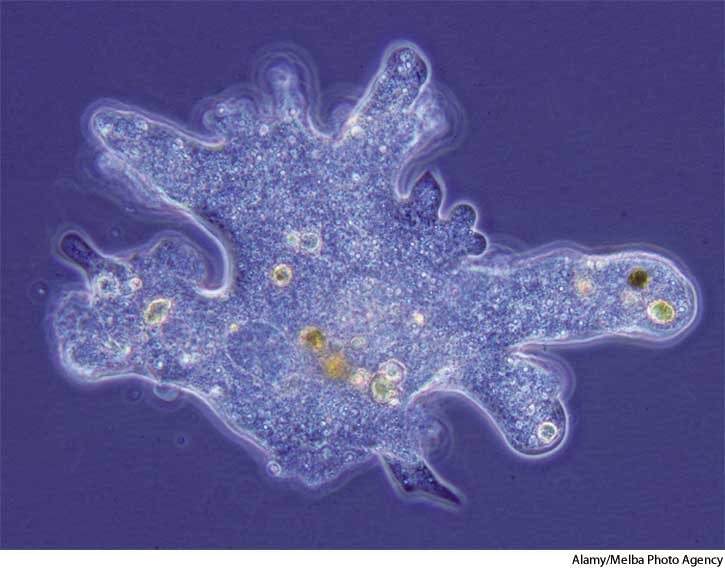
An Amoeba is a unicellular, animal-like protist that lives in ponds and streams. According to cell theory, where did this cell come from?
a)
another pre-existing amoeba cell.
b)
energy from sun that allowed the protist to reproduce.
c)
a multicellular organism.
d)
the nonliving environment.
27.

Which of the following category describes the work of lysosomes the MOST accurately?

a)

Engineering and manufacturing because they bring amino acids together to make proteins

b)

Waste management and recycling because they break down particles and old cellular material and remove or reuse it

c)

Safety and healthcare because lysosomes destroy invading particles such as bacteria and repair damage caused by them

d)

Storage and transportation because lysosomes contain water and nutrients and take them to parts of the cell that need it

28.

What do ribosomes do in the cell?

a)

Provides energy in the form of ATP

b)

Make food for the cell during the process of photosynthesis

c)

Make proteins for the cell

d)

Control all the activities in the cell

29.

In the cafeteria the students empty uneaten food and other wastes into trash cans until it can be removed. The trash cans can be compared to the ___________ in the cell.

a)

Nucleus

b)

Lysosomes

c)

Mitochondria

d)

Chloroplasts
