wayground logo

Free Printable Worksheets

Font size

S
M
L
XL
Worksheets

Electron Configuration

Total questions: 54

Worksheet time: 2hrs 1mins

Name
Class
Date
1.
What atom matches this electron configuration?
1s2s2p3s2
a)
Neon
b)
Magnesium
c)
Aluminum
d)
Potassium
2.
Which is the electron configuration for an oxygen atom?
a)
1s22s22p63s23p64s2
b)
1s22s22p4
c)
1s22s22p6
d)
1s22s22p63s23p6
3.
What is the maximum number of electrons that an orbital can have?
a)
1 electron
b)
2 electrons
c)
3 electrons
d)
4 electrons
4.
How many valence electrons are represented here?
a)
7
b)
5
c)
2
d)
8
5.
How many d orbitals are there in a given sublevel?
a)
1
b)
3
c)
5
d)
7
6.
How many p orbitals are there in a sublevel?
a)
2
b)
1
c)
4
d)
3
7.
How many electrons can the d sublevel hold?
a)
8
b)
10
c)
2
d)
4
8.
What is this element? 
1s22s22p63s23p6
4s23d104p6
a)
Argon
b)
Krypton
c)
Selenium
d)
Bromide
9.
How many electrons can the first energy level hold?
a)
1
b)
2
c)
8
d)
0
10.
How many valence electrons does Chlorine have?
a)
5
b)
2
c)
7
d)
5
11.
How many valence electrons does phosphorus have?
a)
5
b)
2
c)
8
d)
15
12.
What element has the valence shell configuration
3s2 3p2
a)
Al
b)
B
c)
Si
d)
Ga
13.
Which element is pictured?
a)
neon
b)
fluorine
c)
magnesium
d)
argon
14.
Identify the element in Period 5 that has 1 valence electron?
a)
Rb
b)
Nb
c)
Ag
d)
Sb
15.
Which orbital shows a violation of Hund's Rule?
a)
A
b)
B
c)
C
d)
D
16.
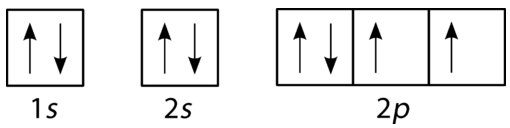
Which element is depicted from this atomic orbital diagram?
a)
Carbon
b)
Nitrogen
c)
Oxygen
d)
Phosphorus
17.
Which element is depicted from this orbital diagram
a)
Fluorine
b)
Neon
c)
Chlorine
d)
Argon
18.
This orbital diagram represents:  
a)
C
b)
B
c)
N
d)
O
19.
What is incorrect about this orbital diagram?
a)
Both arrows in the 2p box should be pointing up
b)
There is nothing incorrect with this diagram
c)
In the 2p box there should only be 1 electron in the first 2p box and one in the 2nd 2p box
d)
All the arrows should be pointing up.
20.
What is the Pauli Exclusion Principle?
a)
An atomic orbital can only hold a maximum of 2 electrons, each with opposite spins
b)
An atomic orbital can hold a minimum of 6 electrons, each with opposite spins
c)
An atomic orbital can hold a maximum of 6 electrons, each with the same spin
d)
An atomic orbital can hold a minimum of 2 electrons, each with opposite spins
21.
Which orbital shows a violation of the Aufbau Principle?
a)
A
b)
B
c)
C
d)
D
22.
What is the name of this element?
a)
Helium
b)
Hydrogen
c)
Argon
d)
Silver
23.

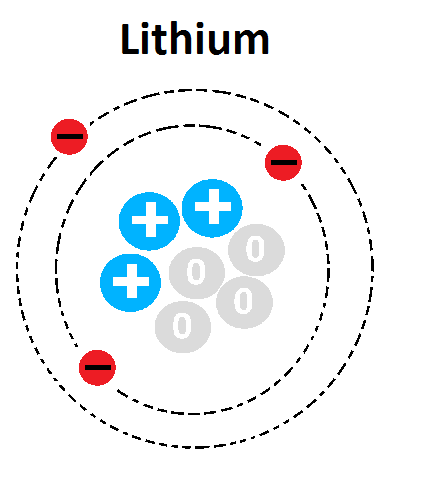
What element is represented in this Bohr Model?

a)

Carbon

b)

Hydrogen

c)

Aluminum

d)

Lithium

24.
What is the name of this element?
a)
Lithium
b)
Boron
c)
Carbon
d)
Neon
25.
What is the name of this element?
a)
Beryllium
b)
Boron
c)
Barium
d)
Bromine
26.
What is the mass number of this atom?
a)
1
b)
3
c)
4
d)
7
27.
What is the atomic number of this atom?
a)
2
b)
4
c)
6
d)
none of the above
28.
What group does this element belong to?
a)
Group 1: Alkali metals
b)
Group 18: Noble Gases
c)
Group 2: Alkaline-Earth Metals
d)
Group 17: Halogens
29.
Identify this atom.
a)
Lithium
b)
Boron
c)
Carbon
d)
Neon
30.
How many valence electrons?
a)
2
b)
3
c)
5
d)
10
31.
What's a valence electron?
a)
electrons in the second energy level
b)
electrons in the outermost energy level
c)
the atomic number
d)
electrons in the first level
32.

The innermost energy level has a maximum of how many electrons?

a)

1

b)

2

c)

6

d)

8

33.

Name this element.

a)

Neon

b)

Magnesium

c)

Sodium

d)

Manganese

34.

Which group includes non-reactive gasses that have a full outer electron shell?

a)

Alkai Metals

b)

Alkaline Metals

c)

Halogens

d)

Noble Gases

35.

Which group includes soft, highly reactive metals with one electron in their outer shell?

a)

Alkai metals (group 1)

b)

Alkaline metals (group 2)

c)

Halogens (group 17)

d)

Noble gasses (group 18)

36.
Remember to use your Periodic Table of Elements to help you identify which Bohr Model is pictured...
a)
calcium
b)
magnesium
c)
bromine
d)
nickel
37.
Remember to use your Periodic Table of Elements to help you identify which Bohr Model is pictured...
a)
oxygen
b)
magnesium
c)
terbium
d)
hydrogen
38.
Remember to use your Periodic Table of Elements to help you identify which Bohr Model is pictured...
a)
oxygen
b)
magnesium
c)
bromine
d)
chlorine
39.
What part of the wave is shown at letter A?
a)
crest
b)
trough
c)
wavelength
d)
frequency
40.
Which part of the wave is shown at letter B?
a)
crest
b)
trough
c)
wavelength resting point
41.
Which wave has a longer wavelength?
a)
wave C
b)
wave D
42.
Which wave has a greater frequency?
a)
wave B
b)
wave C
43.
Which wave has the most energy?
a)
top wave
b)
bottom wave
44.

A particle of light is called a...

a)

Photoelectron

b)

Photon

c)

Proton

d)

Electron

45.

What is the orbital with the least amount of energy?

a)

Excited state

b)

Ground state

c)

Orbital

d)

Bohr model

46.

What is the reaction involved if the electron moves from position 1 to 2?

a)

Light will be emitted

b)

Light will be absorbed

c)

The electron will become less excited

d)

The electron will decrease a quantum

47.

Which position represents the highest energy state?

a)

1

b)

2

c)

3

d)

4

48.

Each element produces its own pattern of emission spectra lines because each element has its own distinct

a)

Speed of light

b)

Electron configuration

c)

Number of neutrons

d)

None of these

49.

The unknown emissions spectra belongs to the element

a)

Hydrogen

b)

Mercury

c)

Neon

d)

Sodium

50.

The unknown emissions spectra belongs to the element

a)

Hydrogen

b)

Mercury

c)

Neon

d)

Helium

51.

Which change occurs when an atom in an excited state returns to the ground state?

a)

Energy is emitted

b)

Energy is absorbed

c)

The number of electrons decreases

d)

The number of electrons increases

52.
The arrows pointing down represents...
a)
photon absorption
b)
proton emission
c)
electron absorption
d)
electron transition
53.
Light is emitted when electrons ...
a)
jump from high to low 
b)
jump from low to high 
c)
either of these
d)
none of these
54.

What is the distance from crest to crest or trough to trough of any given wave?

a)

Wavelength

b)

Crest Length

c)

Photon

d)

Trough Length