wayground logo

Free Printable Worksheets

NEW

Font size

S
M
L
XL
Worksheets

Finals Practice Quiz

Total questions: 51

Worksheet time: 38mins

Name
Class
Date
1.
Which subatomic particle has a positive (+) charge?
a)
Neutron
b)
Proton
c)
Electron
2.
Which subatomic particle has a negative (-) charge?
a)
Proton
b)
Electron
c)
Neutron
3.
Which subatomic particle has a neutral or no charge?
a)
Proton
b)
Electron
c)
Neutron
4.
Where is the nucleus located in an atom?
a)
Near the electron shells/levels
b)
Near the center of an atom
5.
Where are the Electrons found in the structure of an atom?
a)
In the nucleus
b)
In spaces around the nucleus
6.
Which is an electron?
a)
A
b)
B
c)
C
7.

How many electrons go in the first shell (ring) ?

a)

6

b)

8

c)

4

d)

2

8.

This is a Bohr Diagram of Aluminum. How many valence electrons does Aluminum have?

a)

3

b)

4

c)

5

9.

How many valence electrons does Lithium (Li) have?

a)

8

b)

1

c)

5

d)

2

10.

How many valence electrons does Tin (Sn) have?

a)

8

b)

7

c)

5

d)

4

11.
What is a valence electron?
a)
an electron that is found in the outermost shell of an atom. 
b)
an electron found in the innermost shell of an atom.
c)
an electron found in the middle shell.
12.

Which of these is incorrect?

a)
b)
13.

Which of these is correct?

a)
b)
c)
14.
This could be the dot diagram of 
a)
Ne
b)
Si
c)
Al
d)
Be
15.

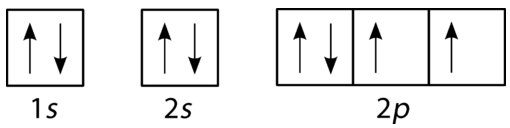
This orbital diagram represents:

a)

Carbon

b)

Boron

c)

Nitrogen

d)

Oxygen

16.

This orbital diagram represents

a)

Nitrogen

b)

Oxygen

c)

Carbon

d)

Neon

17.

What is incorrect about this orbital diagram?

a)

Both arrows in the 2p box should be pointing up

b)

There are too many electrons in the 1s orbital

c)

In the 2p boxes, there should only be 1 electron in the first 2p box and one in the 2nd 2p box

d)

All the arrows should be pointing up

18.

This orbital diagram represents

a)

Nitrogen

b)

Oxygen

c)

Carbon

d)

Neon

19.

This orbital diagram represents

a)

Sodium

b)

Magnesium

c)

Aluminum

d)

Iron

20.

The vertical (up and down) columns in the Periodic Table are called

a)

groups

b)

towers

c)

periods

d)

atomic numbers

21.

A row in a periodic table is called

a)

group

b)

block

c)

period

d)

element

22.

how many groups are there in modern periodic table

a)

8

b)

9

c)

18

d)

17

23.

All elements in the same row have the same number of shells.

a)

True

b)

False

c)

Sometimes

24.

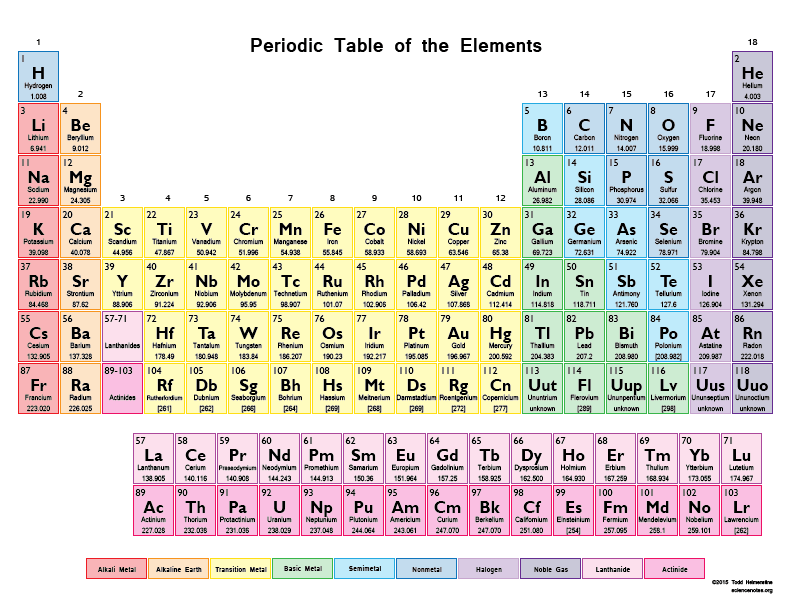
What block is represented by the colour green?

a)

p-block

b)

d-block

c)

s-block

d)

f-block

25.

Atoms of elements in group 1 have ____________.

a)

one electron in their outermost energy level

b)

two electrons in their outermost energy level

c)

seven electrons in their outermost energy level

d)

eight electrons in their outermost energy level

26.

What block is represented by the colour red?

a)

p-block

b)

d-block

c)

s-block

d)

f-block

27.

What block is represented by the colour blue?

a)

p-block

b)

d-block

c)

s-block

d)

f-block

28.

What block is represented by the colour yellow?

a)

p-block

b)

d-block

c)

s-block

d)

f-block

29.
24.1% of all the isotopes of a an element have a mass of 75.23 amu, 48.7% have a mass of 74.61 amu, and 27.2% have a mass of 75.20 amu.
What is the average mass of this element?
a)
74.92 amu
b)
24.97 amu
c)
75.01 amu
d)
74.51 amu
30.
An element with 4.35% have a mass of 49.9461 amu, 83.79% have amass of 51.9405 amu, 9.50% have a mass of 52.9407 amu, and 2.36% have a mass of 53.9389amu.
a)
51.99 amu
b)
52.19 amu
c)
53.45 amu
d)
17.33 amu
31.
4.35% of all X atoms have a mass of 39.946 amu. 83.79% have a mass of 41.941 amu, 9.50% have a mass of 42.941 amu, and 2.36% have a mass of 43.939 amu. What is the average atomic mass of atom X?
a)
41.97 amu
b)
42.19 amu
c)
10.43 amu
d)
40.04 amu
32.
An element has two naturally occurring isotopes. One is 10.013 amu and is 19.9% abundant. The other is 11.01 amu and is 80.1% abundant. What is the average atomic mass? What element is it?
a)
9.012, Beryllium
b)
12.011, Carbon
c)
6.941, Lithium
d)
10.812, Boron
33.
What is the atomic number?
a)
the number of protons
b)
the number of protons and neutrons
c)
the number of neutrons
d)
the number of protons and electrons
34.
What is the mass number defined as?
a)
the number of protons
b)
the number of protons and neutrons
c)
the number of neutrons
d)
the number of protons and electrons
35.
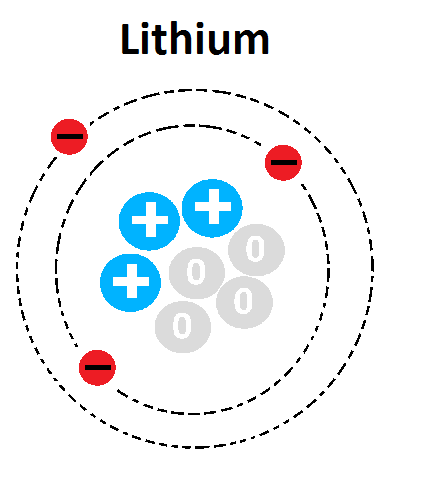
What is the atomic number of this atom?
a)
1
b)
3
c)
4
d)
7
36.

How many neutrons does C-14 contain? (tap to enlarge the image)

a)

6

b)

7

c)

14

d)

8

37.

Atoms of the same element which have a different number of neutrons are called _________________.

a)

ions

b)

isotopes

c)

quarks

d)

molecules

38.
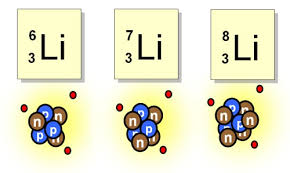
which atom has  4 neutrons?
a)
Li-6
b)
Li-7
c)
Li-8
d)
they have the same # of neutrons
39.

How many electrons are in an neutral atom with an atomic number of 50?

a)

5

b)

8

c)

50

d)

2

40.
Four isotopes of lead include lead-204, lead-206, lead-207, and lead-208.  The average atomic mass of lead is 207.2.  Which isotope of lead is likely to be the most abundant.
a)
204
b)
206
c)
207
d)
208
41.
How many neutrons does the isotope below have?     89 36Kr
a)
53
b)
36
c)
89
d)
125
42.
If X is the symbol for an element, which of the following two symbols represent    isotopes of the same element?     I. 7735X  II. 7733X  III. 8137X  IV. 8135 X
a)
I and II
b)
III and IV
c)
I and IV
d)
I and III
43.
What atom matches this electron configuration?
1s22s22p63s2
a)
Neon
b)
Magnesium
c)
Aluminum
d)
Potassium
44.
Which electron configuration belongs to Chlorine (Cl)?
a)
1s2s2p3s3p5
b)
1s2s2p3s3p6
c)
1s2s2p3s3p7
45.
What atom matches this electron configuration?
1s22s22p63s23p64s23d10
a)
Zinc
b)
Copper
c)
Nickel
d)
Germanium
46.

Which would be the correct electron configuration for the silver ion?

a)

1s2 2s2 2p6 3s2 3p6 4s2 3d10 4p6 5s1 4d9

b)

1s2 2s2 2p6 3s2 3p6 4s2 3d10 4p6 5s2 4d9

c)

1s2 2s2 2p6 3s2 3p6 4s2 4d10 4p6 5s1 5d9

d)

1s2 2s2 2p6 3s2 3p6 4s2 3d10 4p6 5s2 4d8

47.

What atom matches this electron configuration? 1s22s22p63s23p64s23d8

a)
Zinc
b)
Copper
c)
Nickel
d)
Germanium
48.

The 4 orbitals are

a)

s, p, d, f

b)

a, b, c, d

c)

2, 4, 6, 8

49.

Which would be the correct electron configuration for the Fe+4 ion?

a)

1s2 2s2 2p6 3s2 3p6 4s2 3d6

b)

1s2 2s2 2p6 3s2 3p6 4s2 3d3

c)

1s2 2s2 2p6 3s2 3p6 3d4

d)

1s2 2s2 2p6 3s2 3p6 4s1 3d6

50.

The electron configuration 1s2 2s22p6 3s23p6 represents which noble gas?

a)

neon

b)

argon

c)

helium

d)

krypton

51.
Which electron configuration belongs to Chlorine (Cl)?
a)
1s2s2p3s3p5
b)
1s2s2p3s3p6
c)
1s2s2p3s3p7