
 Worksheets
SE&E U1 Review Game
Total questions: 43
Worksheet time: 1hrs 19mins

If this ellipse were the orbit of a planet around the sun, the sun would sit at the -
Co-vertex
Vertex
Center
Focus

A celestial body or manmade object that is in orbit around another celestial body
Satellite
Magnitude
Inertia
Orbit
When orbital period increases, the orbital speed...
increases
decreases
stays the same
Which ellipse most likely has an eccentricity of 0.4 ?


Choose the ellipse that is most similar to Earth's orbit, which has an eccentricity of 0.0167.

What 3 pieces of evidence were used to support the theory of seafloor spreading?
Rock formations, age of rocks, WWII shipwrecks
Age of rocks, magnetic seafloor stripes, WWII ship logs
Rock formations, magnetic seafloor stripes, age of rocks
Radiometric dating, age of craters
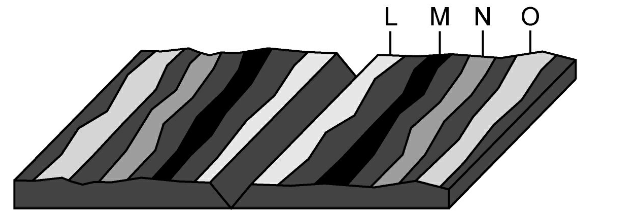
The diagram shows a mid-ocean ridge with magnetic polarity striping. Where would the oldest rock be found?
L
M
N
O
One reason Earth does not have nearly as many craters as the Moon is because -
the Moon protected the Earth from many asteroid impacts.
the Earth's magnetic field deflects incoming asteroids.
many of the Earth's craters have eroded away.
the Earth isn't as old as the Moon.
Erosion
can be caused only by wind.
only occurs on planets that have an atmosphere.
may cause planets to have more craters.
all of the above.
The number of visible craters on Earth will probably continue to decrease in the future for which of the following reasons?
Human technology that protects Earth from all meteor impacts may be developed.
Most meteors that hit Earth land in the ocean and don't leave craters.
There are not as many meteor impacts today as there were when the Earth first formed due to our atomsphere.
Earth processes like erosion and plate tectonics cover them up.
Hotspots are volcanoes that form...
at convergent plate boundaries.
at divergent plate boundaries.
at transform plate boundaries.
in the middle of a tectonic plate.
Hotspots form because...
magma is pushed to the surface at a plate boundary.
a mantle plume weakens Earth's crust.
water is pushed up to Earth's surface
a mantle plume strengthens Earth's crust.
The Earth's _____________ in broken into pieces that shift and interact where they meet up.
Crust
Mantle
Inner Core
Outer Core
Which are older - continental rocks or rocks from the ocean floor?
Continental rocks are much older.
Continental rocks are much younger.
Oceanic rocks are the same age as continental rocks.
There are no observable patterns in rock age.
Which are evidence of sea-floor spreading? Choose all.
Molten magma constantly erupting
Drilling samples of rock
Magnetic stripes
Fossil evidence
Which of the following has tectonic plates?
Mars
Earth
Jupiter
Earth's Moon

The diagram below shows how scientists think some of Earth's continents were joined together in the geologic past.
When do scientists think these continents were joined together?
Hundreds of years ago
Thousands of years ago
Millions of years ago
Billions of years ago
Compare the age of the Earth and the age of the solar system.
The Earth is older than the Solar System.
The Earth is younger than the Solar System.
The Earth is the same age as the Solar System.
Which observation about the Mid-Atlantic Ridge region provides the best evidence that the seafloor has been spreading for millions of years?
The bedrock of the ridge and nearby seafloor is igneous rock.
The ridge is the location of irregular volcanic eruptions.
Several faults cut across the ridge and nearby seafloor.
Seafloor bedrock is younger near the ridge and older farther away.

Base your answer to the following question on the diagram below. The diagram shows a model of the relationship between Earth's surface and its interior.
Mid-ocean ridges (rifts) normally form where tectonic plates are -
converging
diverging
stationary
sliding past each other
What geologic feature/event would you most likely to find at a convergent collision boundary between two pieces of continental crust?
Volcano (Volcanoes)
Mountains / Cordillera
Rift (Valley)
Island Arc
In the region where two continental plates collide, what geological feature MOST often forms?
an ocean
a volcano
a river valley
a mountain chain
A place where two plates slip past each other, moving in opposite directions, is known as a _______
transform boundary
divergent boundary.
convergent boundary.
rift valley.

This diagram shows the chain of volcanic islands near the Hawaiian hot spot. The asterisks indicate modern volcanoes; their ages are in million years [Schubert et al., 2004; Tarduno et al., 2000]. Which of the following claims about the data are most likely true?
The largest island is the oldest.
It seems that the tectonic plate on which these islands are forming is moving to the northwest.
The island of Hawaii has the most modern volcanoes.
Nihai is the island that was formed first.

This terrestrial landform is called a _____ and was caused by _____.
Crater, the collision of a meteor
Crater, the divergence of two tectonic plates
Rift, the collision of two tectonic plates
Volcano, the divergence of two tectonic plates
Select the two terms describe the time it takes for Earth to complete one circle around the sun:
Rotation
Revolution
Period
Barycenter
Gravity

Gravity on our moon is less than the gravity on earth because -
a. moon's mass is less
b. moon's mass is more
c. moon's mass is equal to Earth
d. moon has no mass

