wayground logo

Free Printable Worksheets

Font size

S
M
L
XL
Worksheets

Variation and inheritance

Total questions: 40

Worksheet time: 29mins

Name
Class
Date
1.
What are small stretches of DNA that code for traits
a)
Nucleus
b)
Chromosomes
c)
Gene
d)
Centromeres
2.
Where is all the genetic information in a cell?
a)
Nucleus
b)
Nucleotides
c)
Chromosomes
d)
Cytoplasm
3.

How many chromosomes are found in each cell of your body?

a)

46

b)

23

c)

40

d)

45

4.

Which of the following statements about chromosomes is correct?

a)

Chromosomes are long, thread-like structures

b)

Chromosomes are found in the nucleus of all cells in the human body

c)

Chromosomes contain DNA

d)

All of the above

5.
The twisted ladder shape of DNA is referred to as a ....
a)
Twizzler candy
b)
twisted ladder
c)
double helix
d)
yo mama
6.

From smallest to largest how would genetic information be organized?

a)

genes, cell, nucleus, chromosome, DNA

b)

chromosome, cell, gene, DNA, nucleus

c)

DNA/nucleotides, gene, chromosome, nucleus, cell

d)

nucleus, cell, gene, DNA, chromosome

7.
Individuals with favorable traits survive, reproduce, and pass their traits onto their offspring.  This is called
a)
Mutation
b)
Adaptation
c)
Evolution
d)
Natural Selection
8.
Natural selection as the mechanism for evolution was first proposed by what scientist?
a)
Charles Darwin
b)
Albert Einstein
c)
Steven Hawking
d)
Isaac Newton
9.
Genetic differences between organisms of the same species are
a)
Variations
b)
Adaptations
c)
Behaviors
d)
Environments
10.
All rabbits living in a particular area would be an example of a(n)
a)
population
b)
species
c)
fossil
d)
individual organism
11.
"Survival of the Fittest" describes which theory
a)
a) natural selection
b)
b) gravity
c)
c) heredity
d)
d) string theory
12.
Modern whales developed their traits through natural selection.  What occurs during the process of natural selection?
a)
Organisms choose mates from other species to create new species
b)
Breeders selectively cross organisms with desired traits
c)
Only the fittest organisms can survive and reproduce
d)
Organisms remain exactly the same over time.
13.
The example of the peppered (brown) moths living near English industrial cities demonstrates that
a)
A change in an environment can result in the evolution of species living there
b)
Evolution occurs so slowly that is it not possible to determine that it has happened in less than a million years
c)
The environment near these cities has always favored dark colored moths
14.
Any variation that can help a species survive in a given environment is called...
a)
an adapatation
b)
a characteristic
c)
a homologous structure
d)
a vestigial structure
15.
When every organism of a species has died.
a)
Evolution
b)
Natural Selection
c)
Extinction
d)
Artificial Selection
16.

Some rabbits are born that can run very fast. Some are quite slow. Rabbits are eaten by foxes. How will natural selection work?

a)

Rabbits will eat the best foxes.

b)

The foxes will eat the fastest rabbits.

c)

The foxes will eat the slowest rabbits.

d)

The foxes will eat the rabbits at random.

17.

If foxes catch and eat the slower rabbits, what will the next generation of rabbits be like, compared to the one before?

a)

They will be fluffier than the generation before.

b)

They will be faster than the generation before.

c)

They will be bigger than the generation before.

d)

They will be darker than the generation before.
18.
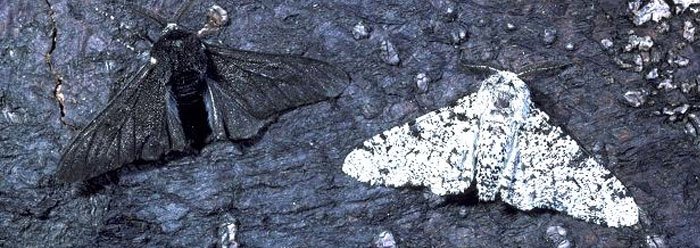
The trees these moths used to live on were white, but have been covered in soot from coal factories. Which moth will be more successful in this environment?
a)
Dark moth
b)
Light moth
c)
Both will be equally successful
d)
Neither will be successful
19.
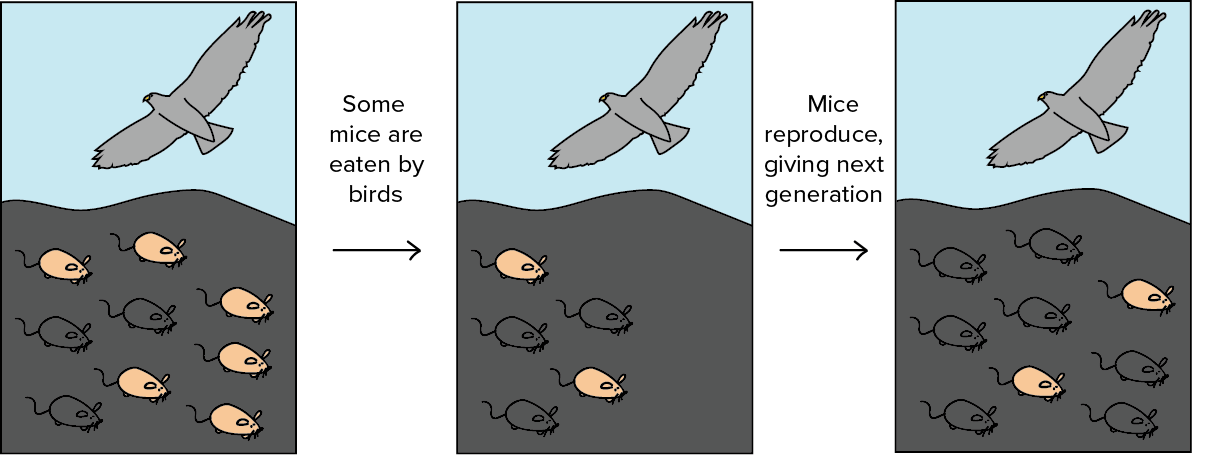
Why is the mouse population changing over time?
a)
The light mice can reproduce more successfully than the dark mice
b)
The hawks eat more dark mice than light mice because the dark mice taste better
c)
The hawks eat more light mice than dark mice because they can see the light mice more easily
d)
The hawks eat more dark mice than light mice because they can see the dark mice more easily
20.
Which of the following is NOT a reason a species may become extinct?
a)
competition
b)
reproducing
c)
habitat loss
d)
overhunting
21.

Species that are in danger of becoming extinct are called __________.

a)

endangered

b)

not lucky

c)

extinct

d)

in a jam

22.

Evidence of an animal or plant that lived a long time ago on Earth is called a ________.

a)

fossil

b)

tiger

c)

extinct

d)

endangered

23.
Humans are causing extiction in which ways?
a)
By over hunting animals for food or products.
b)
By destroying the natural habitat of species.
c)
By polluting the environments of the world.
d)
All of the above.
24.

What is Natural Selection?

a)

Favorable traits that will help one survive in the environment are passed on to offspring.

b)

All of the species surviving in their environment.

c)

Species being selected to fight.

d)

The weaker traits are passed down to offspring.

25.
When a population becomes divided by an event such as a new river forming, ____________ has occurred.
a)
Differentiation 
b)
Isolation
c)
Adaptation
d)
Separation
26.

Humans can cause species to become endangered or extinct. What other factors could cause species to go extinct? (choose all that apply)

a)

asteroid strikes

b)

disease

c)

Lack of food

d)

Better adapted competition

e)

Loss of habitat

27.
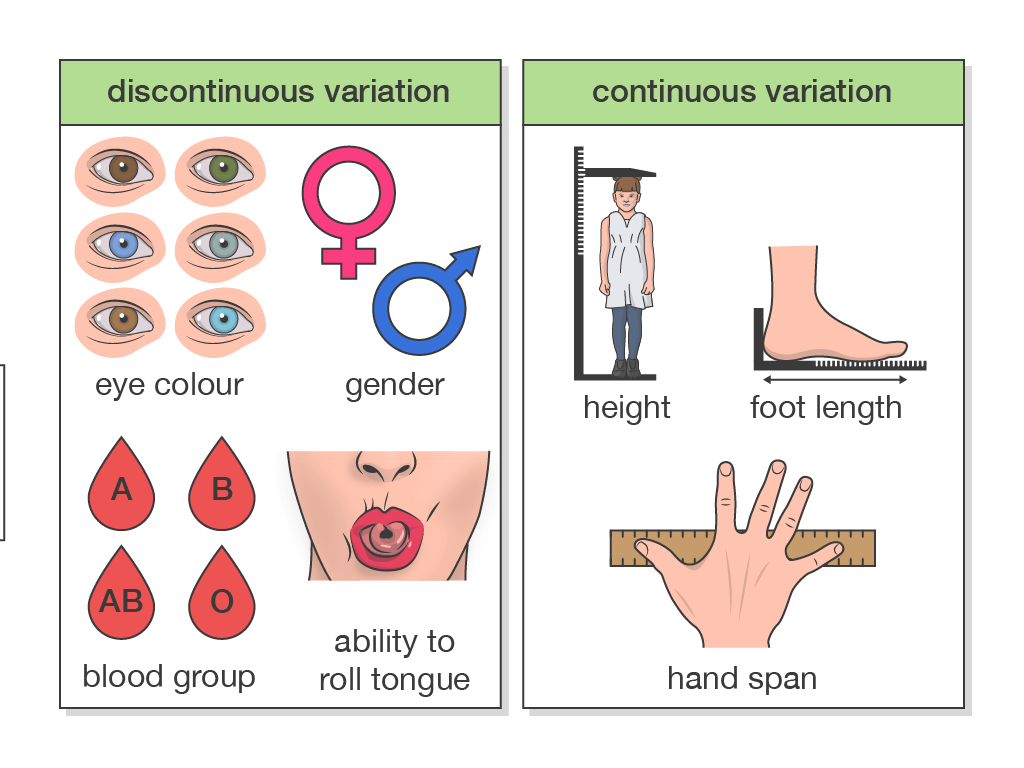
Which one of the following shows discontinuous variation?
a)
Eye colour
b)
Height
c)
Strength
d)
Weight
28.
Which one of the following shows continuous variation?
a)
Blood group
b)
Height
c)
Male or female
d)
Tongue rolling
29.
What type of graph do we use for discontinuous variation?
a)
A bell-shape
b)
Bar chart
c)
Line graph
d)
Scatter Graph
30.
What shape graph do you see for many examples of continuous variation?
a)
A straight line downwards
b)
A straight line upwards
c)
A bell-shape
d)
A flat line
31.

Which type of data would student height be categorized as?

a)

Categorical

b)

Continuous

c)

Discontinuous

d)

Normal

32.

Student eye colour could be considered what type of data

a)

Discontinuous

b)

Independent

c)

Continuous

d)

Colours

33.
Which of the following is an example of Inherited variation?
a)
Eye colour
b)
Blood type
c)
Skin colour
d)
All of the above
34.
Which of the following is an example of discontinuous variation?
a)
Weight
b)
blood type
c)
height
d)
Hand span
35.

What causes variation?

a)

inherited factors only

b)

environmental factors only

c)

inherited and environmental factors

36.

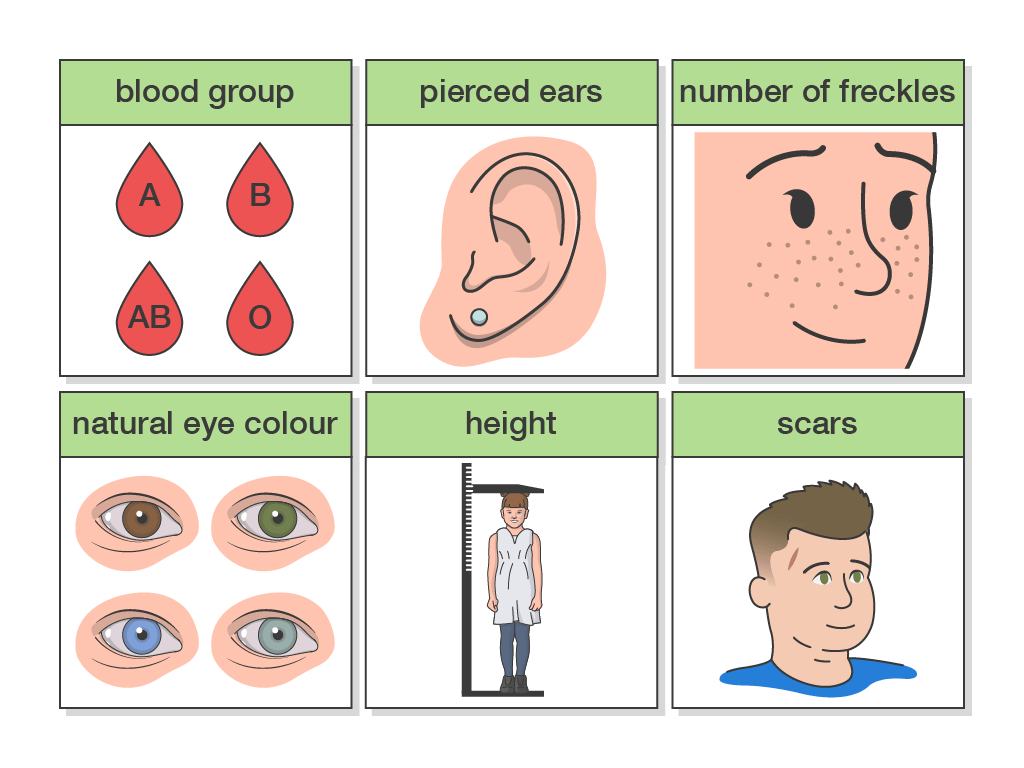
Which two characteristics show variation as a result of environmental factors only?

a)

blood group

b)

pierced ears

c)

Scar

d)

natural eye colour

e)

height

37.

For which type of variation can a measurement have any numerical value?

a)

continuous variation

b)

discontinuous variation

38.

For which type of variation are differences grouped into categories?

a)

continuous variation

b)

discontinuous variation

39.

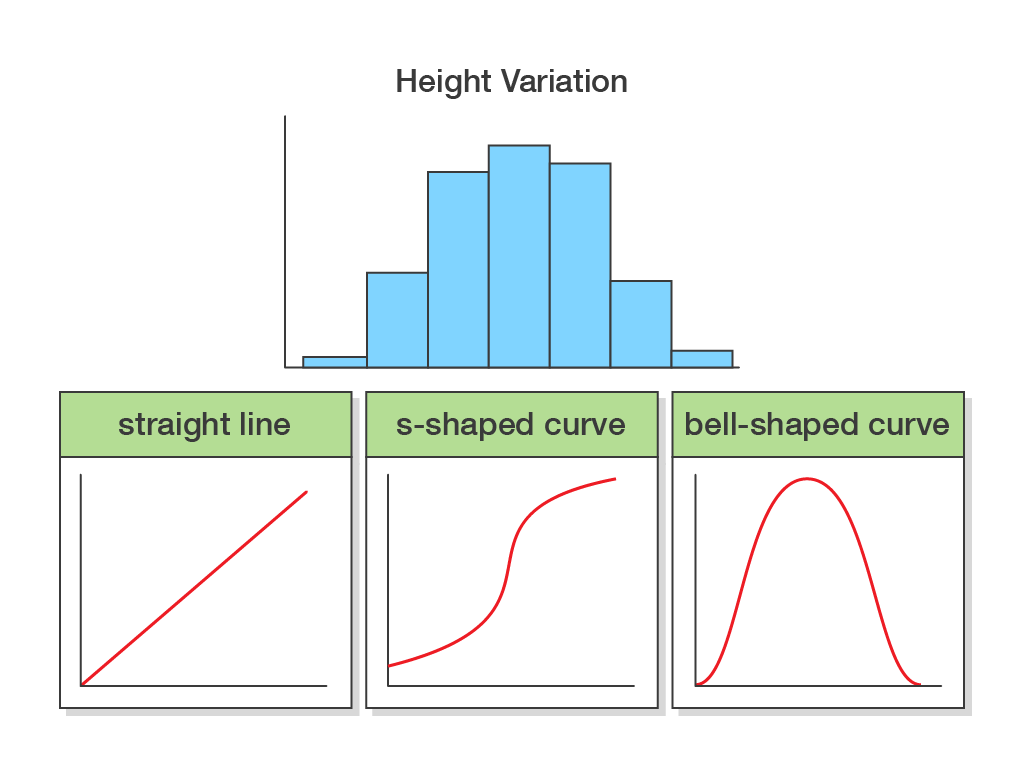
Features with continuous variation have a normal distribution curve, which is shown by the bars on the graph. What shape do the bars form when there is normal distribution?

a)

straight line

b)

s-shaped curve

c)

bell-shaped curve

40.

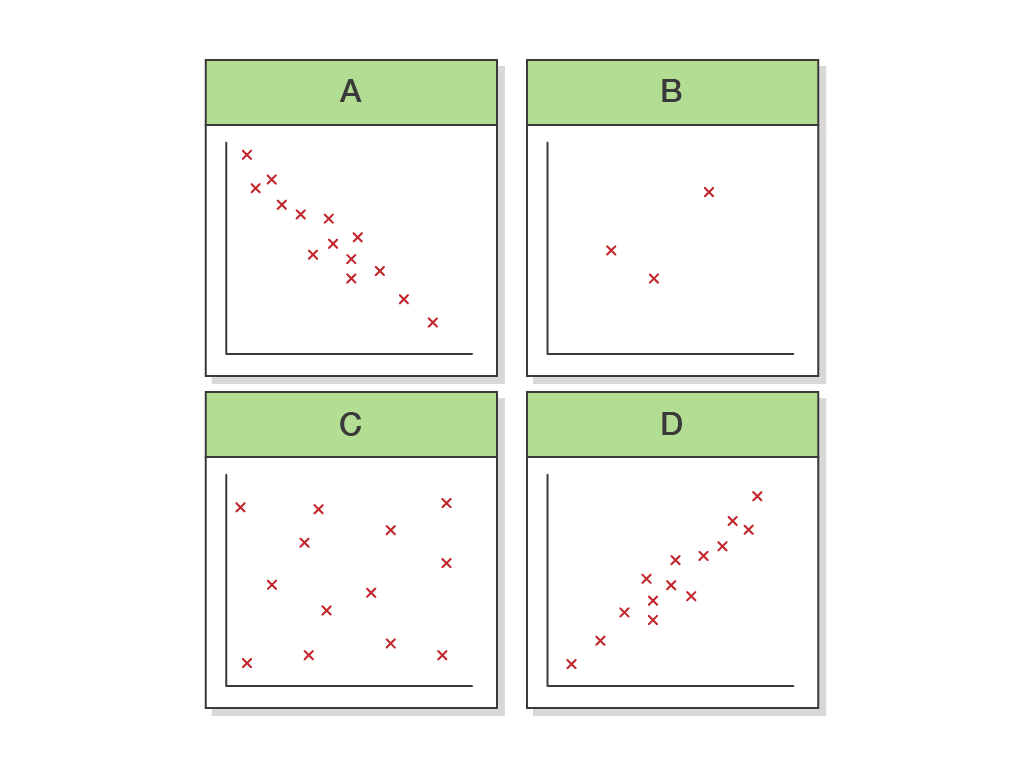
Which two scattergraphs show a correlation (relationship) between the two plotted variables?

a)

scattergraph A

b)

scattergraph B

c)

scattergraph C

d)

scattergraph D