
 Worksheets
Atomic Structure and Isotopes Review
Total questions: 53
Worksheet time: 1hrs 22mins
Name
Class
Date
1.
The atomic mass is equal to _.
a)
the number of protons only
b)
the number of neutrons only
c)
the total number of protons and neutrons
d)
the number of protons, neutrons, and electrons.
2.
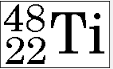
How many protons does this isotope of titanium have? Hint titanium has an atomic number of 22.
a)
48
b)
22
c)
26
d)
70
3.

What is the net charge on the element shown above?
(Calcium - atomic number 20)
(Calcium - atomic number 20)
a)
cation +1 charge
b)
cation +2 charge
c)
anion -1 charge
d)
anion -2 charge
4.

What is the atomic number of Fe? (click to see image)
a)
26
b)
55.845
c)
56
d)
None of these
5.

Carbon has an atomic number of 6 and an atomic mass of 12. Which elements are considered isotopes of carbon?
a)
Carbon-12
b)
Carbon-13
c)
Carbon-14
d)
Both Carbon-13 and Carbon-14
6.

How many neutrons does Lithium have (atomic mass = 6.94)
a)
3
b)
4
c)
6.94
d)
24.94
7.
Which phrase describes two atoms that are isotopes
a)
Same mass number, same atomic number
b)
Same mass number, different atomic number
c)
Different mass number, same atomic number
d)
Different mass number, different atomic number
8.
What is the atomic number?
a)
the number of protons in the nucleus
b)
the number of protons and neutrons in the nucleus
c)
the number of neutrons in the nucleus
d)
the number of protons in the energy levels
9.
What is the mass number?
a)
the number of protons in the nucleus
b)
the number of protons and neutrons in the nucleus
c)
the number of neutrons in the nucleus
d)
the number of protons and electrons in the atom
10.
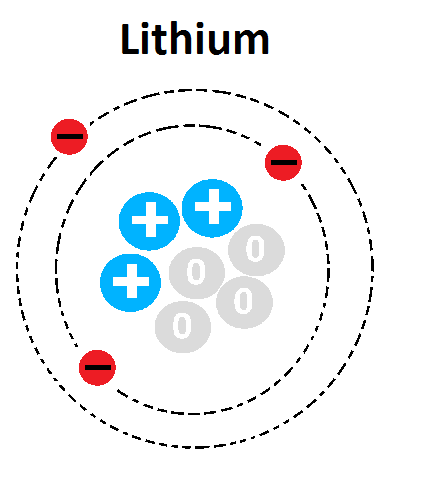
What is the atomic number of this atom?
a)
1
b)
3
c)
4
d)
7
11.
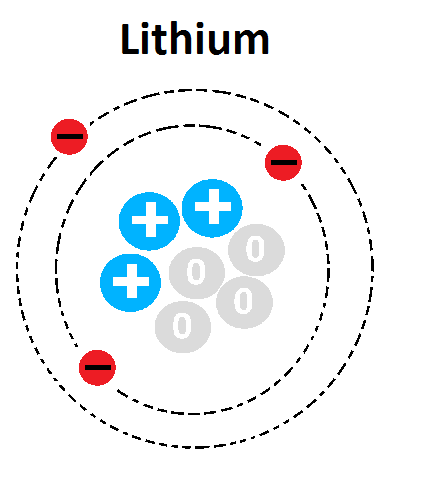
What is the mass number of this atom?
a)
1
b)
3
c)
4
d)
7
12.
Most of the mass in an atom is made up of _____________________?
a)
protons and electrons
b)
protons and neutrons
c)
neutrons and electrons
d)
electrons and quarks
13.
Which of the following determines the identity of an element?
a)
number of protons
b)
atomic mass
c)
number of neutrons
d)
number of shells
14.
What scientist is best known for his gold foil experiment?
a)
J.J. Tomson
b)
Ernest Rutherford
c)
John Dalton
d)
Democritus
15.

Bonus question: What element is this an atom of?
a)
nitrogen
b)
lithium
c)
beryllium
d)
carbon
16.
What is the standard unit of mass at the atomic level?
a)
centimeters
b)
millimeters
c)
amu
d)
milligrams
17.
What is the electrical charge of a proton?
a)
1+
b)
1-
c)
neutral
d)
2-
18.
How many particles are in the nucleus of an atom of fluorine-19?
a)
9 protons, 10 neutrons, 9 electrons
b)
9 protons, 9 neutrons
c)
9 protons, 10 neutrons
d)
19 protons, 19 neutrons
19.
Carbon-13 differs from carbon-12 by:
a)
1 extra neutron
b)
1 less neutron
c)
1 extra proton
d)
1 extra electron
20.
How many neutrons are in the isotope potassium-40?
a)
19
b)
40
c)
20
d)
21
21.
An atom is found to have 11 neutrons and 10 protons. What is the identity of the atom?
a)
neon-20
b)
neon-21
c)
sodium-21
d)
sodium-23
22.
Which of the following statements regarding subatomic particles is incorrect?
a)
Protons are positively charged particles and neutrons have no charge.
b)
The relative mass of the proton, electron and neutron the same.
c)
In a neutral atom the number of protons equals the number of electrons.
d)
Isotopes of an element have the same number of protons but a different number of neutrons.
23.
A neutral atom of the isotope 2612Mg would consist of
a)
12 protons, 26 neutrons, 26 electrons
b)
26 protons, 12 neutrons, 26 electrons
c)
26 protons, 14 neutrons, 14 electrons
d)
12 protons, 14 neutrons, 12 electrons
24.
An atom is electrically neutral when
a)
protons and neutrons are the same
b)
protons and electrons are the same
c)
neutrons and electrons are the same
d)
neutrons balance the protons and electrons
25.
Iron-60 (atomic number 26) is an isotope that is often used to study meteorites. How many neutrons does iron-60 have?
a)
26
b)
60
c)
34
d)
86
26.
Which of the following particle pairs has approximately the same mass?
a)
protons and neutrons
b)
protons and electrons
c)
neutrons and electrons
d)
protons, neutrons and electrons
27.
The element, antimony (Sb) has two major isotopes of similar abundances, both around 50%. The atomic mass of antimony is reported on the periodic table as 121.76. Choose the most likely set of mass numbers for these two antimony isotopes.
a)
Antimony-121 and Antimony-123
b)
Antimony-120 and Antimony-127
c)
Antimony-123 and Antimony 122
d)
Antimony-121 and Antimony-118
28.
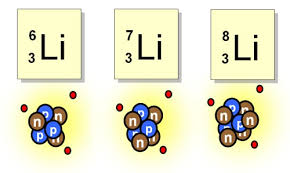
which atom has 4 neutrons?
a)
Li-6
b)
Li-7
c)
Li-8
d)
they have the same # of neutrons
29.
Four isotopes of lead include lead-204, lead-206, lead-207, and lead-208. The average atomic mass of lead is 207.2. Which isotope of lead is likely to be the most abundant.
a)
204
b)
206
c)
207
d)
208
30.

What is the name of the pictured isotope?
a)
Copper-29
b)
Copper-63
c)
Copper-34
d)
CopperWopperHopperBopper
31.

Who discovered the nucleus of an atom?
a)
JJ Thomson
b)
Ernest Rutherford
c)
John Dalton
d)
Democritus
32.

What are electrons?
a)
Massive, positively charged particles
b)
Tiny, negatively charged particles
c)
Clouds of dust in the nucleus
d)
Neutral particles around the nucleus
33.

Whose model is most similar to the solar system?
a)
Bohr
b)
Thomson
c)
Rutherford
d)
Dalton
34.

What element is represented in this Bohr Model?
a)
Carbon
b)
Hydrogen
c)
Aluminum
d)
Lithium
35.
What identifies the element?
a)
Protons
b)
Neutrons
c)
valence electrons
d)
Nucleus
36.
Which following atom has the biggest mass?
a)
Hydrogen
b)
Helium
c)
Boron
d)
Argon
37.
The first element on the periodic table is:
a)
Hydrogen
b)
Helium
c)
Oxygen
d)
Lithium
38.
Which of these have 8 outer most level electrons?
a)
Carbon
b)
Helium
c)
Neon
d)
Boron
39.
How many total electrons does element 15 have?
a)
5
b)
2
c)
8
d)
15
40.
When an atom gains an electron, it becomes-
a)
negative
b)
postive
c)
neutral
d)
a new element
41.
When an element loses an electron, it becomes?
a)
positive
b)
negative
c)
neutral
d)
a new element
42.
24.1% of all the isotopes of a an element have a mass of 75.23 amu, 48.7% have a mass of 74.61 amu, and 27.2% have a mass of 75.20 amu.
What is the average mass of this element?
What is the average mass of this element?
a)
74.92 amu
b)
24.97 amu
c)
75.01 amu
d)
74.51 amu
43.
Calcium has three different isotopes. One has a mass of 35.00 amu; another has a mass of 41.00 amu; and another has a mass of 40.00 amu. Which isotope is the most abundant of the three?
a)
40.00 amu
b)
41.00 amu
c)
35.00 amu
d)
impossible to tell
44.
Do the following atoms belong to the same element? Explain
Aluminum-27
An atom with 14 protons and 13 neutrons
Aluminum-27
An atom with 14 protons and 13 neutrons
a)
Yes because they have the same number of protons
b)
Yes because they have the same mass
c)
No because they have different number of protons
d)
No because they have different number of neutrons
45.
What is the average atomic mass?
a)
The weighted average of all the naturally occurring isotopes.
b)
the same as the mass number
c)
the number of protons and neutrons in the nucleus
d)
the mass of all the electrons in an atom
46.
A concept in dalton's atomic theory that is no longer considered true.
a)
atoms are the smallest particle
b)
atoms combine in simple whole number ratios
c)
atoms are made up of protons, neutrons and electrons
47.
Proposed the Modern Electron Cloud Model of the atom
a)
Schrodinger & Heisenberg
b)
Dalton
c)
Chadwick
d)
Rutherford
48.
Created the Planetary Model of the atom
a)
Bohr
b)
Dalton
c)
Rutherford
d)
Chadwick
49.
The only element with no neutrons in its nucleus.
a)
Oxygen
b)
Helium
c)
Hydrogen
d)
Lithium
50.

The Billiard Ball is the nickname for ________ theory.
a)
Dalton
b)
Neils Bohr
c)
JJ Thomson
d)
Ernest Rutherford
51.
JJ Thomson's theory was nicknamed _______.
a)
Billiard Ball Theory
b)
Solar System Theory
c)
Electron Cloud
d)
Plum Pudding
52.
Electron cloud is based on
a)
Quantum Mechanics
b)
Gold Foil Experiment
c)
Matter is made up of small particles called atoms
d)
Nuclear Theory
53.
What did Thomson discover?
a)
electron
b)
proton
c)
neutron
d)
electron cloud
100 %

