
 Worksheets
The History of Atomic Structure
Total questions: 31
Worksheet time: 31mins
Name
Class
Date
1.

Who believed that electrons were scattered amongst positively charged material.
a)
JJ Thomson
b)
Ernest Rutherford
c)
John Dalton
d)
Niels Bohr
2.

Believed that atoms are small, hard particles that were "indivisible"
a)
Democritus
b)
Aristotle
c)
Schrodinger
d)
Greek Philosophers
3.

Discovered that the atom has a small, dense, positively charged nucleus.
a)
Ernest Rutherford
b)
Heisenberg
c)
Democritus
d)
JJ Thomson
4.

Believed that electrons traveled around the nucleus in definite paths.
a)
Niels Bohr
b)
John Dalton
c)
Modern Atomic Theory
d)
Ernest Rutherford
5.

Determined that electron paths cannot be predicted and exist inside the Electron Cloud.
a)
Schrodinger & Heisenberg
b)
Ernest Rutherford
c)
John Dalton
d)
Democritus
6.

Believed that all atoms of the same element would be the same.
a)
John Dalton
b)
JJ Thomson
c)
Niels Bohr
d)
Modern Atomic Theory
7.

The following picture represents which atomic model?
a)
Plum Pudding
b)
Electron Cloud
c)
Planetary
d)
Billiard Ball
8.

The smallest unit of matter is called?
a)
An electron
b)
An element
c)
An atom
d)
A solid
9.
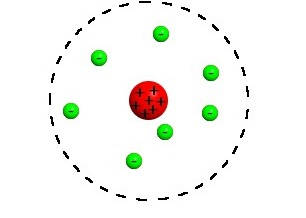
This model this model was the first to show a nucleus, consisting of protons and neutron. Electrons surround the nucleus but are not shown in distinct energy levels.
a)
The "Rutherford Model" of the atom
b)
The "Plum Pudding Model" of the atom
c)
The "Quantum Mechanical Modell" of the atom
d)
Democritus's model of the atom
10.

This was the first model of the atom ever proposed. It was simple and described atoms as tiny spheres that could not be broken down into smaller pieces.
a)
Democritus's model of the atom
b)
The "Plum Pudding Model" of the atom
c)
The "Rutherford Model" of the atom
d)
The "Quantum Mechanical Model" of the atom
11.

This model added on to previous models by showing electrons existed at certain "energy levels". However it does not accurately show what those levels look like.
a)
The "Bohr Model" of the atom
b)
The "Rutherford Model" of the atom
c)
The "Plumb Pudding Model" of the atom
d)
The "Quantum Mechanical Model" of the atom
12.

Ernest Rutherford discovered that atoms were mostly _________________.
a)
negatively charged
b)
positively charged
c)
electrons
d)
empty space.
13.
In the gold foil experiment, most of the positively charged alpha particles passed through the gold foil, but some were deflected or bounced back. What did we conclude because of this?
a)
Atoms are small indivisible spheres
b)
Atoms are mostly empty space with a small, dense, positive center
c)
Atoms have negatively charged particles which orbit the nucleus
d)
Light is a wave, not a particle
14.
His atomic model included a dense positive core in an atom, surrounded by negatively charged particles
a)
Joseph Thomson
b)
Niels Bohr
c)
Ernest Rutherford
15.
Discovered the nucleus
a)
Democritus
b)
Robert Millikan
c)
James Chadwick
d)
Ernest Rutherford
16.
What did Dmitri Mendeleev invent?
a)
Electrons
b)
Periodic Table
c)
Russian currency
d)
Calculator
17.
Created the Planetary Model of the atom
a)
Bohr
b)
Dalton
c)
Rutherford
d)
Chadwick
18.
Discovered the neutron within the atom
a)
Democritus
b)
Thomson
c)
Rutherford
d)
Chadwick
19.
"wave theory"
a)
Planck
b)
Heisenberg
c)
de Broglie
d)
Schrodinger
20.
"Electrons have particle and wave-like properties."
a)
Planck
b)
Heisenberg
c)
de Broglie
d)
Schrodinger
21.
created an equation to treat the electron as a wave
a)
Planck
b)
Heisenberg
c)
de Broglie
d)
Schrodinger
22.
The position & momentum of the electron cannot be known at the same time.
a)
Planck
b)
Heisenberg
c)
de Broglie
d)
Schrodinger
23.
"Energy is quantized."
a)
Planck
b)
Heisenberg
c)
de Broglie
d)
Schrodinger
24.

Place the following scientists in order, from earliest to latest:
Rutherford, Dalton, Bohr, Thomson
Rutherford, Dalton, Bohr, Thomson
a)
Dalton, Rutherford, Bohr, Thomson
b)
Thomson, Dalton, Rutherford, Bohr
c)
Dalton, Thomson, Rutherford, Bohr
d)
Bohr, Dalton, Rutherford, Thomson
25.
He first measured the mass and charge of an electron using the oil drop experiment.
a)
Joseph Thomson
b)
Robert Millikan
c)
John Dalton
d)
Niels Bohr
26.
How did each model of the atom help to develop the atomic theory?
a)
Each model provided opinions that were added.
b)
Each model showed different properties of the same structure.
c)
Each model showed new particles that had been discovered.
d)
Each model built upon the other to show new particles or properties of previously discovered particles.
27.
Which one of the following discoveries came first?
a)
electrons
b)
neutrons
c)
quarks
d)
atoms
28.

The picture above represents Rutherford’s __________ experiment.
a)
gold foil
b)
cathode ray tube
c)
oil drop
d)
physical and chemical changes
29.

The drawing above is Thomson’s ________.
a)
cathode ray tube experiment
b)
oil drop experiment
c)
gold foil experiment
30.
What is the name of the experiment that led to the discovery of the electron?
a)
Cathode Ray Tube (CRT) Experiment
b)
Gold Foil Experiment
c)
x-ray tube experiments
d)
mass spectroscopy
31.
Neutrons were so difficult to discover because
a)
they have a negative charge.
b)
they have a positive charge.
c)
they have no charge, making it difficult to attract to a detection device.
100 %

