wayground logo

Free Printable Worksheets

NEW

Font size

S
M
L
XL
Worksheets

KS3 Electricity

Total questions: 30

Worksheet time: 42mins

Name
Class
Date
1.
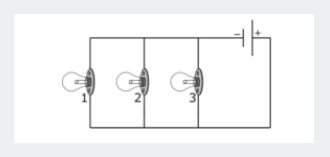
What kind of circuit is this?
a)
series
b)
parallel
2.
If bulb 1 burns out, what will occur?
a)
bulbs 2 and 3 will go out
b)
bulbs 2 and 3 receive more volts
c)
bulbs 2 and 3 will stay lit
d)
nothing will happen
3.
Does this statement best describe a parallel or a series circuit.
 
When more light bulbs are added they all remain bright. 
a)
Parallel circuit
b)
Series circuit
4.
A material in which electrons are not able to move easily is called _______.
a)
Circuit 
b)
Insulator 
c)
Resistance 
d)
Conductor
5.

What electrical charge to electrons carry?

a)

Positive

b)

Negative

c)

Neutral

6.
Three resistors, R1=3.0 ohm, R2=6.0 ohm, R3=9.0 ohm, are connected in parallel in a circuit with an 18 V battery. What is the current passing through each resistor? 
a)
11 A
b)
6A through R1 and R2, and 2 A through R3.
c)
6 A through R1, 3 A through R2, and 2 A through R3.
d)
1.6 A
7.
What is static electricity?
a)
The buildup of neutrons
b)
Electricity flowing through a current
c)
Particles staying still
d)
The buildup of electric charges on an object
8.
What will happen to the other bulbs in the circuit if one bulb goes out?
a)
The other bulbs will go out
b)
The other bulbs will get brighter
c)
The other bulbs will get dimmer
d)
They will flash on and off
9.
What will happen when a light bulb is removed from the circuit below?
a)
The remaining bulbs will go out
b)
The remaining bulbs will brighten
c)
The remaining bulbs will dim
d)
The brightness of the remaining bulbs will not change
10.

What type of circuit is shown in the picture?

a)

Series circuit

b)

Parallel circuit

c)

Open circuit

11.

What is the effect of changing the wire in a circuit from a thick wire to a thin wire?

a)

The overloaded bulb will blow out.

b)

The bulb brightness stays the same.

c)

The bulbs become dimmer.

d)

The bulbs become brighter.

12.

What is a circuit?

a)

The buildup of electric charges

b)

A complete, closed path through which electric charges flow

c)

Opposition to the flow of charge

d)

Electric potential

13.
An example of a parallel circuit is
a)
the wiring in a house
b)
a flashlight
c)
a single circular path
14.
Copper is used in wiring because it is an excellent______________ of electricity.
a)
circuit breaker
b)
conductor
c)
insulator
d)
fuse
15.

Why do electricians always wrap wires in plastic?

a)

Plastic comes in many different colors

b)

Plastic is a good electrical conductor

c)

Plastic makes the wires easy to bend

d)

Plastic is a good electrical insulator

16.
A small device that stores energy in a chemical form
a)
Complete circuit
b)
Switch
c)
Power source
d)
Battery
17.
The unit for current is the 
a)
Volt
b)
Ohm
c)
Electron
d)
Amp
18.
What is the unit for resistance?
a)
Volts
b)
Amperes
c)
Ohms
19.
If the battery produced 12.6 Volts and what would be the current flow be for a 6 Ohm resistor
a)
2.1 Amps
b)
2.4 Amps
c)
1.71 Amps
d)
15 Amps
20.
What voltage is needed to cause a 2A current flow through a 10Ω resistor?
a)
5V
b)
0.2V
c)
20V
d)
200V
21.
What resistance is needed to cause a 20A current flow because of a 100V battery?
a)
0.2Ώ
b)
2000Ώ
c)
120Ώ
d)
22.

What voltage is needed to cause a 50A current flow through a 10Ω resistor?

a)

15V

b)

500V

c)

500 kV

d)

0.2V

23.
What would the circuit resistance be if a 7.5 Amp draw was present with the engine running and the charging system producing 15 Volts
a)
15 Ohms
b)
4 Ohms
c)
0.3333 Ohms
d)
2 Ohms
24.
Tiny particles that have a negative charge
a)
protons
b)
neutrons
c)
electrons
d)
circuits
25.
You measure a potential difference with..
a)
a voltmeter
b)
An Ammeter 
26.
The charge on a proton is
a)
positive
b)
negative
c)
neutral
27.
the tendency for a material to oppose the flow of electrons
a)
current
b)
circuit
c)
resistance
d)
difference
28.
When objects have equal numbers of positive and negative charges, they are
a)
positively charged
b)
negatively charged
c)
electrically neutral
d)
unbalanced
29.
Ms. Jo Jo rubbed two balloons with a piece of wool. What will happen when the balloons are brought near each other?
a)
The balloons will repel each other.
b)
The balloons will attract each other.
c)
The balloons will become positively (+) charged.
d)
The balloons will pop.
30.
What is resistance?
a)
a measure of how difficult it is for electrons to flow
b)
a measure of the difference in electrical potential between objects that have opposite charges
c)
the continuous flow of electrons around a circuit
d)
the fast sudden movement of electrons from a negative to a positive material