
Font size
 Worksheets
Ch 1 Practice Test (Anatomy Intro)
Total questions: 36
Worksheet time: 20mins

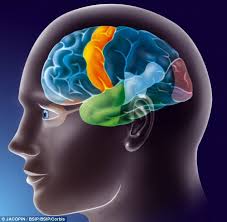
[The eyes are _______ to the brain].
Your feet are ________ to your knees.
proximal
anterior
distal
superior
The head is _____ to the shoulders.
proximal
caudal
superior
inferior

This plane divides the body into superior and inferior parts.
coronal plane
frontal plane
transverse plane
sagittal plane
The study of the structure and organization of living organisms / Focuses on identifying and describing the different parts of the body.
Anatomy
Physiology
The study of how the body functions and works. / Explores how different body parts and systems interact and contribute to overall bodily functions.
Anatomy
Physiology
How are anatomy and physiology related?
Anatomy and physiology are unrelated studies
The heart (physiology) is a muscular organ that pumps blood (anatomy) to the rest of the body
Understanding how the body functions helps us understand its structure
Understanding the structure of body parts helps us understand how they function
Which of the following statements regarding atoms and molecules is correct?
Select the two correct answers.
Atoms combine to form molecules
Examples of molecules include water, proteins, and carbohydrates
Atoms are larger than molecules
Molecules are the smallest units of matter in the body
Groups of similar cells working together, examples include epithelial, connective, muscle, and nervous.
cells
organs
organ system
tissue
Basic units of life that contain organelles that perform specialized tasks.
cells
organs
organ system
tissue
Composed of different types of tissues working together, examples include the heart, lungs, liver, and brain.
cells
organs
organ system
tissue
What does growth refer to in an organism?
Ability to respond to stimuli
Increase in size or number of cells
Ability to produce offspring
Ability to change position or move internal parts
Which of the following are examples of responsiveness in living organisms?
Select the two correct answers.
A seed sprouting into a plant
Pulling your hand away from a hot stove
Obtaining and utilizing oxygen to release energy
A baby growing into an adult
Plants turning towards sunlight
The movement of fluids, such as blood, throughout the body to transport nutrients and oxygen.
circulation
digestion
respiration
excretion
The elimination of waste products produced during metabolism.
circulation
digestion
respiration
excretion
The process of obtaining and utilizing oxygen to release energy from nutrients.
circulation
digestion
respiration
excretion
What is homeostasis?
The body's ability to adapt to changes in the external environment
The body's ability to maintain a stable internal environment
The body's ability to maintain a stable external environment
The body's ability to adapt to changes in the internal environment
The ideal or desired value for a specific variable within the body.
Set Point
Control Center
Effectors
Receptors
Organs or tissues that bring about a response to restore the variable back to its set point.
Set Point
Control Center
Effectors
Receptors
A specialized structure such as the brain, spinal cord, or specific glands that compares the information received from receptors to the set point and activates effectors.
Set Point
Control Center
Effectors
Receptors
Sensors located throughout the body that detect changes in the internal or external environment.
Set Point
Control Center
Effectors
Receptors
which cuts the body into symmetrical left and right sides?
transverse
frontal
parasagittal
sagittal/ midsagittal
What are the two main divisions of the body?
Pelvic and Appendicular divisions
Axial and Appendicular divisions
Cranial and Vertebral divisions
Thoracic and Abdominal divisions
Which division includes the head, neck, and trunk?
vertebral division
cranial division
axial division
appendicular division
Thoracic Cavity
Spinal Cord
Brain
Stomach, Liver, Intestines, and Kidneys
Heart and Lungs
Which of the following statements correctly apply the relative positions in the body according to the anatomical position?
Select the two correct answers.
The heart is deep within the chest cavity
The chest is on the posterior side of the body
The ears are medial to the nose
The fingers are proximal to the wrist
The head is superior to the shoulders
A specialized subunit or structure within a cell that has a specific function.
anatomy
organelle
metabolism
appendages
Any external part of an organism that protrudes from its body and has a particular function.
anatomy
organelle
metabolism
appendages

Use the diagram below for the following questions:
A = ?
Receptors
Control Center
Effector
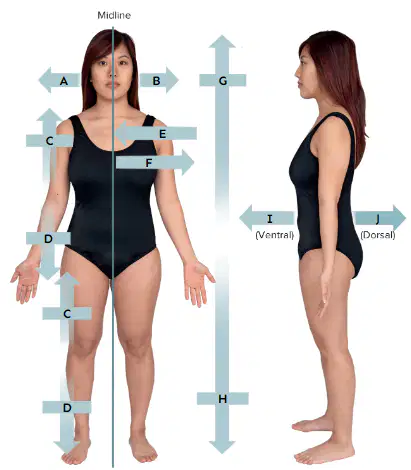
Use the diagram below for the following questions:
C = ?
Proximal
Distal
Superior
Medial
Posterior
Use the diagram below for the following questions:
J = ?
Proximal
Distal
Superior
Medial
Posterior
Use the diagram below for the following questions:
B = ?
Superior
Inferior
Right
Left

