wayground logo

Free Printable Worksheets

NEW

Font size

S
M
L
XL
Worksheets

review for mid term

Total questions: 75

Worksheet time: 2hrs 48mins
Name
Class
Date
1.
Testing a hypothesis often involves a(n):
a)
answer
b)
experiment
c)
problem
d)
safety check
2.
What is a hypothesis?
a)
A hypothesis is the right answer to an experiment.
b)
A hypothesis is the wrong answer to an experiment.
c)
A hypothesis is an educated guess.
d)
I don't know.
3.
If the Earth moved farther away from the Sun, what would probably happen?
a)
There would be colder weather
b)
There would be more seasons
c)
There would be no moon
d)
There would be no tides
4.
About how long does it take Earth to make one complete orbit (revolution) around the Sun?
a)
24 hours
b)
7 day
c)
1 month
d)
1 year
5.
During which season is the northern hemisphere tilted toward the Sun?
a)
Summer
b)
Fall
c)
Winter
d)
Spring
6.
During which two seasons is neither hemisphere of Earth tilted toward or away from the Sun?
a)
Summer and Winter
b)
Winter and Spring
c)
Fall and Winter
d)
Fall and Spring
7.
What causes the seasons of the year?
a)
The tilt of Earth on its axis
b)
The rotation of the Moon around Earth
c)
The spinning of Earth on its axis
d)
The northern and southern hemisphere
8.
Which of the following is the result of the rotation of Earth?
a)
Cloud formation
b)
Day and night
c)
The seasons
d)
Weather
9.
Spinning of Earth on its axis.
a)
Rotation
b)
Revolution
10.
Waxing means...
a)
Growing
b)
Dying
c)
Losing light
d)
Moving
11.
Which planet is closest to the sun?
a)
Uranus
b)
Mercury
c)
Neptune
d)
Earth
12.
Which planet is farthest from the sun?
a)
Neptune
b)
Pluto
c)
Earth
d)
Uranus
13.
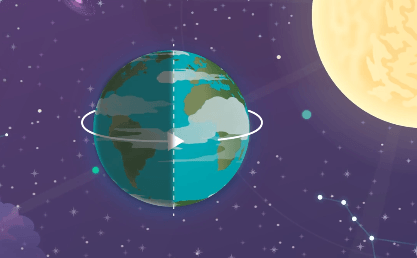
Which of the following is best shown in the picture?
a)
Earth's revolution
b)
A month on Earth
c)
A year on Earth
d)
Earth's rotation
14.
Which of the following do the blue arrows represent in the picture?
a)
A day on Earth
b)
Earth's rotation around the Sun
c)
Earth's revolution around the Sun
d)
A month on Earth
15.
Day and night are caused by _______________.
a)
Earth's rotation
b)
Earth's revolution
c)
Moon's revolution
d)
Moon's rotation
16.
List the following items from smallest to largest.
a)
universe, solar system, galaxy
b)
galaxy, solar system, universe
c)
solar system, galaxy, universe
d)
solar system, universe, galaxy
17.
How many planets are in the solar system?
a)
10
b)
8
c)
9
d)
7
18.
The Earth is rotating on its axis, creating _____
a)
the 12 months
b)
the years
c)
the seasons
d)
day and night
19.
When the Earth completes a full orbit around the Sun, it has completed _____ rotations or days
a)
7
b)
30
c)
91
d)
365
20.

Which of these cycles is a direct result of Earth's rotation?

a)

Day and Night

b)

Moon Phases

c)

Rainfall and evaporation

d)

Seasons

21.
The earth is a tilted planet.  What is the degree of tilt?
a)
Approximately 25 degrees
b)
Exactly 25 degrees
c)
23.5 degrees
d)
90 degrees with respect to the sun
22.
The outermost solid layer of the Earth is called the
a)
mantle
b)
outer core
c)
inner core
d)
crust
23.
This layer of the Earth is found between the core and the crust.
a)
mantle
b)
outer core
c)
inner core
d)
crust
24.
This is the outermost, rigid layer of the Earth, made up of two parts, is divided into pieces call tectonic plates.
a)
Inner Core
b)
Asthensophere
c)
Lithosphere
d)
Outer Core
25.
The solid, dense center of our planet that extends from the bottom of the outer core to the center of the Earth.. 
a)
mantle
b)
outer core
c)
inner core
d)
crust
26.
Identify the letter in the diagram.  Identify letter F
a)
Lithosphere
b)
Asthenosphere
c)
Mantle
d)
Outer Core
27.
Which layer is the thickest?
a)
Crust
b)
Mantle
c)
Core
d)
All of them are the same size
28.
What are the three main layers of the Earth?
a)
Center, Middle, Outer
b)
Center, Mantle, Crush
c)
Core, Mantle, Crust
d)
Core, Middle, Crush
29.
What type of features are associated with a divergent boundary?
a)
Rift valleys
b)
Volcanic mountains
c)
Fold mountains
d)
Fault block mountains
30.
The San Andréa fault in California is one example of a...  
a)
Divergent boundary
b)
Convergent boundary
c)
Transform boundary
d)
All of the above
31.

The process by which the ocean floor sinks beneath a deep-ocean trench and back into the mantle is known as _______

a)

convection.

b)

continental drift.

c)

subduction.

d)

conduction.

32.

The geological theory of _______ states that pieces of Earth’s lithosphere are in constant, slow motion.

a)

subduction

b)

plate tectonics

c)

deep-ocean trenches

d)

sea-floor spreading

33.

A place where two plates slip past each other, moving in opposite directions, is known as a _______

a)

transform boundary

b)

divergent boundary.

c)

convergent boundary.

d)

rift valley.

34.

The place where two plates come together is known as a _______

a)

transform boundary.

b)

divergent boundary.

c)

convergent boundary.

d)

rift valley.

35.

Below is a picture of sea-floor spreading. How are the ocean crusts moving?

a)

Converging

b)

Diverging

c)

Sliding

d)

No movement

36.
What are Tectonic Plates?
a)
A continent 
b)
The Trees in Vietnam 
c)
ThE PlaTES That MoVE uNdERGRound :)
d)
The Plates that move the Continents
37.
What is Pangaea?
a)
the name of a German scientist
b)
the name of the super-continent that existed millions of years ago
c)
another name for continental drift
d)
the name of an ancient fossil
38.
A break in Earth's crust along which rocks move is called a ________.
a)
plate
b)
rift
c)
fault
d)
breach
39.
The process by which molten material adds new oceanic crust to the ocean floor is called ___________.
a)
Divergent boundary
b)
Sea-floor spreading
c)
Convergent boundary
d)
Renovating 
40.

What type of event will occur at this boundary?

a)

Earthquake

b)

Volcano Eruption

c)

Tornado

d)

Mountain Building

41.

A divergent boundary occurs when plates ....

a)

Pull apart

b)

Come together

c)

Slide past each other

d)

subducting

42.

Which of the following is the name of the ancient supercontinent formed 28 Million Years ago.

a)

Pangea

b)

Gondwanda

c)

Laurasia

d)

Neverland

43.
What is molten rock that has formed deep within the Earth?
a)
Hot Spot
b)
Magma
c)
Lava
d)
Volcano
44.
What is molten rock that has reached the Earth's surface?
a)
Aa
b)
Lava
c)
Magma
d)
Pahoehoe
45.
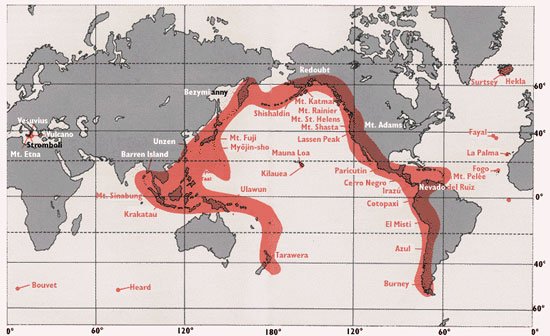
Where are most volcanoes found?
a)
Southern Hemisphere
b)
Ring of Fire
c)
Mid-Atlantic Ridge
d)
Hot Spots
46.
What is the definition of dormant?
a)
sleeping
b)
extinct
c)
active
d)
invisible
47.
What are scientists that study volcanoes called?
a)
doctor
b)
vet
c)
volcanologist
d)
volcano scientist
48.
This is the name for the chain of volcanos around the edge of the Pacific Plate.
a)
Circle of Fire
b)
Ring of Lava
c)
Ring of Fire
d)
Circle of Magma
49.
The process by which water, wind, ice, and changes in temperature break down rock into fragments called sediments.
a)
Deposition
b)
Erosion
c)
Weathering
d)
Igneous Rock
50.
Rock that forms when minerals form from solutions or sediment from older rocks get pressed and cemented together.
a)
Sedimentary Rock
b)
Metamorphic Rock
c)
Igneous Rock
51.
The process by which metamorphic rocks are formed...
a)
heat and pressure
b)
compaction and cementation
c)
melting and cooling
52.
The process by which igneous rocks are formed...
a)
heat and pressure
b)
melting and cooling
c)
compaction and cementation
53.
rock altered, changed, by pressure and heat
a)
sedimentary rock
b)
metamorphic rock
c)
igneous
d)
erosion
54.
The name rock is given when it is broken down into smaller pieces.
a)
texture
b)
weathering
c)
sediment
d)
erosion
55.
What two processes make sediment?
a)
Weathering
b)
Erosion
c)
Weathering & Erosion
56.
The process by which sediment is moved from one place to another.   Can be caused by water, wind, ice, and gravity.
a)
Rock Cycle
b)
Uplift
c)
Deposition
d)
Erosion
57.
This rock was formed by lots of fossils that settled on top of each other over time. What type of rock is this?
a)
Sedimentary
b)
Igneous
c)
Metamorphic
58.
What are the 3 major types of rocks?
a)
Igneous, Metamorphic, Sedimentary
b)
Metamorphic, Igneous, Cementation
c)
Brown, Red, Gray
d)
Streak, Hardness, Breakage
59.
The process in which dissolved minerals crystallize and glue sediment together.
a)
compaction
b)
deposition
c)
organic rock
d)
cementation
60.
The process when rocks break into smaller pieces due to exposure to natural elements is called
a)
erosion
b)
weathering
c)
sediments
61.
Extreme Heat and Pressure creates a _________ rock.
a)
Igneous
b)
Metamorphic
c)
Sedimentary
d)
Mineral
62.
What is it called when plants give off water vapor as a waste product?
a)
condensation
b)
evaporation
c)
sublimation
d)
transpiration
63.
Where is most water found on Earth?
a)
glaciers
b)
lakes
c)
rivers
d)
oceans
64.
What source of energy evaporates the most water from Earth’s surface?
a)
volcanoes
b)
the sun
c)
lightning
d)
wind
65.
What is water doing when it is changed to water vapor?
a)
evaporating
b)
condensing
c)
precipitating
d)
runoff
66.
What is water vapor doing when it changes to water?
a)
evaporating
b)
condensing
c)
precipitating
d)
runoff
67.
What is the process of water droplets or ice crystals falling from the sky?
a)
evaporating
b)
condensing
c)
precipitating
d)
runoff
68.
What is water that flows in rivers and streams into the oceans and lakes?
a)
evaporating
b)
condensing
c)
precipitating
d)
runoff
69.
Where does condensation occur in the water cycle?
a)
clouds forming
b)
ocean water changing to water vapor
c)
water flowing down a river
d)
underground water soaking into soil
70.
What is the energy source for the water cycle?
a)
the sun
b)
the earth
c)
water
d)
the moon
71.
Which of these is an example of precipitation?
a)
snow
b)
air
c)
clouds
d)
vapor
72.
Snow, sleet, hail, and rain are all examples of  ________________. 
a)
evaporation
b)
condensation
c)
accumulation
d)
precipitation
73.
What is the water cycle?
a)
the 3 forms of water
b)
the movement of water on, above, or below the surface of the Earth
c)
when water melts
d)
when clouds form
74.
What is water doing when it is changed to water vapor? 
a)
Evaporating
b)
Condensing
c)
Precipitating
75.
What is water doing when it changes to water? 
a)
Evaporating
b)
Condensing
c)
Precipitating