
 Worksheets
Earth Moon and Sun System
Total questions: 73
Worksheet time: 58mins
About how long does Earth take to rotate once on its axis?
365 days
6 months
24 hours
1 month
27 days
How many moons does Earth have?
4
1
7
0
Earth is a
star
planet
moon
eclipse
The moon orbits, or circles, the Earth.
True
False
Earth ________ on it's axis.
rotates
swings
eclipse
terrestrial
The sun is a ….
planet
star
moon
All of the planets in our solar system orbit around the sun.
True
False
The sun provides _______ and ________.
light and water
light and energy
energy and waves
energy and rings
The sun is located at the _______ of our solar system.
outside
left
right
center
The moon gives off it's own light.
True
False
Earth's rotation causes __________ .
day and night
spring, summer, fall, and winter
rainy and dry seasons
solar eclipses
About how long does it take for Earth to orbit the Sun?
24 hours
1 day
28 days
365 days
The imaginary line that runs through the north and south poles of Earth is the __________ .
equator
revolution
axis of Earth
orbit of Earth
The __________ is at the center of the Solar System.
galaxy
moon
earth
Sun
I am a medium sized star. Who am I?
Sun
Earth
Moon
I usually take 365 days to orbit the Sun. Who am I?
Sun
Earth
Moon
The gravitational pull of moon keeps the Earth orbiting around it.
true
false
The gravitational pull of the sun keeps ____ orbiting around it.
moon
Earth
What orbits around the Earth?
sun
moon
The moon is made of cheese.
true
false
The sun provides _______ and ___________ for the Earth.
sun, light
heat, light
food, light
light, earth
What is the sun?
a star
a comet
a planet
an asteroid
An ____________ is a path followed by an object as it revolves around another object.
orbit
planet
star
sunrise
What is the shape of Earth's orbit around the Sun?
(a)
What is the shape of Moon's orbit around the Earth?
(a)
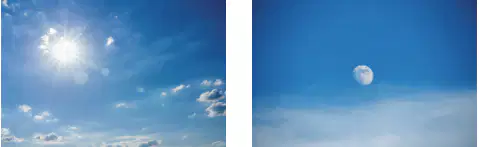
In these photos, the Moon and the Sun appear to be the same size. Which statement best explains the photos?
The Moon and the Sun are truly the same size.
The Sun is larger, but it is farther away from Earth.
The Moon is larger, but it is farther away from Earth.
The Sun is smaller and is closer to Earth.
Which orbit represents the length of one year?
the orbit of Earth around the Moon
the orbit of the Sun around Earth
the orbit of the Moon around Earth
the orbit of Earth around the Sun
Which events make up the system in space with Earth, the Sun, and the Moon? Select two answers.
Earth revolves around the Sun.
The Sun revolves around Earth.
The Moon revolves around Earth.
The Moon revolves around the Sun.
What is another word for REVOLVE?
(a)
What is the diameter of the Earth using Moons?
1.3 million Moons
64.3 million Moons
440 Moons
4 Moons
What is the diameter of the Sun using Moons?
1.3 million Moons
64.3 million Moons
440 Moons
4 Moons
What is the volume of the Sun using Moons?
1.3 million Moons
64.3 million Moons
440 Moons
4 Moons
What is the diameter of the Sun using Earth?
1.3 million Earths
64.3 million Earths
440 Earths
110 Earths
What is the volume of the Sun using Earth?
1.3 million Earths
64.3 million Earths
440 Earths
110 Earths
How many moons does Earth have?
4
1
7
0
The moon orbits, or circles, the Earth.
True
False

How many days does it take the Earth to revolve around the Sun?
30 days
365 days
100 days
40 days
What does the Sun provide earth? Choose 2
Air
Light
Heat
Water

What does the picture show?
the relationship between the planets and the Sun
the relationship between Earth and the Sun
the relationship between the Sun, Moon, and Earth
Which object in this system is the largest?
Sun
Earth
Moon
Which object in this system is the smallest?
Sun
Earth
Moon
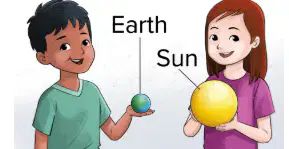
Lionel and Patrice are modeling the system formed by Earth and the Sun. Which step should they follow?
Move the Sun in an orbit around Earth.
Move Earth in an orbit around the Sun.
Move Earth back and forth along a straight path to the Sun.
Move the Sun back and forth along a straight path to Earth.

Which of these cycles is a direct result of Earth's rotation?
Day and Night
Moon Phases
Rainfall and evaporation
Seasons


Venus ( thick atmosphere that traps in heat) ((hottest planet))
1st
2nd
3rd
4th


Mars (gets its reddish color from the iron in the dust and sane)
1st
2nd
3rd
4th

Jupiter ( giant red spot is a storm)
5th
6th
7th
8th
Saturn
5th
6th
7th
8th


Inner Planets- select all that apply
dense core
rocky
few moons
thin atmosphere
smaller than outer planets
Outer Planets- select all that apply
small inner cores
larger
gaseous
many moons
temperatures are colder than inner planets
How many planets are in our solar system?
4
8
1
0
Which is true about our planets?
They all orbit the Sun.
They all have gaseous surfaces.
They are all the same size.
They all have rocky surfaces.
What are the inner planets?
Mercury, Venus, Earth, and Mars
The Sun, Moon, and Earth
Jupiter, Saturn, Uranus, and Neptune
What are the outer planets?
Mercury, Venus, Earth, and Mars
The Sun, Moon, and Earth
Jupiter, Saturn, Uranus, and Neptune

What planets are being shown in the image below?
inner planets
outer planets

Which planets are being shown in the image?
inner planets
outer planets
What is the nickname for the inner planets?
Gas Giants
Rocky Planets
Dwarf Planets
What is the nickname for the outer planets?
Gas Giants
Rocky Planets
Dwarf Planets
What do all inner planets have in common? (Choose TWO answers)
smaller in size
have water on them
have gaseous surfaces
have rocky surfaces
What do all outer planets have in common? (Choose TWO answers)
smaller in size
larger in size
have gaseous surfaces
have rocky surfaces

