wayground logo

Free Printable Worksheets

Font size

S
M
L
XL
Worksheets

Force & Motion Practice

Total questions: 160

Worksheet time: 2hrs 20mins

Name
Class
Date
1.
What is a PUSH or PULL of an object?
a)
Motion
b)
Force
c)
Friction
d)
Gravity
2.

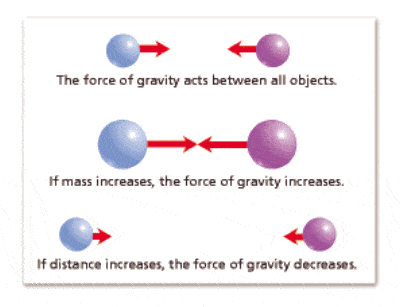
How is gravity affected by mass?

a)

the larger the mass of the object, the greater the gravity

b)

small objects have no gravity

c)

gravity is not affected by mass of objects, whether large or small

d)

the more the mass of the object, the less the gravity
3.
Why does a rolling ball stop?
a)
Gravity
b)
Friction
c)
Waterfalls
d)
Sand
4.
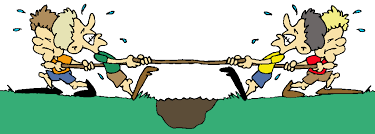
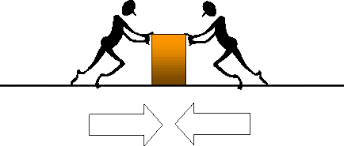
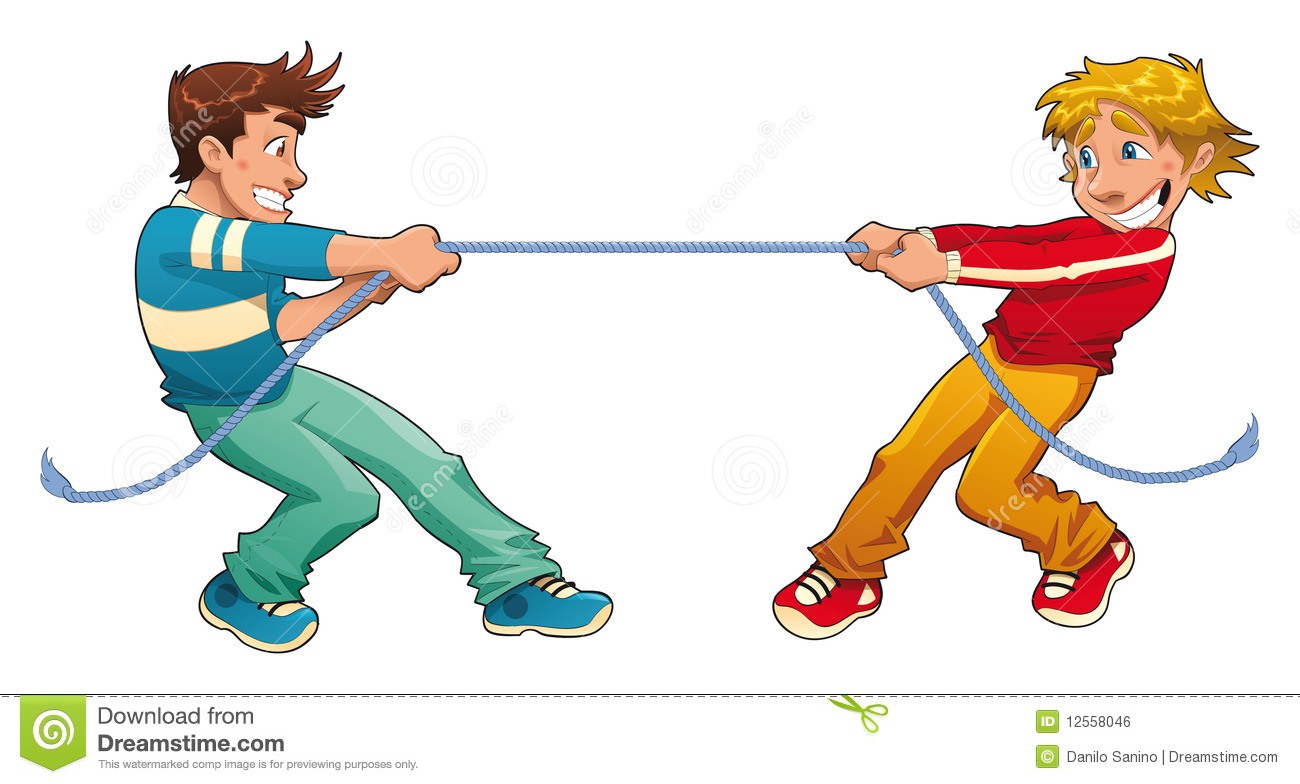
If these boys are pulling with the same amount of force.  What will happen?
a)
The boy in blue will win.
b)
They will not move at all.
c)
The boy in red will win.
d)
Both will fall down.
5.
What pulls a ball back to earth?
a)
Gas
b)
Gravity
c)
Friction
d)
Molecules
6.
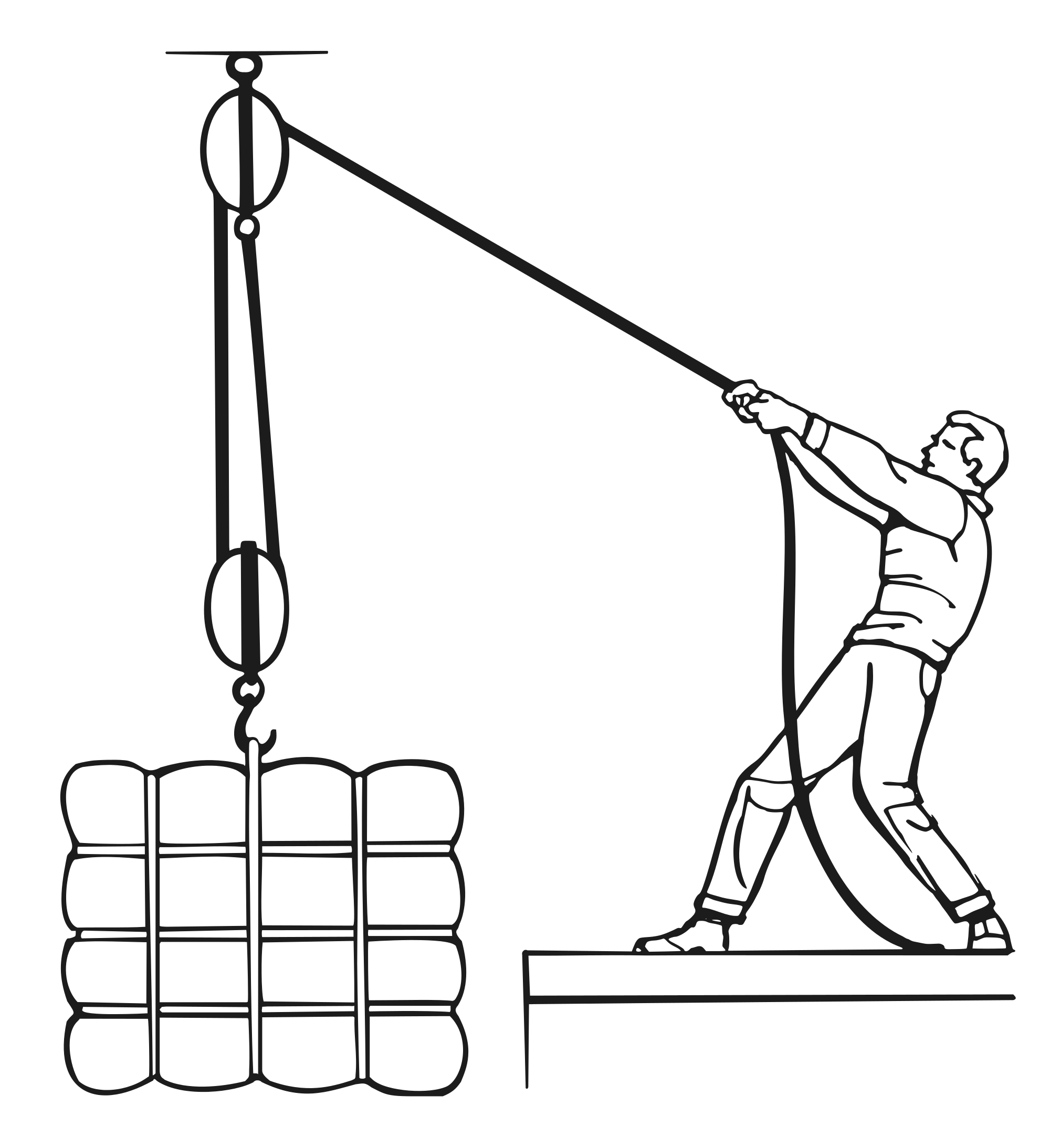
If you pull the cord, what direction will the box move?
a)
Up
b)
Down
c)
Left
d)
Right
7.

Which will be different on the moon?

a)

Mass of an object

b)

Weight of an object

c)

Volume of an object

d)

None of them

8.

A person weighs _____ on the moon than they do on Earth.

a)

less

b)

more

c)

the same

d)

No idea

9.

An object at rest will stay at rest unless...

a)

acted upon by energy

b)

acted upon by an outside force

c)

acted upon by waves

d)

acted upon by light

10.

Another way to think about the term force:

a)

push and pull

b)

up and down

c)

give and take

d)

po-ta-to and pa-ta-to

11.

On which surface will a toy car travel the farthest?

a)

Carpet

b)

Polished Wood

c)

Ice

d)

Sand paper

12.
Friction is a force that acts in an ___________ direction of movement.
a)
similar
b)
opposite
c)
parallel
d)
west
13.
What is MOVEMENT?
a)
Inertia
b)
Force
c)
Work
d)
Motion
14.
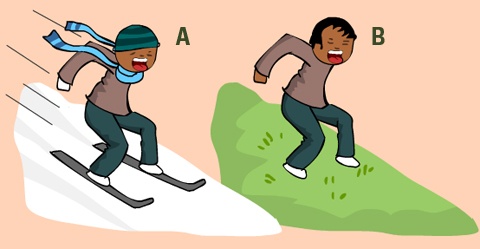
Why is it harder for the boy in Image B to get down the hill?
a)
Motion
b)
Friction
c)
Work
d)
Displacement
15.
An object may move when a _______ is applied to it. 
a)
force
b)
gravity
c)
friction
d)
speed
16.

_______ is a force that acts between two objects which are touching. This force slows any movement between the two objects.

a)

pressure

b)

magnetism

c)

friction

d)

gravity

17.
Is gravity a push or a pull?
a)
push
b)
pull
c)
neither
d)
both
18.
What is one way to reduce friction?
a)
Put sandpaper between the surfaces that touch.
b)
Push the surfaces closer together.
c)
Shine a light on the surfaces.
d)
Put a slippery substance between the surfaces.
19.
Which has the least friction?
a)
snowboard on a snowy hill
b)
running on the playground
c)
sandpaper on wood
d)
a racer on a track
20.
What is a force that works AGAINST MOTION?
a)
Force
b)
Motion
c)
Gravity
d)
Friction
21.

Who discovered gravity?

a)

Isaac Newton

b)

Albert Einstein

c)

Benjamin Franklin

d)

Aaron Abel

22.
___ is created when friction occurs.
a)
Cold
b)
Heat
c)
Gravity
d)
Friction
23.

What is gravity?

a)

A force

b)

Energy

c)

A push

d)

All of them

24.

Without gravity we would________.

a)

Float away

b)

Stay in the ground

c)

Nothing would happen.

d)

I don't know

25.

Which has more mass, Earth, you or the Moon?

a)

Earth

b)

Moon

c)

The same

d)

You

26.

Where can you jump higher, on Earth, Jupiter, Uranus or on the Moon?

a)

Earth

b)

Moon

c)

Jupiter

d)

Uranus

27.

What is mass?

a)

Amount of space that object has

b)

Amount of gravity acts on an object

c)

Amount of matter contained in the object

d)

None of them

28.
Rubbing your hands together is a simple example of ___.
a)
Force
b)
Friction
c)
Gravity
d)
Speed
29.
___ is created when friction occurs.
a)
Cold
b)
Heat
c)
Gravity
d)
Friction
30.
Which would require the most force to move?
a)
a toy car
b)
a sleeping cat
c)
a science book
d)
a chair with a friend sitting in it
31.

Definition of force

a)

how far something travels

b)

how fast something moves

c)

something that causes a change in motion (a push or pull)

d)

force that works against motion as objects rub together

32.

Definition of friction

a)

force that pulls objects toward Earth's surface

b)

how fast something moves

c)

force directly exerted on an object

d)

force that works against motion as surfaces rub together

33.

Definition of air resistance

a)

force that pulls objects toward's Earth's surface

b)

force in liquid that keeps objects afloat

c)

frictional force air exerts against a moving surface

d)

force directly exerted on an object

34.

Definition of gravity

a)

force that pulls objects toward Earth's surface

b)

force in liquid that keeps objects afloat

c)

force directly exerted on an object

d)

frictional force air exerts against a moving object

35.

How could you make something move faster?

a)

push with less force

b)

push with more force

c)

make a wider shape

d)

add mass

36.

What would happen to the motion of a car traveling at 60mph if a strong wind wind was blowing on its front?

a)

It would speed up.

b)

It would go backward.

c)

It would slow down.

d)

It would stay at the same speed.

37.

Students are racing mail carts across the parking lot. Each student pushes with the same force and for the same amount of time. Which cart will go the fastest?

a)

a full cart pushed by one kid

b)

a full cart pushed by two kids

c)

an empty cart pushed by one kid

d)

an empty cart pushed by two kids

38.
What is the name for a push or pull?
a)
A movement
b)
A force
c)
Speed
d)
Density
39.

What is a force that works AGAINST MOTION?

a)

Force

b)

Motion

c)

Gravity

d)

Friction

40.

Why does a rolling ball stop?

a)

Gravity

b)

Friction

c)

Waterfalls

d)

Sand

41.

What pulls a ball back to earth?

a)

Gas

b)

Gravity

c)

Friction

d)

Molecules

42.
What is the SI unit used to measure force? 
a)
pounds 
b)
grams 
c)
newtons 
d)
friction
43.
The force of gravity acting on an object is the object's ______.
a)
mass
b)
matter
c)
weight 
d)
friction 
44.
The law of universal gravitation is credited to whom?
a)
Einstein
b)
Galileo
c)
Darwin
d)
Newton
45.
The amount of matter in an object is 
a)
pressure
b)
weight
c)
mass
d)
force
46.
Which of the following never changes no matter where in the universe?
a)
weight
b)
force
c)
mass
d)
pounds
47.
A person would weigh less on on the Moon than on the Earth because . . .
a)
Moon has more mass, and therefore more gravity
b)
Moon has less mass, and therefore more gravity
c)
Moon has more mass, and therefore less gravity
d)
Moon has less mass and therefore less gravity
48.
Two factors effecting the magnitude of the force of gravity between 2 objects are...
a)
mass and distance 
b)
mass and matter
c)
distance and weight 
d)
weight and mass
49.
If Earth's mass was cut in half, what would happen to your mass?
a)
increase because gravitational force increases
b)
decrease because gravitational force decreases
c)
decrease because gravitational force increases
d)
nothing, mass is not affected by gravitational force
50.
If Earth's mass was cut in half, what would happen to your weight?
a)
Increase because gravitational force increases
b)
decrease because gravitational force decreases
c)
decrease because gravitational force increases
d)
nothing, weight is not affected by gravitational force
51.
What does this tool measure?
a)
weight
b)
meters
c)
mass
d)
force
52.
What does this tool measure?
a)
weight
b)
meters
c)
mass
d)
force
53.
Two objects with a greater mass have
a)
less gravitational force
b)
stronger gravitational force
c)
no clue
d)
a way to break apart
54.
The closer two objects are to each other
a)
the harder they will land
b)
have no gravitational force
c)
have a stronger gravitational force
d)
yep
55.
A person would weigh more on Jupiter than on the Earth because . . .
a)
Jupiter has more mass, and therefore more gravity
b)
Jupiter has less mass, and therefore more gravity
c)
Jupiter has more mass, and therefore less gravity
d)
Jupiter has less mass and therefore less gravity
56.
As mass increases, what happens to gravitational force?
a)
increases
b)
decreases
c)
stays the same
d)
i don't know
57.
What force keeps objects in our solar system orbiting our Sun?
a)
push
b)
gravity
c)
motion
d)
pull 
58.
What best describes the mass and weight of a person as they move around the universe?
a)
mass and weight changes
b)
Mass and weight stays constant
c)
weight remains constant, mass changes
d)
Mass stays constant, weight changes
59.

How does the Sun's gravity compare to Earth's gravity?

a)

The Earth's gravity is stronger

b)

The Sun's gravity is stronger

c)

Their gravitational pull is the same

d)

Scientists are not able to measure the Sun's gravity

60.

Which of the following will change with different gravitational forces?

a)

mass

b)

amount of matter in an object

c)

weight

d)

kilograms

61.

Definition of air resistance

a)

force that pulls objects toward's Earth's surface

b)

force in liquid that keeps objects afloat

c)

frictional force air exerts against a moving surface

d)

force directly exerted on an object

62.

Definition of gravity

a)

force that pulls objects toward Earth's surface

b)

force in liquid that keeps objects afloat

c)

force directly exerted on an object

d)

frictional force air exerts against a moving object

63.
To calculate net force, when forces are acting in the same direction, the forces are ...
a)
added 
b)
subtracted 
c)
mutiplied 
d)
divided 
64.
What is the net force?
100 N        230 N
<------        --------->
a)
30 N to the right
b)
230 N to the right
c)
130 N to the right
d)
This is a balanced force
65.
The force that opposes the motion of two surfaces sliding past each other is called ___________.
a)
acceleration
b)
inertia
c)
friction
d)
unbalanced
66.
If you travel to Mars, where gravity is 38% of Earth's gravity, what will happen to your mass and weight?
a)
Your mass and weight will both be greater than on Earth.
b)
Your mass and weight will both be less than on Earth.
c)
Your mass will be the same, but your weight will be less than on Earth.
d)
Your mass will be less than on Earth, but your weight will be the same.
67.
the close interaction between two surfaces that are sliding across each other
a)
force
b)
friction
c)
centripetal force 
d)
gravitational force
68.
Any two objects with mass attract each other with a type of force 
a)
kinetic energy
b)
potential energy
c)
inertia
d)
gravitational force
69.
the amount of material in a substance
a)
inertia
b)
force
c)
mass
d)
motion
70.
A force that pulls the apple to the ground is called __________________.
a)
speed
b)
gravity
c)
friction
d)
pulley
71.
Two girls are pulling on opposite ends of a thick rope. Both girls pull on the rope with the same force but in opposite directions. If both girls continue to pull with the same force, what will most likely happen? 
a)
One girl will pull the other toward her.
b)
Both girls will stay in the same place. 
c)
Gravity will cause the rope to sag. 
d)
The rope will break.
72.
Two factors effecting the magnitude of the force of gravity between 2 objects are...
a)
mass and distance 
b)
mass and matter
c)
distance and weight 
d)
weight and mass
73.

As distance between two objects increase the pull of gravity

a)

Increases

b)

Decreases

c)

Stays the same

d)

No Change

74.
The force of gravity acting on an object is the object's ______.
a)
mass
b)
matter
c)
weight 
d)
friction 
75.
The amount of matter in an object is 
a)
pressure
b)
weight
c)
mass
d)
force
76.
Which of the following never changes no matter where in the universe?
a)
weight
b)
force
c)
mass
d)
pounds
77.
A person would weigh less on on the Moon than on the Earth because . . .
a)
Moon has more mass, and therefore more gravity
b)
Moon has less mass, and therefore more gravity
c)
Moon has more mass, and therefore less gravity
d)
Moon has less mass and therefore less gravity
78.
Two factors effecting the magnitude of the force of gravity between 2 objects are...
a)
mass and distance 
b)
mass and matter
c)
distance and weight 
d)
weight and mass
79.
If Earth's mass was cut in half, what would happen to your mass?
a)
increase because gravitational force increases
b)
decrease because gravitational force decreases
c)
decrease because gravitational force increases
d)
nothing, mass is not affected by gravitational force
80.
If Earth's mass was cut in half, what would happen to your weight?
a)
Increase because gravitational force increases
b)
decrease because gravitational force decreases
c)
decrease because gravitational force increases
d)
nothing, weight is not affected by gravitational force
81.
What does this tool measure?
a)
weight
b)
meters
c)
mass
d)
force
82.
What does this tool measure?
a)
weight
b)
meters
c)
mass
d)
force
83.
What is the unit to MEASURE force?
a)
Kilogram
b)
Meter
c)
Pascal
d)
Newton
84.
If these teams are pulling with the same amount of force what will happen?
a)
The boy in blue will win.
b)
They will not move at all.
c)
The boy in red will win.
d)
Both will fall down.
85.
What is the net force?
a)
40 N left
b)
0 N Balalnced
c)
400 N right
d)
40 N right
86.
Which force produces a change in motion?
a)
unbalanced force
b)
balanced force
c)
gravitational force
d)
frictional force
87.
For every action, there is an equal and opposite reaction.
a)
Newton's
1st
Law of Motion
b)
Newton's
2nd
Law of Motion
c)
Newton's
3rd
Law of Motion
88.
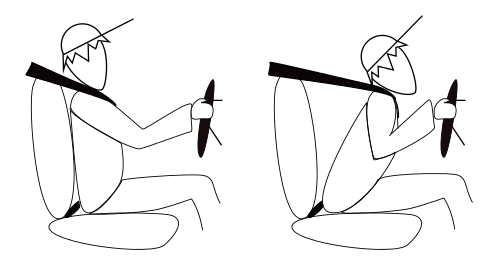
An automobile you are riding in suddenly stops, but you continue to go forward.
a)
Newton's
1st
Law of Motion
b)
Newton's
2nd
Law of Motion
c)
Newton's
3rd
Law of Motion
89.
a)
1st
b)
2nd
c)
3rd
90.
One object has twice as much mass as another object. The first object also has also twice as much...
a)
velocity
b)
gravitational acceleration
c)
inertia
d)
all of these
91.
What is the attractive force that exists between all objects that have mass?
a)
Weight
b)
Mass 
c)
Gravity
d)
Viscosity
92.
If an object is stationary (not moving) the forces acting upon it are _____________
a)
unbalanced
b)
weak
c)
balanced
d)
Hulk Smash!
93.
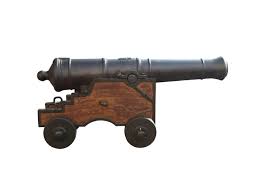
When a cannon fires a cannonball we observe Newton's third law. Which force is the reaction force?
a)
The cannon moving forward
b)
The cannonball moving forward
c)
The cannon moving backward
d)
The cannonball moving backward
94.
What Newtons law does this picture represent
a)
Newtons 2nd law 
b)
Law of gravity 
c)
Newtons 1st law
d)
Newtons 5th law
95.
When you push a boat off from the dock, you are demonstrating Newton's 3rd Law of Motion. It simply states that for every action there is an equal and opposite _______________?
a)
Motion
b)
Change
c)
Reaction
d)
Push
96.
What is Newton's First Law known as? The Law of
a)
Friction
b)
Mass
c)
Inertia
d)
Gravity
97.
What kind(s) of objects have inertia?
a)
all objects with mass
b)
only objects at rest
c)
only objects in motion
d)
only objects whose motion is being changed
98.
What is Newton's First Law
a)
F=ma
b)
Every action has an equal and opposite reaction
c)
An object at rest stays at rest, an object in motion stays in motion. 
d)
Friction 
99.
What Unit do we Measure Force in? 
a)
Newtons
b)
Joules
c)
grams
d)
pounds
100.
Newton's third law is the law of __________________.
a)
action and reaction
b)
inertia
c)
acceleration
d)
science rocks
101.
When you hold an apple above your head, how many force pairs act on the apple?
a)
1
b)
2
c)
3
d)
4
102.
If there are two forces going in the same direction how would you find the net force?
a)
Subtract
b)
Add
c)
Neither
d)
Multiply
103.
According to Newton's 3rd Law, reactions always go in the ___ direction of the action.
a)
same
b)
opposite
104.
With unbalanced forces, the object will move in the direction of the _______ force.
a)
larger 
b)
smaller 
c)
equal 
105.
According to Newton's second law, if you increase the force applied to an object :
a)
it accelerates more
b)
it doesn't move
c)
you get more inertia
d)
it decelerates
106.
A magician pulls a tablecloth out from under dishes and glasses on a table without disturbing them.
a)
Newton's 1st Law
b)
Newton's 2nd Law
c)
Newton's 3rd Law
107.
In the picture, the vehicle will move because of...
a)
Newton's 1st Law
b)
Newton's 2nd Law
c)
Newton's 3rd Law
d)
Newton's 9th Law
108.
Who is the scientist who came up with the Laws of Motion?
a)
Sir Issac Newton
b)
The Greeks
c)
John Dalton
d)
Sir John Newt
109.
Which has more Inertia? (so need more force to move) 
a)
Truck
b)
Ant
c)
A cat
d)
A skateboard
110.

If you lean against a wall, the wall pushes back on you with a(n) weaker force.

a)

True

b)

False

111.
Which statement best explains Newton's Third Law of Motion?
a)
An object at rest tends to stay at rest.
b)
For every action there is an equal and opposite reaction.
c)
The acceleration of an object is based on the force applied.
d)
An object continues its motion until an unbalanced force is applied.
112.
For every action, there is an equal and opposite reaction.
a)
Newton's
1st
Law of Motion
b)
Newton's
2nd
Law of Motion
c)
Newton's
3rd
Law of Motion
113.
The Law of Inertia
a)
Newton's
1st
Law of Motion
b)
Newton's
2nd
Law of Motion
c)
Newton's
3rd
Law of Motion
114.
An automobile you are riding in suddenly stops, but you continue to go forward.
a)
Newton's
1st
Law of Motion
b)
Newton's
2nd
Law of Motion
c)
Newton's
3rd
Law of Motion
115.
When the force on a car is doubled, the acceleration is doubled.
a)
Newton's
1st
Law of Motion
b)
Newton's
2nd
Law of Motion
c)
Newton's
3rd
Law of Motion
116.
A rocket in outer space continues to move.
a)
Newton's
1st
Law of Motion
b)
Newton's
2nd
Law of Motion
c)
Newton's
3rd
Law of Motion
117.
A skater pushes another skater forward, but the one pushing moves backwards.
a)
Newton's
1st
Law of Motion
b)
Newton's
2nd
Law of Motion
c)
Newton's
3rd
Law of Motion
118.
The harder you hit a baseball, the faster it accelerates.
a)
Newton's
1st
Law of Motion
b)
Newton's
2nd
Law of Motion
c)
Newton's
3rd
Law of Motion
119.
You push against a wall and the wall is pushing back on you.
a)
Newton's
1st
Law of Motion
b)
Newton's
2nd
Law of Motion
c)
Newton's
3rd
Law of Motion
120.
The acceleration of a 4 kg bowling ball will be greater than the acceleration of a 6 kg bowling ball if the same force is applied to both.
a)
Newton's
1st
Law of Motion
b)
Newton's
2nd
Law of Motion
c)
Newton's
3rd
Law of Motion
121.
You step from a boat to a dock.  The boat moves backwards as you move forwards and you fall in the water.
a)
Newton's
1st
Law of Motion
b)
Newton's
2nd
Law of Motion
c)
Newton's
3rd
Law of Motion
122.
You push against the floor when you walk and the floor pushes back on you.
a)
Newton's
1st
Law of Motion
b)
Newton's
2nd
Law of Motion
c)
Newton's
3rd
Law of Motion
123.
You are carrying a lunch tray when you bump into the edge of a table.  Although the tray did not tip, your milk falls off of the front of the tray.
a)
Newton's
1st
Law of Motion
b)
Newton's
2nd
Law of Motion
c)
Newton's
3rd
Law of Motion
124.
You slide towards the window when a car makes a sudden turn.
a)
Newton's
1st
Law of Motion
b)
Newton's
2nd
Law of Motion
c)
Newton's
3rd
Law of Motion
125.
A swimmer pushes water back with her arms but her body moves forward.
a)
Newton's
1st
Law of Motion
b)
Newton's
2nd
Law of Motion
c)
Newton's
3rd
Law of Motion
126.

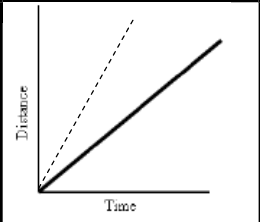
What does this graph represent?

a)

Constant Speed

b)

Increasing Speed

c)

Not moving

d)

Decreasing Speed

127.
What two measurements are necessary for calculating speed?
a)
Mass and time
b)
Temperature and mass
c)
Mass and distance
d)
Distance and time
128.
What is the speed of an object that travels 60 meters in 4 seconds?
a)
240 m/s
b)
15 m/s
c)
0.067 m/s
d)
15 mph
129.
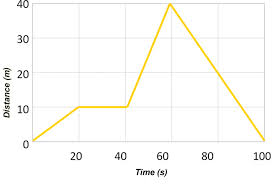
How long did it take this object to travel 10 m?
a)
0 s
b)
10 s
c)
15 s
d)
20 s
130.

Calculate the average speed (in meter/sec) if a cheetah runs 180 meters in 10 seconds.

a)

18 km/h

b)

170 m/sec

c)

12 m/min

d)

18 m/sec

131.
How long did it take this object to travel back to its reference/starting point?
a)
20 s
b)
30 s
c)
60 s
d)
100 s
132.
At 60 seconds, how far had this object traveled? 
a)
0 m
b)
10 m
c)
20 m
d)
40 m
133.

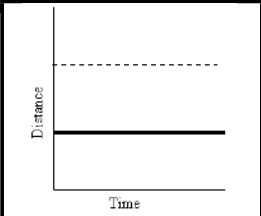
What does this graph represent?

a)

Constant speed

b)

Increasing Speed

c)

Not moving

d)

Decreasing Speed

134.
What is this graph showing?
a)
Constant Speed
b)
Acceleration (speeding up)
c)
Deceleration (slowing down)
d)
No motion
135.
A measurement of how fast an object is moving
a)
Velocity
b)
Speed
c)
Vector
d)
Acceleration
136.

What does this graph represent?

a)

Constant speed

b)

Increasing Speed

c)

Not moving

d)

Decreasing Speed

137.
What is happening at C?
a)
Stationary
b)
Accelerating
c)
Fast steady speed; moving away from the starting position
d)
Slower steady speed; moving away from the starting position
138.
What is the formula to calculate speed?
a)
S = t/d
b)
S = d/t
c)
S = d x t
d)
S = t x d
139.
If you travel 10 miles in 5 minutes, what is your speed?
a)
10 mi/min
b)
15 mi/min
c)
50 mi/min
d)
2 mi/min
140.

Which of the graphs shows that one of runners started 10 yards further ahead of the

other?

a)
b)
c)
d)
141.

In which of the following graphs below are both runners moving at the same speed?

a)
b)
c)
d)
142.

Match the description to the graph:

"The car is stopped."

a)
b)
c)
d)
143.

Match the description to the graph:

"The car is traveling at a constant speed."

a)
b)
c)
d)
144.

Match the description to the graph:

"The speed of the car is decreasing."

a)
b)
c)
d)
145.

Match the description to the graph:

"The car is coming back."

a)
b)
c)
d)
146.

Segment O-A The bus is _________________.

a)

at rest

b)

returning (to original position)

c)

moving forward

d)

increasing speed

147.

Segment A-B The bus is _________________.

a)

at rest

b)

returning (to original position)

c)

moving forward

d)

decreasing speed

148.

Segment B-C The bus is _________________.

a)

at rest

b)

returning (to original position)

c)

moving forward

d)

increasing speed

149.

Segment C-D The bus is _________________.

a)

at rest

b)

returning (to original position)

c)

moving forward

d)

increasing speed

150.

Segment D-E The bus is _________________.

a)

at rest

b)

returning (to original position)

c)

moving forward

d)

increasing speed

151.

Segment E-F The bus is _________________.

a)

at rest

b)

returning (to original position)

c)

moving forward

d)

constant speed

152.

Which runner won the race?

a)

Albert

b)

Bob

c)

Charlie

d)

They completed at the same time

153.

Which runner stopped for a rest?

a)

Albert

b)

Bob

c)

Charlie

d)

None of them

154.

How long did Charlie stop for a rest?

a)

2.5 seconds

b)

2 seconds

c)

3 seconds

d)

5 seconds

155.

How long did Bob take to complete the race?

a)

17 seconds

b)

12 seconds

c)

14 seconds

d)

15 seconds

156.

In which of the following graphs below did one runner overtake (run past) the other?

a)
b)
c)
d)
157.
How long did it take this object to travel 10 m?
a)
0 s
b)
10 s
c)
15 s
d)
20 s
158.
At what rate did the rain fall?
a)
2 cm per hour
b)
1/4 cm per hour
c)
1/2 cm per hour
d)
4 cm per hour
159.
A student runs two times around a running path at a local park.  Each lap is 3 km.  The student completes the first lap in 20 minutes.  The student then sits on a bench and rest for 5 minutes before completing the second lap in 25 minutes.  Which graph bests represents the student's motion?
a)
F
b)
G
c)
H
d)
J
160.

The graph shows Ashley riding her bike to Maria's house.

What was occurring from point B to point C?

a)

She was increasing her speed.

b)

She stopped for 4 minutes

c)

She was decreasing in speed

d)

She was turning to starting point