
 Worksheets
5th Grade Science Test Review Part 1
Total questions: 158
Worksheet time: 2hrs 42mins
What would happen to your dog's full bowl of water if it was left outside while you were gone on vacation for a week in July with your dog?
The water would be at the same level when you returned.
The water would have experienced a physical change as its temperature changed.
The water would have changed physically into a solid.
The bowl would be empty or near empty as the water evaporated.
What law states that in any physical change or chemical change, the total mass of matter does not change?
law of thermodynamics
law of conservation of energy
law of a stop sign
law of conservation of matter
Katie's class is observing how different substances are affected by physical and chemical changes. What evidence might NOT indicate a chemical change?
release of heat
new smell
change in temperature
color change
Julie's lab group wants to know if a physical change occurs during an experiment. Which of the following does NOT indicate a physical change?
a shape change
a change in the type of matter
a temperature change
a change in the state of matter
At what temperature does water freeze?
1000C
00C
320C
00F
Liquid has a definite volume but not a definite ________.
shape
mixture
flow
magnetism
Which of the following does NOT indicate a chemical change?
color change
A new smell is produced.
A new substance is created.
shape change
Which of the following is not a chemical change?
food coloring dissolving in water
leaves turning color
fruit ripening
silver tarnishing
The law of ______ of mass states that in any physical or chemical change, matter is neither created nor destroyed.
conservation
elimination
creation
combustion
Which of the following is not a physical change?
cooking bacon
glass breaking
sugar disolving
ice melting
The form or appearance of matter is altered during a _____ change.
physical
chemical
The mass of a substance before freezing was 450g. What is the mass after freezing?
650 g
900 g
450 g
225 g
Mrs. Adams' favorite vase had a mass of 50g. It broke! What is the mass of the broken pieces?
25 g
75 g
100 g
50 g
When the stopper is removed from a beaker filled with LIQUID, the liquid will flow out of the beaker.
true
false
When the stopper is removed from a beaker filled with GAS, the gas will flow out of the beaker.
true
false
You pour a liquid substance from a beaker into a graduated cylinder. How will the liquid behave once poured into the graduated cylinder?
The liquid substance will take the shape of its container.
The liquid substance will immediately turn into a solid.
The mass of the liquid substance will decrease.
The liquid substance will begin to change colors.
Which properties do NOT provide evidence of a substance's state of matter?
hardness
magnetism
volume
weight
color

Match the picture to the change of state.
evaporation
freezing
melting

Match the picture to the change of state.
evaporation
freezing
melting

Match the picture to the change of state.
evaporation
freezing
melting

Match the picture to the change of state.
evaporation
freezing
melting
Two identical water bottles have the same mass, but one of them breaks. After all the pieces are picked up from the broken bottle they are are weighed again. Which statement is true about the bottles?
The broken water bottle will weigh less because the pieces are smaller.
The broken water bottle will weigh more because there are more pieces even if they are smaller.
Both water bottles would have the exact same mass because of the law of conservation of matter.
None of the statements are true.
Select all evidence that a physical change has occurred.
change in shape
change in temperature
change in state of matter
change in the kind of matter
All energy in ecosystems starts with the ________.
producers
clouds
sun
consumers
True or False: Ecosystems change as a result of natural and human-influenced processes.
True
False
True or False: Matter is neither created nor destroyed in ecosystems.
True
False
A nonliving part of an ecosystem is a/an _______.
nonlimiting factor
limiting factor
biotic factor
abiotic factor
A set of overlapping food chains in an ecosystem is a _________.
food chain
food web
decomposer
producer
Which of the following are examples of biotic factors?
river
grass
sunlight
orangutan
flowers
A living part of an ecosystem is a/an _______.
biotic factor
abiotic factor
limiting factor
unlimiting factor
The path that shows how energy and matter flow from one organism to another is a ________.
food web
food chain
restaurant chain
food path
Organisms that must eat plants or other animals to get energy are called ______.
consumers
producers
decomposers
Organisms that make their own food using nonfood matter and energy from the sun are called ________.
producers
consumers
decomposers
Organisms that break down dead plant and animal material are called _______.
producers
consumers
decomposers
Which of the following are examples of abiotic factors?
lake
oak tree
sunlight
soil
grapes
Decomposers are important to ecosystems because they ________.
return vital nutrients to the ecosystem
are producers
capture energy from the sun
help maintain animal populations
The cycling of matter in an ecosystem is important because ________.
Matter can be created and destroyed.
New matter is constantly being destroyed.
A limited amount of matter is available, so it has to be conserved and recycled.
Bacteria use matter to convert organisms into solar energy.
All the living and nonliving things interacting in a particular area make up a/an ___________.
community
ecosystem
population
_________ are always the first link in a food chain, but the _______ is the original source of energy.
Carnivores; herbivores
Primary consumers; producers
The sun; producers
Producers; sun
Which organism is a producer?
the sun
a rabbit
a sunflower
a snake
Which organism is a consumer?
the sun
a rabbit
a sunflower
grass
Which organism is a decomposer?
grass
the sun
fungi
a vulture

Select all that apply: According to the partial food web, the mouse provides energy for the ________.
grasshopper
snake
hawk
bird
Which one is NOT a predator-prey relationship
fox -rabbit
elephant - giraffe
bird - worm
lion - zebra

Which half of the picture represents a community?
The top half because it includes abiotic factors.
The bottom half because it includes abiotic factors.
The top half because it only includes biotic factors.
The bottom half because it only includes biotic factors.
A rainforest will have ________ species of organisms than a desert because of factors like increased rainfall.
more
fewer
neither more nor fewer

Based on your observations of this forest food web, which of the following correctly shows the flow of matter in a complete food chain?
mountain lion - raven - insects - tree frog
seeds - squirrel - ringtail - bobcat
plants - mule deer - bobcat
tree frog - jackrabbit - coyote
There are more organisms living in an ecosystem in the summer than in the winter because during the summer there are ________ hours of daylight.
fewer
the same
less
more
Which of the following would NOT be used in performing a solubility test?
spoon
magnet
cup of water
stirring motion
Which of the following is a magnetic metal?
copper
brass
steel
gold
Particles of matter are too small to be seen with the naked eye (models can help in demonstrating).
true
false
Adding more solvent to a solution will ________________ the solution.
dilute
increase concentration of
When a gas is formed due to a chemical change, it can be released into the air, causing the mass of the new substance to be less than its original parts.
true
false
Increasing the temperature of a substance will cause its particles to ______________________.
slow down
stay the same
speed up
How would adding more solute to a solution affect the concentration of the solution?
the concentration would decrease
the concentration would increase
the concentration would not change
The ________________________ states that matter cannot be made or destroyed, only transferred and changed.
Law of Conservation of Mass
Newton's Laws of Motion
Law of Changes
Law of Destruction of Mass
Which of the following is an example of a physical change?
burning wood
cutting an apple
metal rusting
a banana turning brown
Which of the following is NOT evidence of a physical change?
melting
evaporation
freezing
change in odor
To make a solution less concentrated means you are diluting the solution.
true
false
A solute is dissolved into a solvent to form a solution.
true
false
A _________________ has a definite shape and definite volume.
gas
solid
plasma
liquid
Mrs. Stringer is combining lemon juice and water. She has 40 g of water and 15 g of lemon juice. What will be the mass of the combined liquids?
25 g
50 g
45 g
55 g
A ___________________ can be described as a mixture in which one substance dissolves evenly into another.
compound
solution
mixture
molecule
Which of the following is an example of a chemical change?
tearing a sheet of paper
boiling water
iron furniture rusting
melting chocolate
Mrs. Walker has a solution (water and salt) with a mass of 75 g. The mass of the sugar is 13 g. What is the mass of the water?
65
88
90
62
Which of the following describes a physical property?
the temperature at which a solid melts
the way the substance reacts with other substances
the tendency of a substance to ignite (catch on fire)
whether or not a metal will rust
What would be the result of leaving a metal spoon in a pot of boiling water?
Metal is a good insulator and could melt from the heat.
The temperature of the spoon would not change.
Metal is a conductor and the handle would get hot.
The Law of Conservation of Matter only applies to chemical changes.
true
false
What would be the best spoon choice for stirring boiling soup?
silver
steel
wood
copper
Due to the property of __________________, oil will float on top of water if poured in the same container.
density
volume
solubility
mass
Corn syrup has a density that is greater than water. Due to its density, the syrup will __________________ when poured in a container with water.
float
sink
The smallest part of a compound that has the properties of the compound.
compound
molecule
element
atom
This physical property of matter is about how an object feels when you touch it.
texture
size
malleability
flexibility
_________ is how well heat and electricity move through a material. ________ are very good ___________.
Conductivity; Wood and rubber; conductors
Insulation; Wood and rubber; insulators
Conductivity; Metals; conductors
Insulation; Metals; insulators
Wood and rubber do NOT allow heat and electricity to pass through easily, so they are __________.
dense
conductors
bouyant
insulators
_______ is the property of a material that refers to how well it dissolves in another material.
density
solubility
conductivity
texture
Which of the following properties of matter can be observed using the senses?
color & shape
texture & hardness
luster & odor
All of them
Which of the following properties of matter can be measured using science tools?
mass & shape
length & texture
mass, weight, length, & temperature
none of the above
Unknown substances can be identified by their properties. What properties of matter CANNOT be used to identify unknown substances?
mass, volume, & state of matter
state of matter, temperature, boiling point
conductivity & solubility
hardness & texture
Which of the following does NOT correctly show a property and its unit of measurement?
mass:
grams, kilograms
volume:
milliliter, liters
length: millimeters, meters, kilometers
temperature: degrees Celsius, degrees Fahrenheit
distance: milliliters, kilograms
When the SAME kinds of atoms in a molecule combine in DIFFERENT amounts, or when you change the kinds of atoms in a molecule, _____________ are formed.
more of the same molecules
different molecules
bigger molecules of the same kind
smaller molecules of the same kind
The SAME matter in DIFFERENT amounts will have _______ mass and volume.
the same
different
equal
no
True or False: All compounds are made up of molecules, but not all molecules are compounds.
True
False
Adding heat to matter causes its particles to move ________, but removing heat from matter causes its particles to move _________.
slower; faster
at the same speed; at a different speed
faster; slower
in place; freely

Which property of matter could not be used to identify the substances in the chart? Why wouldn't that property be helpful?
color; they are all the same color
mass; their masses are all different
melting point; their melting point are very different
density; their densities are similar
Some substances can changes states of matter. These changes generally occur because of changes in _______.
density
solubility
temperature
volume
Our Sun and solar system are part of the __________________.
Titan Galaxy
Nebula Galaxy
Milky Way Galaxy
Proxima Centauri Galaxy
A ___________ is a group of between 1 million and 1 trillion stars.
constellation
galaxy
fixed orbit
meteor shower
The Sun's apparent ____________ (size and brightness) is due to its closeness to Earth.
magnitude
distance
shape
density
The Sun's layers in order from innermost to outermost are:
corona, photosphere, chromosphere
chromosphere, photosphere, corona
chromosphere, corona, photosphere
photosphere, chromosphere, corona
The Sun's gravitational force keeps the planets, their moons, and other space objects in ______________.
fixed orbits
random orbits
changing orbits
rotation
True or False?
The Sun orbits the planets, and the planets orbit the moon.
True
False
We use telescopes because they objects appear ____________.
closer and dimmer
brighter and father away
closer and brighter
dimmer and farther away
___________ are chunks of rock that orbit the Sun, but ___________ are chunks of rock, ice, and dust that have stretched out orbits around the Sun.
asteroids; comets
moons; stars
comets; asteroids
stars; moons
A planet's _____________ is one complete trip around the Sun and what determines the length of a planet's year. A planet's _________ is one complete spin on its axis and determines the length of a planet's day.
orbit; revolution
rotation; revolution
revolution; rotation
revolution; orbit
Which of the outer planets has the longest orbit?
Jupiter
Saturn
Uranus
Neptune
Which of the following are characteristics of the inner planets?
rocky surfaces
few moons
have atmospheres
all of the above
The inner planets and outer planets are separated by ______________.
the asteroid belt
Haley's Comet
a black hole
the Milky Way Galaxy
Which planet has a red surface color due to the high iron content of its soil?
Saturn
Mars
Neptune
Earth
Which planet rotates on its side?
Mercury
Mars
Saturn
Uranus
Which planet is the largest and has a giant storm?
Neptune
Mercury
Jupiter
Earth
The outer planets are called "Gas Giants" because they are very large and because they are made up of gases such as _______________.
oxygen, nitrogen, and phosphorous
hydrogen, helium, and methane
sulfur and carbon
oxygen and nitrogen
Uranus and Neptune appear to be a bluish color because of the _________ gas in their atmospheres.
methane
oxygen
sulfur
helium
Which planet is the hottest and is covered with volcanoes and canyons?
Mercury
Venus
Earth
Mars
Which planet has the fastest revolution and shortest orbit?
Mercury
Venus
Earth
Mars
What are the reasons for the seasons on Earth?
A) Earth's rotation
B) Earth's revolution
C) Earth's tilt on its axis
D) Both B and C


When objects remain in the same place, the forces acting on them are __________.
non-contact forces
contact forces
balanced forces
unbalanced forces


Force is measured in....
Galileos
Newtons
Da Vincis
Einsteins

An unbalanced force causes objects to move in one direction because the force is greater from that direction.
true
false

Inertia is....
a law that says for every action, there is an equal and opposite reaction.
when larger objects take more force to move.
the tendency of an object to resist any change in motion.
a push that acts in the opposite direction and it slows down.
Which force always produces a change in motion?
unbalanced force
balanced force
gravitational force
frictional force
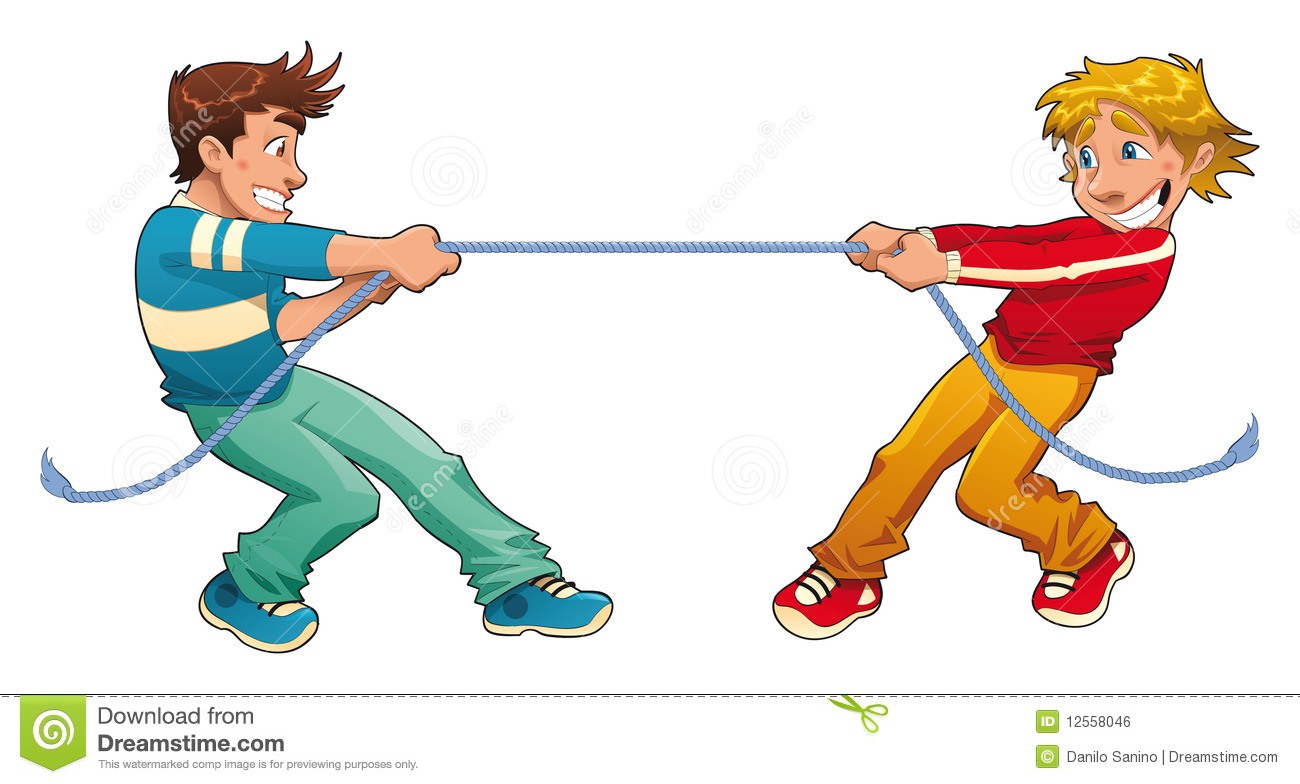
If these boys are pulling with the same amount of force, what will happen?
The boy in blue will win.
They will not move.
The boy in red will win.
Both will fall down.
An automobile you are riding in suddenly stops, why does your body continue to go forward?
Your body resists the change in motion because of your inertia.
Gravity pulls your body towards the earth.
Friction makes your body slow down.
If you push a tennis ball, a bowling ball, and a basketball with the same amount of force, which one will go farthest?
bowling ball
tennis ball
basketball
If a magician pulls a table cloth from under a table of dishes, what should happen based on Newton's 1st law?
The dishes will stay in place on the table.
The dishes will fall to the ground.
The dishes will accelerate and then slow down.
It is much more difficult to move a dresser full of clothes than an empty dresser. Why is this the case according to Newton's 2nd Law of Motion?
An object in motion stays in motion.
It takes more force to move an object with more mass.
It takes more friction to move the empty dresser.
What is Newton's First Law?
Force equals mass times acceleration.
Every action has an equal and opposite reaction.
An object at rest stays at rest, and an object in motion stays in motion with constant velocity (speed and direction).
Friction is a contact force.

Pushing a child on a swing is harder than pushing an adult on the same swing.
True
False
The first law of motion says that a moving object tends to keep
force
speed
distance
moving
If there was no friction or other force acting on an object in motion, then the object in motion would stay in motion forever.
true
false
Why is it harder to push a cart full of bricks than a cart full of feathers?
The bricks have more friction than the feathers.
The feathers have more friction than the bricks.
The bricks have more weight/mass than the feathers.
The feathers have more weight/mass than the bricks.
If one bumper car collides into another bumper car, what should occur according to Newton's Third Law of Motion?
Nothing will happen.
The second bumper car will push back on the first with an equal but opposite force.
The first bumper car's speed will increase rapidly.
The second bumper car will not move, and its driver won't feel the bump.
What pulls objects toward Earth's center?
the moon
the sun
gravity
the atmosphere
What exerts a gravitational force on other objects?
atmosphere
the moon
outer space
everything that has mass
Does gravity exist in space?
Yes
No
True or False - Gravity causes stars to stay in their galaxies and planets and moon to stay in their orbits.
True
False
Night and day are caused by the ___________ of Earth on its axis.
rotation
tilt
exposure
time zones
Earth rotates on its axis every __________.
48 hours
29 days
24 hours
24 minutes
How many time zones are in the United States?
1
2
3
4
As Earth rotates on its axis, it also ____________ around the sun.
exists
revolves
stops
True or False - Earth's revolution around the sun affects the amount of daylight a location gets.
True
False
What causes Earth's seasons?
the tilt of the Earth's axis
the Earth's revolution around the sun
the tilt of the Earth's axis and Earth's revolution around the sun
the moon's revolution around the sun
True or False - The Northern Hemisphere and the Southern Hemisphere have opposite seasons.
True
False
The moon revolves around Earth and also rotates. One complete rotation is about the same as one complete revolution which is how many days?
24 days
29 days
31 days
60 days
The moon does not have its own light but reflects the _____________.
Earth's light
Sun's light
Mars' light
Jupiter's light
True or False - The Moon's gravitational pull on Earth affects the surface levels of the ocean know as tides.
True
False
What causes the different phases of the moon?
the moon's revolution around Earth
the Earth's revolution around the moon
the moon's revolution around the sun
the moon's rotation on its axis
What is the only other natural object in space, other than Earth, that humans have visited?
Mars
Moon
Sun
Venus
A constellation is a group of stars that form a _____________ in the sky.
picture/shape
abstract drawing
map
What causes different constellations to appear at different times on Earth?
the sun
the lunar cycle
the Earth's revolution
the moon's revolution
A ______________________ is a dark area or shape that is made when an object blocks a source of light.
moon
shadow
object
revolution
True or False - As the sun appears to move across the sky in an arc, sunlight shines on objects at different angels. As a result, shadows change their size and direction during the day.
True
False

