wayground logo

Free Printable Worksheets

Font size

S
M
L
XL
Worksheets

graphing motion

Total questions: 157

Worksheet time: 2hrs 17mins

Name
Class
Date
1.
During which interval is the object not moving?
a)
B to C
b)
C to D
c)
D to E
d)
only at point A
2.
During which interval is the object traveling at a constant velocity?
a)
B to C
b)
D to E
c)
F to G
d)
it traveling at a constant velocity during all of the intervals shown.
3.
During which interval is the object speeding up?
a)
A to B
b)
B to C
c)
D to E
d)
E to F
4.
During which interval is the object slowing down?
a)
A to B
b)
D to E
c)
E to F
d)
G to H
5.
Acceleration occurs when an object changes its speed or ______.
a)
direction
b)
force
c)
inertia
d)
mass
6.
Which runner stopped for a rest?
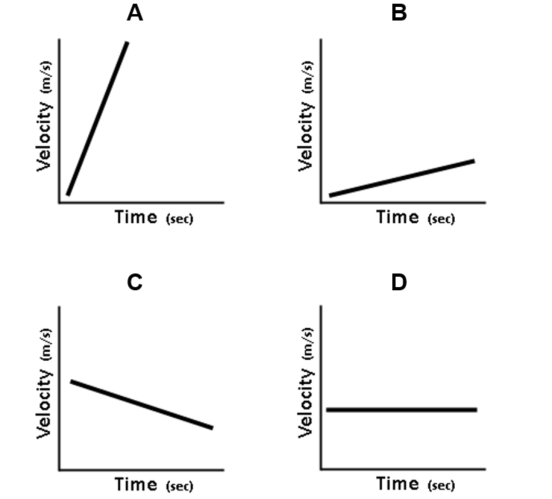
a)
Albert
b)
Bob
c)
Charlie
7.
Which runner won the race?
a)
Albert
b)
Bob
c)
Charlie
8.
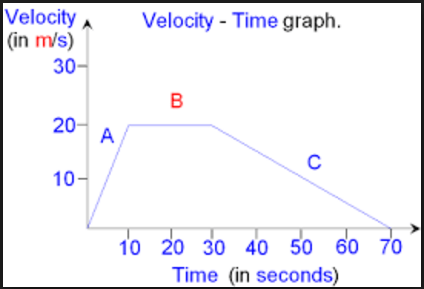
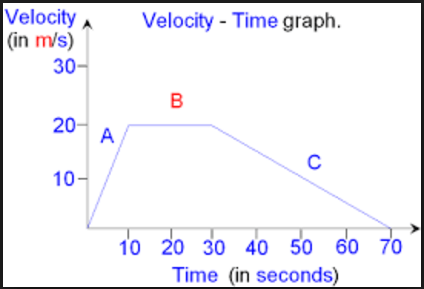
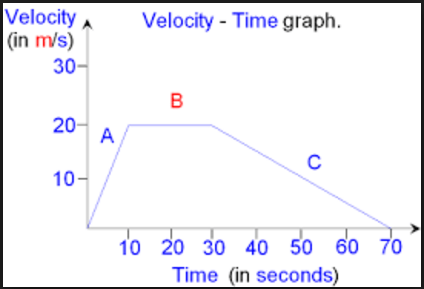
This is a velocity-time graph.  What is the object doing in segment A?
a)
Positive acceleration
b)
Negative acceleration
c)
Constant Velocity
d)
Not moving
9.
This is a velocity-time graph.  What is the object doing in segment C?
a)
Positive acceleration
b)
Negative acceleration
c)
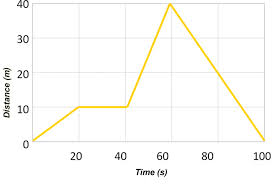
Constant Velocity
d)
Not moving
10.
Calculate the acceleration for segment A.
a)
2 m/s2
b)
20 m/s2
c)
-2 m/s2
d)
0 m/s2
11.
A car driving at 50 miles per hour drives for 2 hours. What distance did it cover?
a)
50 miles
b)
25 miles
c)
100 miles
d)
75 miles
12.
A truck driving at 60 miles per hour travels 150 miles. How long is it driving for?
a)
9000 hours
b)
0.4 hours
c)
210 hours
d)
2.5 hours
13.
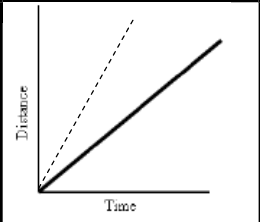
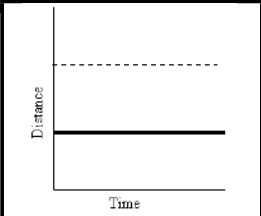
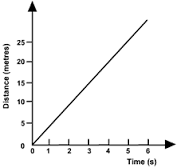
What does this graph represent?
a)
Constant speed
b)
Acceleration
c)
Not moving
14.
What does this graph represent?
a)
Constant Speed
b)
Acceleration
c)
Not moving
15.
What does this graph represent?
a)
Constant speed
b)
Acceleration
c)
Not moving
16.
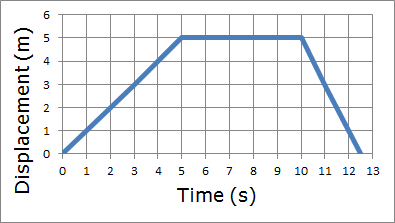
According to the graph how fast does the person travel in the first 5 seconds?
a)
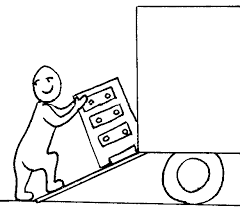
2 m/s
b)
10 m/s
c)
12.5 m/s
d)
1 m/s
17.
The speed of the vehicle between points A-B is...
a)
12m/s
b)
8m/s
c)
10m/s
d)
16m/s
18.
Acceleration of an object happens when things ________
a)
slow down
b)
go faster
c)
change direction (turn)
d)
All of the above
19.
The SI unit for acceleration is
a)
mph
b)
m/s
c)
m/s2
20.
Acceleration: is the rate of change in ___________.
a)
speed
b)
distance
c)
velocity 
d)
displacement 
21.

What is the formula for speed?

a)

distance / time

b)

time / distance

c)

direction / time

d)

direction / distance

22.

What is the total distance divided by the total time known as?

a)

average speed

b)

velocity

c)

total distance

d)

acceleration

23.

How far an object has traveled is what?

a)

time

b)

distance

c)

direction

d)

speed

24.

If I walk 20 miles in 5 hours, what is my speed?

a)

5 miles per hour

b)

0.25 miles per hour

c)

4 miles per hour

d)

20 miles per hour

25.

What is it called when the speed of an object does not change?

a)

average speed

b)

increasing speed

c)

constant speed

d)

decreasing speed

26.

Velocity is:

a)

speed and direction

b)

distance and direction

c)

time and direction

d)

distance and tome

27.

An object used to determine if something is in motion is a:

a)

reference point

b)

constant

c)

position

d)

location

28.

Which segment shows the faster speed?

a)

A to B

b)

C to D

c)

B to C

d)

E to F

29.

What is the speed of the object at 6 seconds?

a)

10 m/s

b)

1.6 m/s

c)

0.6 m/s

d)

16 m/s

30.

What is the motion of the object from segment D to E?

a)

It is moving slowly

b)

It is returning to the starting point

c)

It is moving quickly

d)

It is not moving

31.

When the object gets to D, what is its average speed?

a)

1 km/hr

b)

0.86 km/hr

c)

12 km/hr

d)

0 km/hr

32.

What is the speed of an object traveling for 8 hours, a distance of 48 kilometers?

a)

6 km/hr

b)

56 km/hr

c)

0.16 km/hr

d)

40 km/hr

33.

Which best describes this motion in the graph?

a)

stopped, walking, running home

b)

running, walking, stopped, walking home

c)

walking, stopped, walking, running home

d)

walking, running, running, stopped

34.

Time is plotted on the ______________ and distance is plotted on the ___________.

a)

x-axis, y-axis

b)

z-axis, y-axis

c)

y-axis, x-axis

d)

x-axis, z-axis

35.

What is the formula for velocity?

a)

Time/Distance + Direction

b)

Distance/Time + Direction

c)

Direction/Time + Distance

d)

Time/Direction +Distance

36.
During which interval is the object not moving?
a)
B to C
b)
C to D
c)
D to E
d)
only at point A
37.
During which interval is the object traveling at a constant velocity?
a)
B to C
b)
D to E
c)
F to G
d)
it traveling at a constant velocity during all of the intervals shown.
38.
Which runner complete the 100 meter race in the least amount of time?
a)
Albert
b)
Bob
c)
Charlie
39.
Which runner started out the fastest?
a)
Albert
b)
Bob
c)
Charlie
40.
What was Charlie doing between 8 seconds and 10.5 seconds?
a)
He was stopped
b)
He was accelerating
c)
He was returning to start
d)
He was traveling at a constant velocity
41.
What was Albert doing between 0 and 12 seconds?
a)
Traveling at a constant speed.
b)
Accelerating
c)
Stopped 
d)
Traveling back to start
42.
What does the slope of each line on the graph tell you?
a)
The speed of each runner
b)
The acceleration of each runner
43.
What do you think the cyclist is doing between 11am and 1pm?
a)
The cyclist has stopped for lunch
b)
The cyclists is riding at a constant speed on flat ground
c)
The cyclist is practicing sprints
d)
The cyclist is riding up a hill
44.
What is happening between 9am and 11am?
a)
The cyclist is traveling up a hill
b)
The cyclists is speeding up
c)
The cyclists is traveling at a constant speed
d)
The cyclist is slowing down
45.
What is the total distance covered by 2 pm?
a)
40 miles
b)
30 miles
c)
60 miles
d)
10 miles
46.
What is the line on this graph showing?
a)
moving away from starting point at a constant speed
b)
moving back towards the starting point at a constant speed
c)
acceleration (getting faster)
d)
deceleration (getting slower)
47.
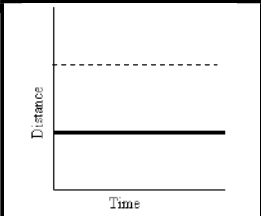
What does the solid line on this graph represent?
a)
Constant speed
b)
Acceleration
c)
Not moving
d)
deceleration
48.
What does this graph represent?
a)
Constant Speed
b)
Acceleration
c)
Not moving
49.
What does this graph represent?
a)
Constant speed
b)
Acceleration
c)
Not moving
50.
What is speed?
a)
how far you go
b)
how much distance is covered over a period of time
c)
how fast you accelerate
d)
the change in the location of a object
51.
According to the graph how far does the person travel in the first 5 seconds?
a)
2 m
b)
10 m
c)
0 m
d)
5 m
52.
A runner races in the 100 meter dash.  It takes her 10 seconds to finish.  What is her average speed?
a)
10 m/s
b)
1000 m/s
c)
100 seconds
d)
10 seconds
53.
What is happening at E?
a)
Stationary
b)
Accelerating
c)
Fast steady speed; moving away from the starting position
d)
Steady speed; returning to start position
54.
What is a PUSH or PULL of an object?
a)
Motion
b)
Force
c)
Friction
d)
Gravity
55.
What is MOVEMENT?
a)
Inertia
b)
Force
c)
Work
d)
Motion
56.
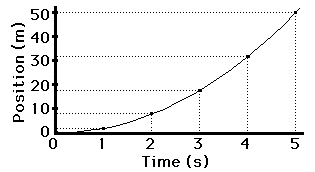
The picture of the position vs. time graph shows an object that is...
a)
accelerating/speeding up
b)
moving at a constant speed 
c)
not moving 
d)
accelerating/slowing down. 
57.
What is force?
a)
A force is a push or a pull upon an object resulting from the object's interaction with another object.
b)
something used in Star Wars 
c)
It is the amount of space between two points.
d)
It is Superman's power
58.
What does the solid line on this graph represent?
a)
Constant speed
b)
Acceleration
c)
Not moving
d)
deceleration
59.
What is the line on this graph showing?
a)
moving away from starting point at a constant speed
b)
moving back towards the starting point at a constant speed
c)
acceleration (getting faster)
d)
deceleration (getting slower)
60.
What does this graph represent?
a)
Constant Speed
b)
Acceleration
c)
Not moving
61.
What does this graph represent?
a)
Constant speed
b)
Acceleration
c)
Not moving
62.
 3 MINUTE QUESTION:
Every morning, Tom walks along a straight road from his home to the bus stop. Below, is a graph representing Tom’s trip to school.
Was Tom walking, jogging, or sprinting during segment 1 (between 0 and 50 seconds)?
a)
walking
b)
jogging
c)
sprinting
63.
2 MINUTE QUESTION:
During the 2nd segment (50 seconds to 70 seconds) which direction as Tom moving?
a)
Tom was moving back towards his house
b)
Tom was moving down a hill
c)
Tom was moving towards the bus stop
d)
Tom was not moving
64.
Which runner stopped for a rest?
a)
Albert
b)
Bob
c)
Charlie
65.
Which runner won the race?
a)
Albert
b)
Bob
c)
Charlie
66.
Which graph represents the greatest acceleration?
a)
A
b)
B
c)
C
d)
D
67.
Which graph shows the object standing still?
a)
A
b)
B
c)
C
d)
D
68.
How many times does this object STOP moving?
a)
None
b)
Once
c)
Twice
d)
Three times
69.
What is happening from point D to E?
a)
The object is moving SLOWLY
b)
The object is moving FAST
c)
The object is decelerating
d)
The object is NOT moving
70.
What is happening in this graph from point B to C?
a)
The object is going down a hill.
b)
The object is returning to its starting location.
c)
The object is slowing down.
d)
The object is staying still.
71.
What is happening in the graph from point O to A?
a)
The object is moving SLOWLY
b)
The object is moving FAST
c)
The object is NOT moving
d)
The object is accelerating
72.
What is this graph showing?
a)
Constant Speed
b)
Acceleration (speeding up)
c)
Deceleration (slowing down)
d)
No motion
73.
If your velocity is negative and your acceleration is negative you will...
a)
Speed Up 
b)
Slow Down 
c)
Change Direction 
d)
Eventually Stop
74.
A change in position over time is...
a)
Distance 
b)
Acceleration 
c)
Velocity
d)
Speed
75.
Which Quantity can you NOT get from a v vs. t graph? 
a)
Distance
b)
Displacement 
c)
Acceleration 
d)
Velocity
76.
Negative velocity means an object is…
a)
Speeding up
b)
Slowing down
c)
Moving forwards 
d)
Moving backwards
77.
The slope of a line segment on a position vs. time graph is…
a)
Average velocity
b)
Instantaneous velocity
c)
Average acceleration
d)
Instantaneous acceleration
78.
A horizontal line on a acceleration vs. time graph means
a)
Constant position 
b)
Constant velocity 
c)
Constant acceleration
d)
Constant time
79.

Which is true about Bob's speed between 4 and 6 hours?

a)

His speed was faster than it was during 0 to 2 hours.

b)

His speed was the same as it was during 0 to 2 hours.

c)

His speed was slower than it was during 3 to 4 hours.

d)

His speed was the same as it was during 3 to 4 hours.

80.

For how long did the student walk before he stopped?

a)

2 seconds

b)

4 seconds

c)

6 seconds

d)

8 seconds

81.

Which line segment shows a period of time when the car was stopped?

a)

segment BD

b)

segment CD

c)

segment DE

d)

segment EF

82.

Which bus made only 2 stops during its route?

a)

Bus W

b)

Bus X

c)

Bus Y

d)

Bus Z

83.

Which best describes the motion of the object between seconds 7 and 8?

a)

the object remained at rest.

b)

The object’s motion increased.

c)

The object’s motion decreased.

d)

The object moved at a constant speed.

84.

How far did they travel during the first 2 hours of the trip?

a)

50 km

b)

100 km

c)

200 km

d)

350 km

85.

During what part of the trip did the runner move the fastest?

a)

0 min to 10 min

b)

10 min to 30 min

c)

40 min to 60 min

d)

70 min to 80 min

86.

How far did the bus travel in 4 minutes?

a)

500 m

b)

800 m

c)

1000 m

d)

2000 m

87.
Which runner complete the 100 meter race in the least amount of time?
a)
Albert
b)
Bob
c)
Charlie
88.
What was Charlie doing between 8 seconds and 10.5 seconds?
a)
He was stopped
b)
He was changing his speed
c)
He was returning to start
d)
He was traveling at a constant speed
89.
What is happening between 9am and 11am?
a)
The cyclist is traveling up a hill
b)
The cyclists is speeding up
c)
The cyclists is traveling at a constant speed
d)
The cyclist is slowing down
90.
What is the total distance covered by 2 pm?
a)
40 miles
b)
30 miles
c)
60 miles
d)
10 miles
91.
Between which two letters is the speed the fastest?
a)
B and C
b)
A and B 
c)
E and F
d)
C and D
92.
At which point in time, does this person turn around?
a)
3 seconds
b)
5 seconds
c)
10 seconds
d)
25 seconds
93.
What is the object's position at 3 seconds?
a)
20m
b)
30m
c)
40m
d)
50m
94.
What is the best way to describe the speed of object C?
a)
Fast
b)
Moving backwards
c)
Not Moving
d)
Slow
95.
Describe the motion the graph shows
a)
Constant Speed
b)
Speeding up
c)
Slowing Down
d)
all the answer choices
96.
What two measurements are necessary for calculating speed?
a)
Mass and time
b)
Temperature and mass
c)
Mass and distance
d)
Distance and time
97.
How long did it take this object to travel 10 m?
a)
0 s
b)
10 s
c)
15 s
d)
20 s
98.
How long did it take this object to travel back to its reference/starting point?
a)
20 s
b)
30 s
c)
60 s
d)
100 s
99.
What is happening at A?
a)
Stationary
b)
Accelerating
c)
Slower steady speed; moving away from the starting position
d)
Steady speed; returning to start position
100.
What is happening at D?
a)
Stationary
b)
Accelerating
c)
Fast steady speed; moving away from the starting position
d)
Slower steady speed; moving away from the starting position
101.
What is happening at C?
a)
Stationary
b)
Accelerating
c)
Fast steady speed; moving away from the starting position
d)
Slower steady speed; moving away from the starting position
102.
What is happening at B?
a)
Stationary
b)
Accelerating
c)
Slower steady speed; moving away from the starting position
d)
Steady speed; returning to start position
103.
At 60 seconds, how far had this object traveled? 
a)
0 m
b)
10 m
c)
20 m
d)
40 m
104.

What is the object's average speed?

a)

.4 m/s

b)

.8 m/s

c)

.67 m/s

d)

1.5 m/s

105.

What is the object's average speed?

a)

2.67 km/hr

b)

0.38 km/hr

c)

1.33 km/hr

d)

0.75 km/hr

106.

How many times did this object come to a stop?

a)

once

b)

twice

c)

never

d)

four

107.

What type of forces did this object experience?

a)

balanced forces - speed is always constant or stationary

b)

unbalanced forces - speed increases and decreases

c)

opposing forces

108.
What is the average speed of the person during the first 5 seconds?
a)
0 m/s
b)
1 m/s 
c)
3 m/s
d)
6 m/s 
109.
What was the average speed for Blue Lightning after 80 s?
a)
0.53 m/s
b)
1.875 m/s
c)
12000 m/s
d)
None of the above
110.

The graph shows how the SPEED of an object changed over time. During which segments of this graph were the forces acting on the object balanced?

a)

R only

b)

Q and S

c)

R and T

d)

R, S and T

111.
 Every morning, Tom walks along a straight road from his home to the bus stop. Below, is a graph representing Tom’s trip to school.
-
 What is the distance covered through the second segment, which is between 50 seconds, and 70 seconds?
a)
40 meters
b)
60 meters
c)
80 meters
d)
20 meters
112.

Which graph(s) show an object experiencing balanced forces?

a)

A, B and F only

b)

A, B, C and F

c)

D and E

d)

A only

113.

Which graph(s) show an object experiencing unbalanced forces?

a)

A, B and F only

b)

A, B, C and F

c)

D and E

d)

A only

114.

Which table represents an object at rest?

a)

Table 1

b)

Table 2

c)

Table 3

d)

Table 4

115.

Which two tables represent objects moving with constant speed?

a)

Table 1

b)

Table 2

c)

Table 3

d)

Table 4

116.
A bat flies three kilometers. A scientist want to find the bat's speed. Which other information does the scientist need?
a)
the bat's starting position
b)
the bat's mass while flying
c)
the direction the bat flies
d)
the amount of time the bat flies
117.
Jose and Sarah both leave school for the library at 3 p.m. Jose rides his bike at a speed of 16 miles per hour. Sarah ride her bike at a speed of 14 miles per hour. Which is MOST LIKELY  happen?
a)
they will ride in two different directions.
b)
Jose will arrive at the library before Sarah.
c)
Sarah will arrive at the library before Jose.
d)
They will arrive at the same time.
118.
This is a velocity-time graph.  What is the object doing in segment B?
a)
Positive acceleration
b)
Negative acceleration
c)
Constant Velocity
d)
Not moving
119.
What kind of acceleration is shown here?
a)
positive
b)
negative
c)
none
d)
varies
120.
Is the speed constant or non-constant?
a)
constant
b)
non-constant
121.
Which section of the graph shows increasing velocity?
a)
AB
b)
BC
c)
DE
d)
EF
122.
Which is not a type of simple machine?
a)
spring
b)
screw
c)
pulley
d)
wedge
123.
work is...
a)
energy from the sun
b)
a type of machine
c)
a force that moves an object
d)
a force that pulls you toward the earh
124.
What type of simple machine is found on the cap of a pickle jar?
a)
lever
b)
inclined plane
c)
pulley
d)
screw
125.
What type of simple machine is found on the floor of a bathtub?
a)
screw
b)
inclined plane
c)
wedge
d)
pulley
126.
Which of these is an example of a wedge?
a)
skateboard
b)
broom
c)
stairs
d)
butter knife
127.
A screw is made up of _____ wrapped around a post or rod.
a)
threads
b)
springs
c)
treads
d)
strings
128.
Which of these is not an example of an inclined plane?
a)
ladder
b)
stairs
c)
wall
d)
driveway
129.
Which is an example of someone using a simple machine to do work?
a)
a boy runs across a football field
b)
a banker counts money
c)
a mother pushes a stroller up a ramp
d)
a girl eats a sandwich
130.
Jan is using a screwdriver, which is a type of ...
a)
a pulley
b)
a screw
c)
a lever
d)
a wheel and axle
131.
Which is a characteristic of a simple machine?
a)
They run on electricity.
b)
They take a long time to make.
c)
They have few or no moving parts.
d)
They are not very large.
132.
Which type of simple machine would be found on the bottom of a wagon??
a)
a pulley
b)
a screw
c)
a wedge
d)
a wheel and axle
133.
What two parts might make a pulley?
a)
wheel and axle
b)
wheel and wire
c)
wheel and screw
d)
wheel and fulcrum
134.
A device that transmits or modifies force or motion
a)
Slope and Rise
b)
Load
c)
Simple Machine
d)
Mechanical Advantage
135.
Elements of an Inclined Plane
a)
Slope and Rise
b)
Load
c)
Mechanical Advantage
d)
Simple Machine
136.
To create a mechanical advantage is the purpose of...
a)
Load
b)
Work
c)
Inclined Plane
d)
Effort
137.
The object or weight being moved or lifted is...
a)
Work
b)
Effort
c)
Weight
d)
Load
138.
The amount a machine multiplies force is...
a)
Mechanical Advantage
b)
Slope and Rise
c)
Effort
d)
Simple Machine
139.
The vertical height of an inclined plane from the base to its highest point is...
a)
Slope
b)
Load
c)
Rise
d)
Work
140.
The inclined plane makes work easier by _____ the amount of effort that must be applied to raise or lower a load.
a)
increasing
b)
accelerating
c)
reducing
d)
softening
141.
This is also referred to as a slope.
a)
Mechanical Advantage
b)
Effort
c)
Inclined Plane
d)
Simple Machine
142.
Using a force to move an object a distance is...
a)
Force
b)
Effort
c)
Load
d)
Work
143.
A force applied to a machine to do work = Effort
a)
True
b)
False
144.
To reduce the amount of effort needed to raise or lower an object in an inclined plane, the length of the slope should be ______.
a)
Distance
b)
Extended
145.
A push or pull = Force
a)
True
b)
False
146.
The longer the inclined plane, the ___________________ to move the object
a)
the less input force you need
b)
the more input force you need
c)
the more output force you need
d)
the less output force you need
147.
A flat, sloped surface is called a(n)...
a)
Lever
b)
Screw
c)
Fulcrum
d)
Inclined Plane
148.
What is a disadvantage of using an inclined plane to lift a heavy object?
a)
The object must be moved a greater distance.
b)
It takes less effort to move the object.
c)
Many objects are difficult to lift straight up.
d)
Heavy object usually take up more space.
149.
Students pulled the same mass up an inclined plane that was 20 cm, 30 cm, and 40 cm long. Each time, they used a spring scale to measure the force needed to pull the mass up the inclined plane. What did they conclude?
a)
Less force was needed on the 20 cm plane
b)
More force was needed on the 40 cm inclined plane.
c)
The least amount of force was needed on the 40 cm inclined plane.
d)
The least amount of force was needed on the 30 cm inclined plane.
150.
An inclined plane reduces the amount of force needed to move an object by - 
a)
increasing the distance the object moves.
b)
transferring more of the force to the object
c)
reversing the direction the object is moved.
151.
Which of the following decreases when an object is moved using an inclined plane?
a)
The distance the object moves.
b)
The pull of gravity on the object.
c)
The force needed to move the object.
d)
The amount of space the object occupies.
152.
Friction acts in a direction_______ to the direction of an object's motion.
a)
unrelated
b)
equal
c)
opposite
d)
perpendicular
153.
 The unit for force is _____. 
a)
A.  Neutrons 
b)
B.  Newtons
c)
C.  Tons
d)
D.  Inches 
154.
A force exerted over a distance to move an object is ______________________.
a)
power
b)
work
c)
momentum
d)
Watt
155.
Which best describes the role friction plays in the operation of a bicycle?
a)
Friction makes the bike go faster.
b)
Friction keeps the bike from stopping.
c)
Friction turns the bike in a new direction.
d)
Friction helps the bike slow down and stop.
156.
How does friction affect speed?
a)
more friction decreases (lowers) speed
b)
more friction increases speed
c)
less friction decreases (lowers) speed
157.
Which has the longer distance - straight lift from the ground directly to the back of truck or using an inclined plane?
a)
Straight lift
b)
Inclined plane
c)
They are the same