wayground logo

Free Printable Worksheets

Font size

S
M
L
XL
Worksheets

Mechanics REVIEW

Total questions: 115

Worksheet time: 3hrs 25mins

Name
Class
Date
1.

Acceleration of an object happens when things...

a)

slow down

b)

go faster

c)

both

2.

What are the units for velocity?

a)

Km

b)

s

c)

m/s

d)

m/s2

3.

What are the units for acceleration?

a)

m/s

b)

m

c)

m/s2

d)

s

4.

The rate at which velocity changes is called...

a)

motion

b)

average speed

c)

instantaneous speed

d)

acceleration

5.

On a distance vs. time graph, the steeper the slope...

a)

the slower the speed

b)

the faster the speed

c)

less acceleration

d)

greater acceleration

6.

Change in velocity over a given period of time is...

a)

position

b)

motion

c)

speed

d)

acceleration

7.

You walk 10 meters to math class in 20 seconds. Your velocity is...

a)

2 m/s

b)

0.5 m/s

c)

200 m/s

d)

5 m/s

8.

The slope of a velocity v. time graph is...

a)

velocity

b)

acceleration

c)

meters per second

d)

meters

9.

The slope of a position v. time graph is...

a)

velocity

b)

acceleration

c)

seconds

d)

meters

10.

A larger change in time will result in a larger force.

a)

True

b)

False

11.

A larger change in time will result in a smaller force.

a)

True

b)

False

12.

A negative acceleration ALWAYS causes an object to slow down.

a)

True

b)

False

13.

A positive acceleration ALWAYS causes an object to speed up.

a)

True

b)

False

14.

Force is directly related to acceleration.

a)

True

b)

False

15.

The graph represents

a)

no motion

b)

constant velocity

c)

positive acceleration

d)

negative acceleration

16.

The graph represents

a)

no motion

b)

constant velocity

c)

positive acceleration

d)

negative acceleration

17.

The graph respresents

a)

No motion

b)

constant Velocity

c)

positive acceleration

d)

negative acceleration

18.
"For every action, there is an equal and opposite reaction."
a)
Newton's 1st Law
b)
Newton's 2nd Law
c)
Newton's 3rd Law
d)
Newton's 4th Law
19.
Force = Mass x Acceleration
a)
Newton's 1st Law
b)
Newton's 2nd Law
c)
Newton's 3rd Law
d)
Newton's 4th Law
20.
"An object in motion (or at rest) will to stay in motion (or at rest) until an outside force acts upon it."
a)
Newton's 1st Law
b)
Newton's 2nd Law
c)
Newton's 3rd Law
d)
Newton's 4th Law
21.

The tendency of a moving object to resist changes in its motion is...

a)

momentum

b)

force

c)

acceleration

d)

velocity

22.

Which of the following is the units for momentum?

a)

kg*m/sec/sec

b)

kg*m/sec

c)

m/sec/sec

d)

m/sec

23.

A Newton is a unit of...

a)

force

b)

inertia

c)

acceleration

d)

velocity

24.

When a heavy football player and a light one run into each other, who exerts more force?

a)

The heavy one

b)

The light one

c)

They are equal

25.
If a ball of cheese is fired into frictionless space, the amount of force needed to keep it going equals
a)
twice the force with which it was fired
b)
the same amount of force with which it was fired
c)
1/2 the force with which it was fired
d)
zero, since no force is requires to keep it moving. 
26.
What is the speed of an object that travels 20 meters in 4 seconds?
a)
80 m/s
b)
0.2 m/s
c)
5 m/s
d)
24 m/s
27.

The momentum of an object depends upon the object's ___________ and _____________.

a)

size and shape

b)

mass and acceleration

c)

mass and veloctiy

d)

mass and energy

28.
The equation to calculate momentum is
a)
p=mv
b)
p=1/2mv2
c)
p=mgh
d)
p=mg
29.
Which has more momentum: a car stopped at a red light or a bike moving at 15 mph?
a)
car
b)
bike
c)
they are equal
d)
cannot determine using the info provided
30.

What is the momentum of 1000 kg car moving at 20 m/s?

a)

20000 N

b)

20000 J

c)

20000 kg * m/s

d)

10000 kg * m/s

31.

A runner has a momentum of 720 kg*m/s and is traveling at a velocity of 5 m/s. What is his mass?

a)

14.4 kg

b)

1400 kg

c)

144 kg

d)

360 kg

32.

A 2 kg cart has a momentum of 10 kg*m/s. What is its velocity?

a)

22 m/s

b)

.2 m/s

c)

5.0 m/s

d)

20 m/s

33.

An object with a mass of 2000 kg at rest has what momentum?

a)

2000 kg*m/sec

b)

0 kg*m/sec

c)

2000 kg

d)

2000 m/sec

34.
A 0.250 kg cart moving at 0.500 m/s has how much momentum?
a)
0.5 kg*m/s
b)
.125 kg*m/s
c)
12.5 kg*m/s
d)
10 kg*m/s
35.

A 2.5 kg ball moving at 5 m/s collides with a 2.5 kg stationary ball in a perfectly elastic collision. What is the velocity of the second ball after the collision (assuming the first one is now stopped)?

a)

5 m/s

b)

2.5 m/s

c)

10 m/s

d)

7.5 m/s

36.

A 9300 kg railroad car traveling at a velocity of 5 m/s strikes a second boxcar that weighs 5000 kg at rest. The two cars stick together. At what speed will the railroad and boxcar move afterwards?

a)

18.6 m/s

b)

3.25 m/s

c)

7.5 m/s

d)

1.86 m/s

37.
A .030 kg bullet is fired from a gun with a speed of 350 m/s. If the gun has a mass of 0.9 kg, What is the recoil speed of the gun?
a)
11.7 m/s
b)
9.0 m/s
c)
10.5 m/s
d)
10 m/s
38.
A 9 kg blob moving at 5 m/s collides and sticks to a second blob with a mass of 5 kg. If the two bobs stick together, what will the velocity of the two blobs move at?
a)
3.57 m/s
b)
3.2 m/s
c)
10.0  m/s
d)
9.0  m/s
39.
When the speed of an object is doubled, its momentum
a)
remains unchanged in accord with the conservation of momentum.
b)
doubles
c)
quadruples
d)
decreases
40.

This graph shows...

a)

an object stopped.

b)

an object slowing down.

c)

an object speeding up.

d)

an object moving at constant speed.

41.

This graph shows...

a)

an object stopped.

b)

an object speeding up.

c)

an object slowing down.

d)

an object moving at constant speed.

42.

This graph shows...

a)

an object speeding up.

b)

an object stopped.

c)

an object turning around

d)

an object slowing down.

43.
Which is longer? A Centimeter or an inch?
a)
centimeter
b)
inch
44.
What is the SI unit for length?
a)
meter
b)
liter
c)
mass
d)
second
45.
What 2 units can be used when measuring volume? 
a)
cubic meters and liters
b)
grams and seconds
c)
milliliters and centimeters
d)
cubic centimeters and kelvin
46.
What is the SI unit for mass?
a)
kilograms 
b)
meters
c)
pounds
d)
liters
47.
What is weight?
a)
a measure of the force of gravity acting on an object
b)
a measure of the amount of matter an object contains
c)
the amount of space an object takes up
d)
don't ask me that, I'm sensitive
48.
How do you calculate density?
a)
mass divided by volume
b)
volume divided by mass
c)
mass times volume
d)
very carefully
49.
How do you calculate the volume of a rectangular solid?
a)
length x width x height
b)
mass divided by volume
c)
with a triple beam balance
d)
it's impossible
50.
What is mass?
a)
a measure of the amount of matter an object contains
b)
a measure of the force of gravity acting on an object
c)
the amount of space an object takes up
d)
a temperature scale
51.
What will never change, wherever you are in the universe?
a)
mass
b)
weight
52.
How do you measure the volume of an irregular solid?
a)
displacement method
b)
length x width x height
c)
mass divided by volume
d)
kick it
53.
What is the volume? Count by 2s.
a)
22 ml
b)
25 ml
c)
28 ml
d)
18 ml
54.
What is the volume of the battery?
a)
17 cm3
b)
5 cm3
c)
22 cm3
d)
24 ml
55.
1000 mg = _____g
a)
0.001
b)
1
c)
1,000,000
d)
100
56.
7,000 g = ____ kg
a)
70
b)
700
c)
7
d)
0.07
57.
Frank has a paper clip. It has a mass of 9g and a volume of 3cm3. What is its density?
a)
3 g/cm3
b)
1/3 g/cm3
c)
27 g/cm3
d)
39 g/cm3
58.
Which box has a higher density?  
a)
Box A
b)
Box B
c)
cannot be determined
d)
they are the same
59.
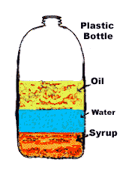
Which liquid is the least dense?
a)
oil
b)
water
c)
syrup 
d)
plastic bottle
60.
How much longer is the key than the paper clip?
a)
3 cm
b)
2 cm
c)
4 cm
d)
1 cm
61.
Which measurement would you use to measure the following?
the length of a piece of paper
a)
centimeters
b)
liters
c)
kilograms
d)
meters
62.
Which measurement would you use to measure the following?
the volume of a soda bottle
a)
centimeters
b)
liters
c)
kilograms
d)
grams
63.
Which measurement would you use to measure the following?
your mass
a)
centimeters
b)
liters
c)
kilograms
d)
milliliters
64.
What tool do scientists use to measure volume of a liquid?
a)
graduated cylinder
b)
meter stick
c)
spring scale
d)
triple-beam balance
65.
What do we use a meter stick to measure?
a)
volume
b)
distance/length
c)
mass
d)
weight
66.
When measuring the temperature, what SI unit(s) do we use?
a)
Celsius only
b)
Fahrenheit, Celsius
c)
Kelvin, Fahrenheit
d)
Kelvin, Celsius
67.
What tool do we use to measure weight?
a)
electronic scale
b)
triple-beam balance
c)
spring scale
d)
thermometer
68.
Jamal put a block of wood on a triple-beam balance and read the amount in grams.  What was he measuring?
a)
temperature
b)
mass
c)
weight
d)
volume
69.

Roni measured the weight of her agenda. The unit she used was ____________.

a)

liter

b)

meter

c)

gram

d)

Newton

70.
Celia needed to get the mass of a beaker of sugar.  What tool should she use?
a)
electronic scale, triple-beam balance
b)
graduated cylinder, beaker
c)
meter stick, meter tape
d)
electronic scale, spring scale
71.

Sheri put some water in a graduated cylinder and then looked at it at eye level at the meniscus and saw it was 25 mL. What measurement did she get?

a)

mass

b)

volume

c)

weight

d)

length, distance

72.
Measure to the nearest milliliter.
a)
73 mL
b)
73.0 mL
c)
76 mL
d)
76.1 mL
73.
Read this graduated cylinder to the nearest tenth of a milliliter
a)
21.5 
b)
22.5
c)
20
d)
21
74.
What is the moment acting on the seesaw?
a)
1.6Nm
b)
15Nm
c)
16N
d)
4Nm
75.
A seesaw is unbalanced with two people of different masses sitting equal distances from the center. Which of the following will result in equilibrium?
a)
The larger person moving further away from the center.
b)
Moving the smaller person closer to the center.
c)
Moving the smaller person further from the center.
d)
Making the larger person do nothing.
76.
The easiest way to open a heavy door  is by applying the force
a)
Near the hinges
b)
In the middle of the door
c)
At the edge of the door far from the hinges
d)
At the top of the door
77.

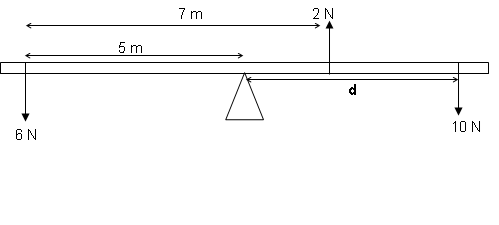
Assuming the system is in equilibrium, calculate the missing distance d

a)

3.4 m

b)

2.8 m

c)

4.4 m

d)

1.6 m

78.

The figure below shows a man lifting a heavy rock using a steel bar. He pushes downwards on the end of the bar with a force F.


Which pivot positions allows the force F to be as small as possible?

a)

A

b)

B

c)

C

d)

D

79.

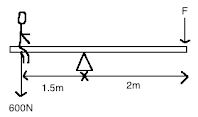
A boy of weight 600N sits on the see-saw as shown at a distance of 1.5m from the pivot. What is the force F required at the other end to balance the see-saw?

a)

450 N

b)

350 N

c)

4.5 N

d)

200 N

80.
What is the formula for force?
a)
F=M/A
b)
F=A/M
c)
F=M*A
d)
F=M*F
81.
What is a PUSH or PULL of an object?
a)
Motion
b)
Force
c)
Friction
d)
Gravity
82.
What happens when two forces act in the same direction?
a)
They cancel each other out.
b)
The stronger one prevails.
c)
Their strengths are added.
d)
Their sum divided by the two is the total force.
83.
Which of the following statements is true? 
a)
Balanced forces cause a change in motion. 
b)
Unbalanced forces cause a change in motion. 
c)
Forces do not effect the change in motion. 
84.
8 N to the left , and 4 N to the right. Find the net force. Is this balanced 
a)
12 N Right  No
b)
4 N Left  No
c)
12 N Right  Yes
d)
4 N Left  Yes
85.
What is the standard unit force is measured in?
a)
Newtons
b)
pounds
c)
grams
d)
meters
86.
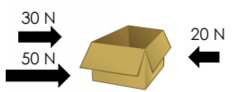
Calculate the Net Force. 
a)
60N, Left 
b)
40N, Right 
c)
0N
d)
60N, Right
87.

State the principle of moments.

a)

When a system is in equilibrium, the sum of the total clockwise moment is equal to the sum of the total anti-clockwise moment about the same pivot.

b)

When a system is in equilibrium, the sum of the total clockwise moment is greater the sum of the total anti-clockwise moment about the same pivot.

c)

When a system is in equilibrium, the sum of the total clockwise moment is less than the sum of the total anti-clockwise moment about the same pivot.

d)

When a system is in equilibrium, the sum of the total clockwise moment is equal to the sum of the total anti-clockwise moment about the different pivot.

88.
How are speed and velocity different?
a)
Speed includes direction
b)
Speed indicates momentum
c)
Velocity includes Momentum
d)
Velocity includes direction
89.

A nut can be loosened more easily with

a)

a short spanner because a larger turning effect can be produced.

b)

a long spanner because a larger turning effect can be produced.

c)

a long spanner because a larger force can be produced.

d)

a short spanner because a larger force can be produced.

90.

What is the equation for moments?

a)

Moment = force x perpendicular distance from pivot

b)

Moment = mass x velocity

c)

Moment = force x distance

d)

Moment = force x parallel distance from pivot
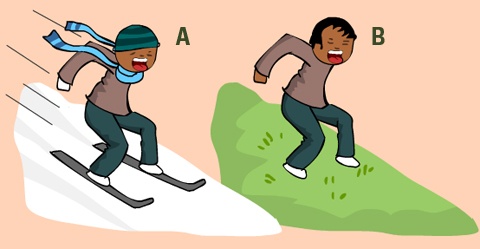
91.
Why is it harder for the boy in Image B to get down the hill?
a)
Motion
b)
Friction
c)
Work
d)
Displacement
92.
How do you calculate power?
a)
P = W/t
b)
P = E/t
c)
P = w * t
d)
P = bbq/chicken
93.
How do we calculate work?
a)
W = F * d
b)
w = f * D
c)
W = F * D
d)
w = f * d
94.
The SI unit of work is?
a)
Joules
b)
Watts
c)
Newtons
d)
meters
95.
The energy of movement is...? 
a)
Kinetic
b)
Potential
96.
Energy that is stored is called...
a)
Kinetic
b)
Potential 
97.
The SI unit for power is...?
a)
Watts
b)
Joules
c)
Newtons
d)
Meters
98.
A force exerted over a distance to move an object is ______________________.
a)
power
b)
work
c)
momentum
d)
Watt
99.
The faster an object moves, the ________ kinetic energy it has. 
a)
more
b)
less
c)
none of the above
d)
all of the above 
100.
Gravitational potential energy depends on the ________ and ________ of the object. 
a)
Height and mass
b)
Friction and movement
c)
Mass and Movement
d)
Height and Friction 
101.
What is the formula for calculating the total amount of mechanical energy?
a)
ME = KE + PE
b)
KE = ME + PE
c)
PE = KE + ME
d)
ME = 1/2 mv2
102.
Why does the total amount of mechanical energy stay constant in a system?
a)
energy is not created or destroyed
b)
energy leaves
c)
energy enters
d)
energy is not converted from one form into another
103.

The equation for POTENTIAL ENERGY is

a)

PE = mass x gravity x height

b)

PE = gravity x weight

c)

PE = height / work

d)

PE = work / time

104.

The equation for KINETIC ENERGY is

a)

KE = mass x gravity

b)

KE = 1/2 height x speed

c)

KE = mass2

d)

KE = 1/2 mass x speed2

105.

The property of an object or system that allows it to do work is ________________.

a)

Work

b)

Energy

c)

Power

d)

Distance

106.

How will you describe the energy at Point A?

a)

mostly potential energy

b)

mostly kinetic energy

c)

losing PE, gaining KE

d)

losing KE, gaining PE

107.

What is the kinetic energy of a 4 kg rock falling through the air at 5 m/s?

a)

10 J

b)

50 J

c)

20 J

d)

200 J

108.

If a rock falls from a cliff, at what point are its kinetic energy and its potential energy the same? Ignore air resistance.

a)

Just as it starts to fall

b)

just before it hits the bottom

c)

halfway down

d)

never

109.

If two rocks are launched through the air at the same speed, but one has twice as much mass as the other, how do their kinetic energies compare?

a)

The kinetic energy of the two rocks is the same because they have the same speed

b)

The rock with the greater mass will only move a small distance and then fall straight to the ground

c)

The two rock could not have the same speed if they have different masses

d)

The rock with the greater mass has more kinetic energy than the rock with less mass even though they are traveling at the same speeds because both mass and speed affect kinetic energy.

110.

Where would a car traveling on a roller coaster track have the most potential energy?

a)

At the bottom

b)

Halfway to the top

c)

at the top

d)

halfway to the bottom

e)

It is always the same

111.

Which point has the most kinetic energy?

a)

Ball G

b)

Ball F

c)

Ball E

d)

Ball D

e)

Ball A

112.

Which point has the most kinetic energy?

a)

Ball G

b)

Ball F

c)

Ball E

d)

Ball D

e)

Ball A

113.

Jane carries a 5 kg box and Lorie carries a 10 kg box up a set of stairs, who did more work?

a)

Jane because his box was lighter.

b)

Lorie because her box weighed more.

c)

Can't tell.

114.

Work is done only if

a)

a force is applied.

b)

the force applied causes the object's motion.

c)

an object is in motion.

115.

Which two forces do NO work on the gold block?

a)

Fa

b)

Fg

c)

Ff

d)

Fn