
 Worksheets
AQA Physics Paper 1 Combined Science KWH
Total questions: 111
Worksheet time: 1hrs 11mins
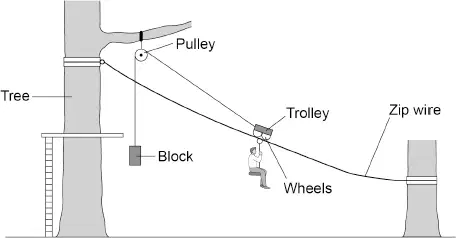
The figure below shows a person using a zip wire to move from a tree to the ground.
As the person moves down the zip wire, the block moves upwards. What happens to the gravitational potential energy of the person as the person accelerates down the zip wire?
Decreases
Stays the same
Increases
The figure below shows a person using a zip wire to move from a tree to the ground.
As the person moves down the zip wire, the block moves upwards. What happens to the kinetic energy of the person as the person accelerates down the zip wire?
Decreases
Stays the same
Increases
As the trolley moves, work is done against friction.
What is the effect of this?
Some energy is destroyed.
Some energy is transferred to the surroundings.
The total energy of the block and trolley increases.
The person oils the wheels on the trolley. Explain how this will affect the speed of the person down the zip wire. Choose two answers.
speed will increase
speed will decrease
friction decreases
friction increases
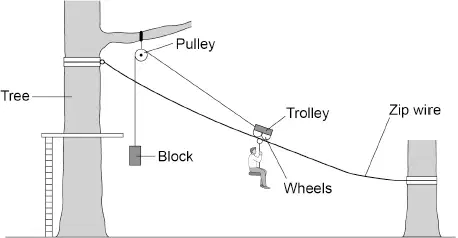
The block is 3.4 m above the ground when the person is at the bottom of the zip wire.
mass of block = 2.5 kg
gravitational field strength = 9.8 N/kg
Calculate the gravitational potential energy of the block.
Use the equation:
gravitational potential energy = mass × gravitational field strength × height
(a)
The trolley is a seat suspended from wheels which can roll along the zip wire. When the person reaches the end of the zip wire, the person gets off the trolley. The block falls downwards pulling the trolley back to the top of the zip wire.
maximum speed of block = 4.8 m/smass of block = 2.5 kg
Calculate the maximum kinetic energy of the block.
Use the equation: kinetic energy = 0.5 × mass × (speed)2
(a)
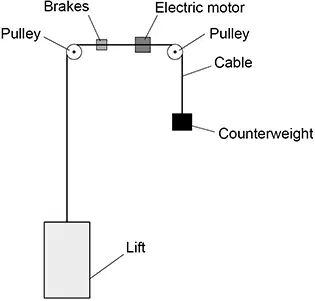
The diagram below shows a lift near the bottom of a building. The lift is attached by a cable to a counterweight. An electric motor moves the lift. The lift is moving up.
As the lift moves up, how far does the counterweight move down?
A shorter distance than the lift.
The same distance as the lift.
A longer distance than the lift.
The diagram below shows a lift near the bottom of a building. The lift is attached by a cable to a counterweight. An electric motor moves the lift. The lift is moving up.
What happens to the gravitational potential energy of the counterweight as it moves down?
It decreases
It stays the same
It increases
Friction between the brakes and the cable causes the speed of the lift to decrease.
As the speed decreases, there is a decrease in the _______________energy of the lift.
chemical
internal
elastic potential
gravitational potential
kinetic
Friction between the brakes and the cable causes the speed of the lift to decrease.
As the speed decreases, there is an increase in the _______________energy of the brakes.
chemical
internal
elastic potential
gravitational potential
kinetic
The motor transfers different amounts of energy each time people use the lift. Which two factors affect the amount of energy transferred by the motor as the lift moves?
The distance moved by the lift
The height of the building
The length of the steel cable
The maximum power of the motor
The weight of the people in the lift
The weight of the lift and the counterweight stretch the cable by 0.015 m.
The cable acts like a spring with a spring constant of 880 000 N/m.
Calculate the elastic potential energy of the stretched cable.
Use the equation:
elastic potential energy = 0.5 × spring constant × (extension)2
(a)
A lift system using a counterweight is more efficient than a lift system that does not use a counterweight.
How does having a more efficient system affect the energy transferred by the motor?
Less energy is transferred.
The same amount of energy is transferred.
More energy is transferred.
The weight of the lift and the counterweight stretch the cable by 0.015 m.
The cable acts like a spring with a spring constant of 880 000 N/m.
Calculate the elastic potential energy of the stretched cable.
Use the equation:
elastic potential energy = 0.5 × spring constant × (extension)2
(a)
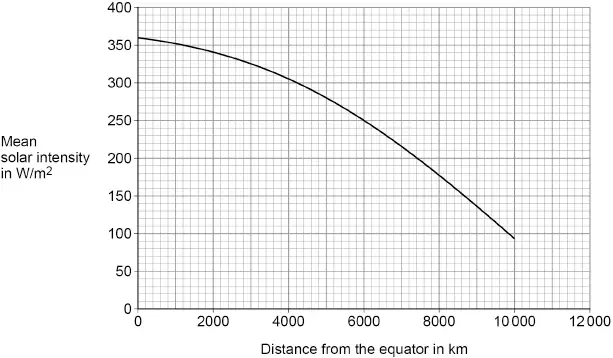
Solar intensity is a measure of the radiation received from the Sun at the surface of the Earth. Figure 1 shows how the mean solar intensity changes with the distance from the equator.
The city of Athens is 4200 km from the equator.
What is the mean solar intensity in Athens?
(a)
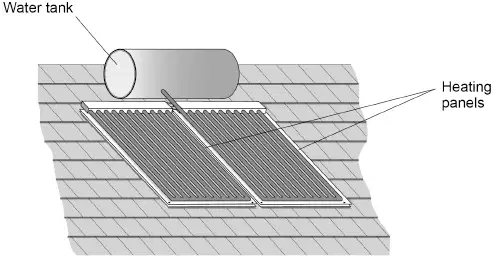
Solar intensity is a measure of the radiation received from the Sun at the surface of the Earth.
Solar water heaters use radiation from the Sun to heat water. The heated water is stored in a water tank. Figure 2 shows a solar water heater on the roof of a building. Cities closer to the equator have many more buildings with solar water heaters than cities further away from the equator. Suggest why.
cities closer to the equator receive a greater solar intensity
cities closer to the equator receive a lower solar intensity
Solar intensity is a measure of the radiation received from the Sun at the surface of the Earth. Figure 1 shows how the mean solar intensity changes with the distance from the equator.
The city of Athens is 4200 km from the equator.
What is the mean solar intensity in Athens?
(a)
The use of solar water heaters may reduce the need to burn fossil fuels.
Burning fossil fuels contributes to global warming because there is an increase in the amount of ____________________ in the atmosphere.
carbon dioxide
nitrogen
oxygen
The efficiency of the solar water heater is 0.61. Calculate the useful power output when the total power input to the solar water heater is 1100 W.
Use the equation:
useful power output = efficiency × total power input
(a)
Different solar water heaters have different sized heating panels. Suggest how the size of the heating panels affects the input power to a solar water heater.
larger heating panels have a greater input power
larger heating panels have a smaller input power
Water has a high specific heat capacity. What is meant by the specific heat capacity of water?
The energy required to change the state of 1 kg of water from liquid to gas.
The energy required to increase the temperature of 1 kg of water by 1 °C.
The power required to change the state of 1 kg of water from liquid to gas.
The power required to increase the temperature of 1 kg of water by 1 °C.
The water tank contained 80 kg of water. The change in thermal energy of the water was 8 400 000 J.
specific heat capacity of water = 4200 J/kg °C
Calculate the temperature change of the water.
Use the equation:
Energy transferred = mass × specific heat capacity × change in temperature
(a)
The water tank is thermally insulated. How does thermal insulation affect the rate of energy transfer from the water in the tank?
Thermal insulation decreases the rate of energy transfer.
Thermal insulation does not change the rate of energy transfer.
Thermal insulation increases the rate of energy transfer.

The table below shows information about different materials.
Which material in the table above is the best thermal insulator?
A
B
C
D
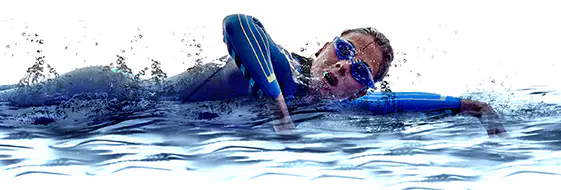
Figure 1 shows a swimmer wearing a wetsuit. The wetsuit helps to keep the swimmer warm. A student wrapped a thermometer in a piece of wetsuit material and placed the thermometer in water containing ice. After 30 seconds in the water the temperature of the thermometer had decreased by 7.5 °C
Calculate the average decrease in temperature each second.
(a)

The student recorded the temperature of the thermometer after 30 seconds for four materials. Each piece of material was the same size and thickness. In each test the starting temperature of the thermometer was 21.0 °C
Which material is the best thermal insulator?
W
X
Y
Z
The student tested a new material with a greater thermal conductivity than material Z. The piece of new material was the same size and thickness as the piece of material Z. What was the temperature of the thermometer after 30 seconds?
Less than 12.0 °C
Exactly 12.0 °C
Greater than 12.0 °C
During the investigation 0.0150 kg of the ice melted. The temperature of the water and ice did not change.
specific latent heat of fusion of ice = 334 000 J/kg
Calculate the energy needed to melt the ice.
Use the equation: energy to melt the ice = mass × specific latent heat
(a)

The student wanted to determine the density of a wetsuit material.
The student measured the length of one side of a cube of wetsuit material with:
a micrometer
a ruler.
The results show that compared to the ruler the micrometer has a higher:
calibration
precision
reproducibility
resolution
Write down the equation that links density (ρ), mass (m) and volume (V).
density = mass / volume
density = mass x volume
mass = volume / density
The student calculated the volume of the cube of wetsuit material to be 0.186 cm3
The density of the cube was 0.300 g/cm3
Calculate the mass of the cube.
Give your answer in grams.
Use the equation: density = mass / volume
(a)
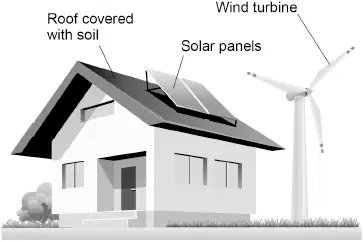
An eco-house is designed to be environmentally friendly. The diagram below shows a picture of an eco-house. he solar panels and a wind turbine are used to generate electricity for the eco-house. Solar and wind are both renewable energy resources. What does renewable energy resource mean?
It can be replenished as it is used.
It is unreliable.
It has no fuel costs.
It produces no greenhouse gases.
The roof of the eco-house is covered with soil. Covering the roof with soil decreases the thermal conductivity of the roof. What are the advantages of having a roof with a lower thermal conductivity? Tick two.
Less energy is needed to heat the house.
The rate of energy transfer by conduction is greater.
The roof is a better insulator.
The roof is less likely to leak.
Weather will have a greater effect on the temperature of the house.
Explain why it is a good idea for the eco-house to have both a wind turbine and solar panels. Choose the two correct explanations.
sometimes it is not sunny/windy
so there’s more chance of electricity being generated at any time
less electricity is generated
which increases the running costs
Biomass, nuclear and natural gas are three other energy resources.
What is Biomass?
Renewable
Non Renewable
Biomass, nuclear and natural gas are three other energy resources.
What is Nuclear?
Renewable
Non Renewable
Biomass, nuclear and natural gas are three other energy resources.
What is natural gas?
Renewable
Non Renewable
Moving air makes the wind turbine spin. The wind turbine generates electricity which is used to charge a battery. When the wind turbine spins faster there is an increase in its _______________ energy.
chemical
electrical
gravitational
kinetic
Moving air makes the wind turbine spin. The wind turbine generates electricity which is used to charge a battery. Charging the battery increases the _______________ store of energy of the battery.
chemical
electrical
gravitational
kinetic
The average power transferred to the solar panels by sunlight is 26 000 W
Calculate the average energy transferred to the solar panels in 30 seconds.
Use the equation: energy transferred = power × time
(a)
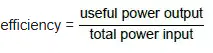
The solar panels on the roof of the eco-house have an efficiency of 0.15. The average power input to the solar panels is 26 000 W. Calculate the average useful power output from the solar panels.
(a)
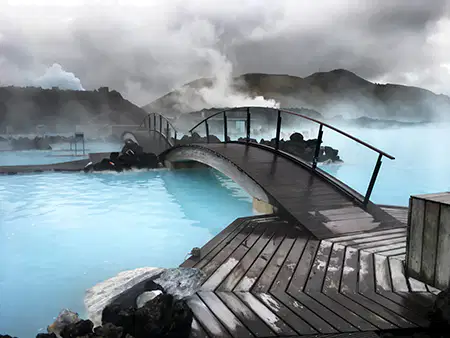
The figure below shows an outdoor swimming pool. The water in the swimming pool comes from the sea.
The water in the pool is heated using a geothermal energy resource.
Which of the following describes a geothermal energy resource?
A non-renewable energy resource with high carbon emissions.
A non-renewable energy resource with low running costs.
A renewable energy resource that uses hot rocks underground.
A renewable energy resource that uses the tides.
The figure below shows an outdoor swimming pool. The water in the swimming pool comes from the sea.
The water in some swimming pools is heated by burning fossil fuels.
Explain one environmental disadvantage of burning fossil fuels.
Tick all that apply.
releases carbon dioxide
which contributes to global warming
releases sulfur
which causes acid rain
which causes pollution
Which of the following units is the same as 1 J/s?
1 N
1 Pa
1 W
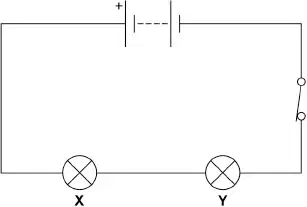
The figure below shows a circuit diagram. The circuit contains a battery and two lamps, X and Y.
How does the current in lamp X compare with the current in lamp Y?
The current in lamp X is smaller.
The current in both lamps is the same.
The current in lamp X is greater.
The switch can be used to turn the lamps on and off. Immediately after the lamps are switched on, the resistance of each lamp increases. Why does the resistance of each lamp increase?
The current in the battery decreases.
The potential difference across each lamp decreases.
The power of the battery increases.
The temperature of each lamp increases.
The figure below shows a circuit diagram. The circuit contains a battery and two lamps, X and Y.
The current in lamp X is 1.2 A. The potential difference across lamp X is 1.5 V.
Calculate the power of lamp X.
Use the equation: power = potential difference × current
(a)
The current in lamp X is 1.2 A. Calculate the charge flow through lamp X in 40 seconds.
Use the equation:
charge flow = current × time
(a)
Lamp Y breaks. What happens to lamp X?
Lamp X gets brighter.
Lamp X stays the same brightness.
Lamp X no longer emits light.
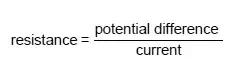
The current in lamp X is 1.2 A.
The potential difference across lamp X is 1.5 V.
Calculate the resistance of lamp X.
Use the equation:
(a)
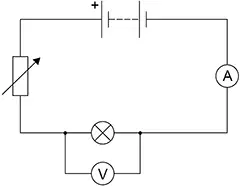
A student investigated how the potential difference across a filament lamp affects the current in the lamp. Figure 1 shows the circuit the student used.
What component does the top symbol represent?
Ammeter
Battery
Lamp
Variable resistor
A student investigated how the potential difference across a filament lamp affects the current in the lamp. Figure 1 shows the circuit the student used.
Which component from Figure 1 did the student use to adjust the potential difference across the lamp?
Ammeter
Battery
Variable resistor
Thermistor
LDR
A student investigated how the potential difference across a filament lamp affects the current in the lamp.
When the voltmeter was not connected to the circuit it gave a reading of 0.4 volts. How can the student correct all the readings taken from the voltmeter?
Add 0.4 volts to each reading
Divide each reading by 0.4 volts
Multiply each reading by 0.4 volts
Subtract 0.4 volts from each reading
A student investigated how the potential difference across a filament lamp affects the current in the lamp.
Increasing the current in a filament lamp makes the temperature of the lamp ____________________
Decrease
Increase
Stay the same
A student investigated how the potential difference across a filament lamp affects the current in the lamp.
Increasing the current in a filament lamp makes the temperature of the lamp increases and and the resistance of the lamp ____________________.
Decrease
Increase
Stay the same

The student recorded three values of current for each potential difference. The table below shows the results for 2.5 volts.
Calculate the mean current in the lamp.
(a)
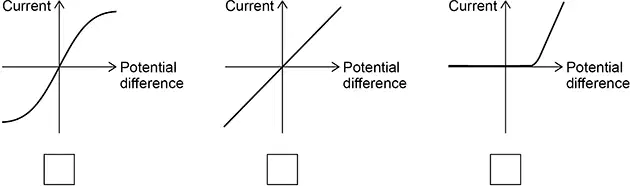
Which graph shows the relationship between potential difference and current for a filament lamp?
1
2
3
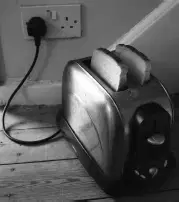
The photograph shows a toaster. The toaster is connected to the mains supply using a three-core cable. What is the function of the earth wire inside the cable?
To carry the current from the supply to the toaster
To complete the circuit in the toaster
To melt if a fault occurs inside the toaster
To stop the metal case of the toaster becoming live if a fault occurs
The photograph shows a toaster. The toaster is connected to the mains supply using a three-core cable. The insulation around the earth wire is green and ____________________ .
blue
brown
orange
white
yellow
The photograph shows a toaster. The toaster is connected to the mains supply using a three-core cable. The insulation around the live wire is ____________________ .
blue
brown
orange
white
yellow
The photograph shows a toaster. The toaster is connected to the mains supply using a three-core cable. The insulation around the neutral wire is ____________________ .
blue
brown
orange
white
yellow
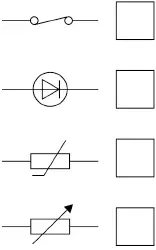
gardener wanted to build an electrical circuit to monitor the temperature in a greenhouse. Which symbol represents an electrical component with a resistance that decreases as its temperature increases?
1
2
3
4
When the resistance of an electrical circuit decreases, the current in the circuit increases. Electrical current is a flow of ____________________.
Charge
Energy
Potential difference
Power
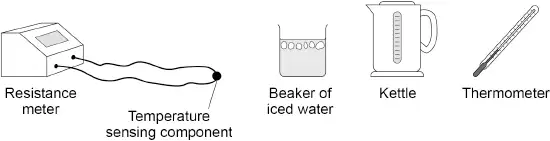
The gardener wanted to find how the resistance of the component varies with temperature. Figure 1 shows the equipment used by the gardener. The resistance meter displays the resistance of the component.
Plan a method the gardener could use to find how the resistance of the component varies with temperature.
1. place the ___________ in the beaker of water.
Resistor
Thermistor
LDR
LED
The gardener wanted to find how the resistance of the component varies with temperature. Figure 1 shows the equipment used by the gardener. The resistance meter displays the resistance of the component.
Plan a method the gardener could use to find how the resistance of the component varies with temperature.
2. record the ________ (of the water) using the _______
Voltmeter
Thermistor
Thermometer
Temperature
Potential difference
The gardener wanted to find how the resistance of the component varies with temperature. Figure 1 shows the equipment used by the gardener. The resistance meter displays the resistance of the component.
Plan a method the gardener could use to find how the resistance of the component varies with temperature.
3. measure the __________ (using the resistance meter)
Voltmeter
Thermistor
Thermometer
Resistance
Potential difference
The gardener wanted to find how the resistance of the component varies with temperature. Figure 1 shows the equipment used by the gardener. The resistance meter displays the resistance of the component.
Plan a method the gardener could use to find how the resistance of the component varies with temperature.
4. change the ___________ of the water (using the kettle) and ________ the measurements (of temperature and resistance)
Repeat
Thermistor
Thermometer
Resistance
Potential difference
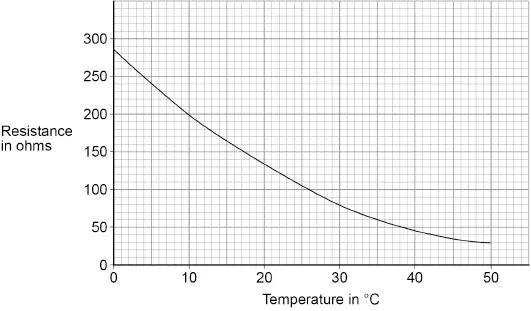
Figure 2 shows how the resistance of the component varies with temperature.
The relationship between the temperature and the resistance of the component is _________________________.
linear
non-linear
directly proportional
Figure 2 shows how the resistance of the component varies with temperature.
The temperature in the greenhouse changed from 10 °C to 30 °C.
Determine the change in resistance of the component between these temperatures.
(a)
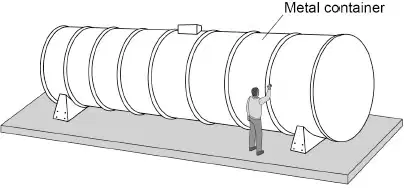
Data-storage computers get very hot. Scientists investigated using the sea to cool data-storage computers. The computers were set up inside a large metal container. Figure 1 shows the metal container before it was lowered into the sea.
Why is the container made of metal?
Metal has a high thermal conductivity.
Metal is a good thermal insulator.
Metal is a poor conductor of thermal energy.
Data-storage computers get very hot. Scientists investigated using the sea to cool data-storage computers. The computers were set up inside a large metal container. Figure 1 shows the metal container before it was lowered into the sea.
How does the air in the container exert pressure on the container?
Air particles absorb energy from the container.
Air particles collide with the walls of the container.
Air particles expand to fill the container.
Data-storage computers get very hot. Scientists investigated using the sea to cool data-storage computers. The computers were set up inside a large metal container.
As the container is lowered into the sea, the temperature of the air in the container decreases.
When the temperature of the air in the container decreases, the average speed of the air particles ____________________ .
decreases
stays the same
increases
Data-storage computers get very hot. Scientists investigated using the sea to cool data-storage computers. The computers were set up inside a large metal container.
As the container is lowered into the sea, the temperature of the air in the container decreases.
After the temperature of the air in the container had decreased, the computers were switched on. The computers caused the temperature of the air to then increase. Describe how the air pressure in the container changed as the temperature decreased and then increased. Choose the two correct answers.
the pressure decreased as temperature decreased
the pressure increased as temperature increased
the pressure decreased as temperature increased
the pressure increased as temperature decreased
The container has a length of 12 m. The container has a cross-sectional area of 7.5 m2.
Calculate the volume of the container.
Use the equation: volume = length × cross-sectional area
(a)
A piece of steel is heated until it has all melted.
The internal energy of the steel increases as the steel is heated.
What is meant by ‘internal energy of the steel’?
The change in energy of the steel particles as the steel melts.
The energy added to the steel particles as they are heated.
The total kinetic energy and potential energy of the steel particles.
A piece of steel is heated until it has all melted.
As the piece of solid steel melts, the mass of the steel ____________________.
decreases
stays the same
increases
A piece of steel is heated until it has all melted.
The density of steel decreases as it melts. How does the spacing of the particles change as the steel melts?
decreases
stays the same
increases
A piece of steel is heated until it has all melted.
Melting is an example of a ____________________ change.
chemical
permanent
physical
Solid steel cannot be poured. Which statement about the particles in a solid gives the reason why?
The number of particles always stays the same.
The particles are close together.
The particles are in fixed positions.
The particles have a fixed size.
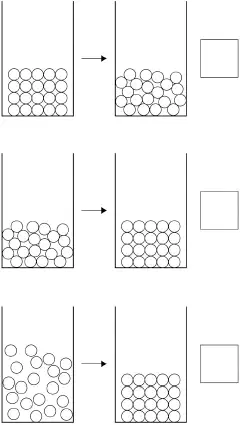
Which diagram shows how the arrangement of particles changes when a solid melts and becomes a liquid?
1
2
3
A scientist had a balloon which was filled with air.
Which statement describes how air particles move?
At random speeds in random directions
At random speeds in the same direction
At the same speed in random directions
At the same speed in the same direction
A scientist had a balloon which was filled with air.
When the balloon was put into liquid nitrogen the temperature of the air in the balloon decreased.
As the air in the balloon cooled down, the speed of the particles_______________.
decreased
stayed the same
increased
A scientist had a balloon which was filled with air.
When the balloon was put into liquid nitrogen the temperature of the air in the balloon decreased.
As the air in the balloon cooled down, the speed of the particles decreased. This is because the kinetic energy of the particles _______________.
decreased
stayed the same
increased
A scientist had a balloon which was filled with air.
When the balloon was put into liquid nitrogen the temperature of the air in the balloon decreased.
The liquid nitrogen boiled. What happens to the temperature of nitrogen as it boils?
Temperature decreases
Temperature stayed the same
Temperature increases
A scientist had a balloon which was filled with air.
When the balloon was put into liquid nitrogen the temperature of the air in the balloon decreased.
The scientist recorded measurements to calculate the specific latent heat of vaporisation of nitrogen.
What is meant by vaporisation?
A change of state from liquid to gas
A change of state from solid to gas
A change of state from solid to liquid
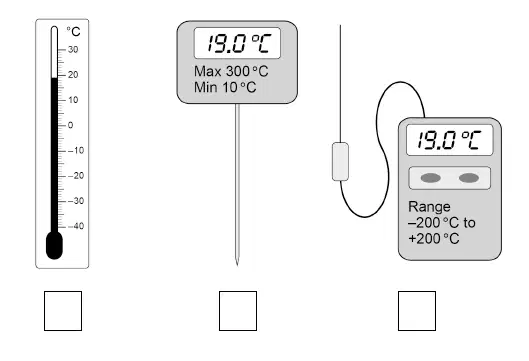
The temperature of the air was 19 °C. The scientist dipped the balloon into liquid nitrogen. The temperature of the liquid nitrogen was −196 °C
Which thermometer could be used to measure the temperature of the liquid nitrogen?
1
2
3
In an experiment, a beam of alpha particles was directed at a thin sheet of gold foil. Most of the alpha particles passed straight through the gold foil. Alpha particles which passed close to the nucleus of a gold atom did not pass straight through. What happened to the alpha particles which passed close to the nucleus of a gold atom?
they changed direction
they stopped
they got stuck in the middle
The results suggested that the diameter of the nucleus of a gold atom is 1/6000 of the diameter of the atom. The diameter of a gold atom is 0.18 nm. Calculate the diameter of a gold nucleus in nm
(a)
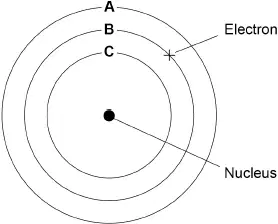
Further experiments showed that gold nuclei are surrounded by electrons in different energy levels. Figure 1 shows three of the energy levels around the nucleus of a gold atom.
The electron in energy level B absorbs electromagnetic radiation. Which energy level will the electron be in after it has absorbed the electromagnetic radiation?
A
B
C
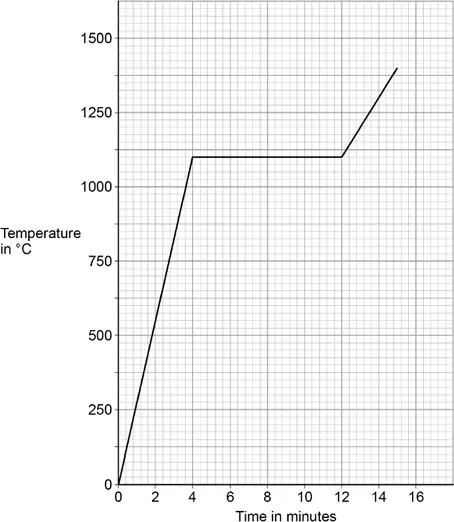
Figure 2 shows how the temperature of a small sample of gold changes as it is heated from a solid to a liquid.
What is the melting point of the gold?
(a)
Figure 2 shows how the temperature of a small sample of gold changes as it is heated from a solid to a liquid.
How many minutes did it take for all of the gold in the sample to change from solid to liquid?
(a)
Figure 2 shows how the temperature of a small sample of gold changes as it is heated from a solid to a liquid.
What does the gradient of the graph in Figure 2 represent?
The internal energy of the gold
The rate of change of temperature of the gold
The specific heat capacity of the gold
Figure 2 shows how the temperature of a small sample of gold changes as it is heated from a solid to a liquid.
How many minutes did it take for all of the gold in the sample to change from solid to liquid?
(a)

Some people used to think that radioactive substances had health benefits. 100 years ago, a company made toothpaste containing the radioactive isotopes radium-228 and radium-226. Figure 1 shows the symbols for these isotopes.
How are atoms of radium-228 different from atoms of radium-226?
Radium-228 atoms have one more neutron and one more proton.
Radium-228 atoms have two more neutrons and two more protons.
Radium-228 atoms have two more neutrons.
Radium-228 atoms have two more protons.
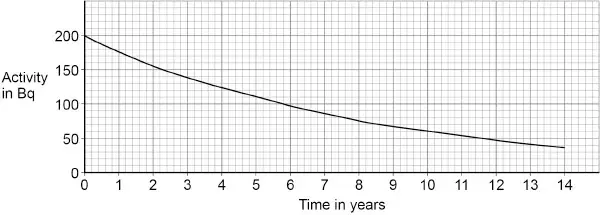
Figure 2 shows how the activity of a sample of radium-228 changed over time.
What is the approximate half-life of radium-228?
6 years
7 years
14 years
100 years
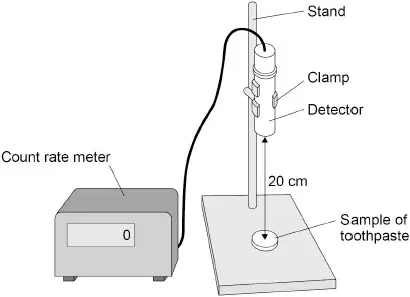
A scientist investigated whether the toothpaste in four tubes of the 100-year-old toothpaste is equally radioactive. Figure 3 shows the equipment used. When the equipment was arranged as shown in Figure 3, it was not possible to detect alpha particles from the toothpaste. Suggest how the scientist adjusted the equipment to detect alpha particles from the toothpaste.
decrease the distance between the toothpaste and the detector
increase the distance between the toothpaste and the detector
keep the distance between the toothpaste and the detector the same
A scientist investigated whether the toothpaste in four tubes of the 100-year-old toothpaste is equally radioactive. Figure 3 shows the equipment used. What was the independent variable in the investigation?
The activity of the toothpaste
The mass of toothpaste used
The temperature of the toothpaste
The tube of toothpaste used
A scientist investigated whether the toothpaste in four tubes of the 100-year-old toothpaste is equally radioactive. Figure 3 shows the equipment used. What was the dependent variable in the investigation?
The activity of the toothpaste
The mass of toothpaste used
The temperature of the toothpaste
The tube of toothpaste used
A scientist investigated whether the toothpaste in four tubes of the 100-year-old toothpaste is equally radioactive. Figure 3 shows the equipment used. When the toothpaste was new, it caused a risk to health because of the nuclear radiation emitted. What happened to the risk to health from the toothpaste after 100 years?
there is less risk
there is more risk
there is no change in risk
A scientist investigated whether the toothpaste in four tubes of the 100-year-old toothpaste is equally radioactive. Figure 3 shows the equipment used. When the toothpaste was new, it caused a risk to health because of the nuclear radiation emitted. Which property makes nuclear radiation hazardous?
Nuclear radiation is ionising.
Nuclear radiation is penetrating.
Nuclear radiation is too small to see.
Nuclear radiation makes objects radioactive.

The scientist adjusted the equipment and determined the activity of the toothpaste from each tube. The table below shows the results. What was the range of activities shown in above table?
(a)
A scientist investigated the radiation emitted by different radioactive isotopes. The scientist had a sample of polonium-210.The radiation emitted by polonium-210 can be represented by the symbol He. Which type of radiation can be represented by the symbol He?
Alpha
Beta
Gamma
How many protons are there in a particle of radiation represented by 42 He?
2
4
6
8

A polonium-210 (Po) nucleus changes into a lead (Pb) nucleus by emitting a He particle. This is shown by the following nuclear equation. What is the value of X?
80
82
84
86

The sample of polonium-210 had an activity of 100 Bq. After one half-life, the activity of polonium-210 in the sample was (a) Bq.

The scientist investigated another radioactive isotope that is a source of gamma radiation. Figure 1 shows the equipment used. The count-rate is the number of counts detected each second. In 30 seconds the number of counts detected was 1500. Calculate the count-rate.
(a)
The scientist investigated another radioactive isotope that is a source of gamma radiation. Figure 1 shows the equipment used. The count-rate is the number of counts detected each second. The scientist placed a thick sheet of lead between the source of gamma radiation and the detector. What was the effect of the sheet of lead on the count-rate?
the count-rate decreased
the count-rate increased
the count-rate stayed the same
The scientist investigated another radioactive isotope that is a source of gamma radiation. Figure 1 shows the equipment used. The count-rate is the number of counts detected each second. The scientist placed a thick sheet of lead between the source of gamma radiation and the detector. The lead was irradiated by the gamma radiation. What happened to the lead when it was irradiated by the gamma radiation?
The lead atoms became radioactive.
The lead gained atoms from the radioactive source.
The lead was exposed to gamma radiation.
The scientist investigated another radioactive isotope that is a source of gamma radiation. Figure 1 shows the equipment used. The count-rate is the number of counts detected each second. In 30 seconds the number of counts detected was 1500. Calculate the count-rate.
(a)
Gamma radiation is emitted from the nucleus of an atom. Gamma radiation consists of ______________________________.
electromagnetic waves
high speed electrons
neutrons
positively charged ions
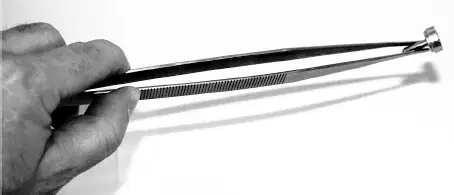
Figure 2 shows the scientist holding the radioactive source using tongs. Suggest one reason why using long tongs rather than short tongs was safer for the scientist.
a greater distance between the scientist and the radioactive source
a shorter distance between the scientist and the radioactive source
increase the amount of radiation the scientist is exposed to
increase the risk of cell mutation

