wayground logo

Free Printable Worksheets

Font size

S
M
L
XL
Worksheets

Thermal Energy Review

Total questions: 115

Worksheet time: 3hrs 16mins

Name
Class
Date
1.

The total amount of energy of the particles is the temperature of an object.

a)

True

b)

False

2.

If the particles of an object begin moving faster...(May be more than one answer)

a)

the temperature will go up

b)

the thermal energy will go up

c)

the mass will go up

d)

the object will move across the floor

3.

Which of the following will increase the thermal energy of an object. (May be more than one answer)

a)

increasing the temperature

b)

increasing the mass

c)

reducing the mass

d)

reducing the temperature

4.

Increasing the mass of an object will increase its temperature

a)

True

b)

False

5.

A substance with a high specific heat requires (more/less) energy to raise the temperature.

(a)  

6.

If you want the temperature to go up quickly, you should choose a substance with a (high/low) specific heat.

(a)  

7.
The amount of energy required to raise the temperature 1ºC for every kilogram is called____?
a)
Thermal Energy
b)
Specific Heat
c)
Temperature
d)
Kinetic Energy
8.

A camp stove has 2,006,800 j of fuel available. How many kg of water can it heat from 20 degrees Celsius to boiling (100 degrees C)?

(a)  

9.

A measure of the average kinetic energy of particles in a substance

a)

temperature

b)

heat energy

c)

heat transfer

d)

conduction

10.

Scientific law stating that energy can be neither created nor destroyed but just changes form

a)

Law of Conservation of Energy

b)

Law of Order

c)

Law of Energy

d)

Law of Convection Current

11.

The total kinetic (motion) energy of the tiny particles that make up matter; the faster the particles move, the warmer the matter becomes

a)

convection

b)

temperature

c)

thermal energy

d)

fire

12.

The total amount of energy of the particles is the temperature of an object.

a)

True

b)

False

13.

If the particles of an object begin moving faster...(May be more than one answer)

a)

the temperature will go up

b)

the thermal energy will go up

c)

the mass will go up

d)

the object will move across the floor

14.

Which of the following will increase the thermal energy of an object. (May be more than one answer)

a)

increasing the temperature

b)

increasing the mass

c)

reducing the mass

d)

reducing the temperature

15.

Increasing the mass of an object will increase its temperature

a)

True

b)

False

16.

A substance with a high specific heat requires (more/less) energy to raise the temperature.

(a)  

17.

If you want the temperature to go up quickly, you should choose a substance with a (high/low) specific heat.

(a)  

18.
The amount of energy required to raise the temperature 1ºC for every kilogram is called____?
a)
Thermal Energy
b)
Specific Heat
c)
Temperature
d)
Kinetic Energy
19.

A camp stove has 2,006,800 j of fuel available. How many kg of water can it heat from 20 degrees Celsius to boiling (100 degrees C)?

(a)  

20.

A measure of the average kinetic energy of particles in a substance

a)

temperature

b)

heat energy

c)

heat transfer

d)

conduction

21.

Scientific law stating that energy can be neither created nor destroyed but just changes form

a)

Law of Conservation of Energy

b)

Law of Order

c)

Law of Energy

d)

Law of Convection Current

22.

The total kinetic (motion) energy of the tiny particles that make up matter; the faster the particles move, the warmer the matter becomes

a)

convection

b)

temperature

c)

thermal energy

d)

fire

23.
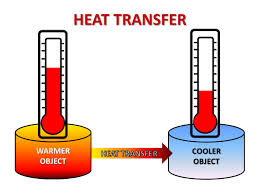
The movement of thermal energy from a warmer object to a cooler object is called:
a)
heat
b)
temperature
c)
motion
d)
momentum
24.
Heat transfer occurs:
a)
in many directions
b)
both from warm objects to colder ones and from cold objects to warmer ones
c)
only from warm objects to colder ones
d)
only from cold objects to warmer ones
25.

The direct transfer of heat from one substance to another substance that it is touching.

a)

convection

b)

conduction

c)

temperature

d)

radiation

26.

Burning your finger on a hot pan is an example of

a)

convection

b)

conduction

c)

radiation

d)

conservation

27.
When holding a cup of ice water, your warm hand becomes cold. How does the heat transfer?
a)
From the cold cup to your hand
b)
From the cold cup to the warm air
c)
From the ice to your hand
d)
From your warm hand to the cold cup.
28.
Conductors are materials that...
a)
Allow heat to pass through
b)
Stop heat from passing through
c)
Allow cold to pass through
d)
Stop cold from passing through
29.
What is one type of good conductor that we learned about in class?
a)
Most plastics
b)
Most fruits
c)
Most wood products
d)
Most metals
30.
Heat will always flow from
a)
from warmer object to a cooler object
b)
inside and object to outside an object
c)
from a cooler object to a warmer object
d)
up to down
31.
The heat from a hot burner to a pot is transferred by ______.
a)
convection
b)
insulation
c)
radiation
d)
conduction
32.
What is the equation to measure change in Thermal Energy?
a)
Q=mc∆t
b)
Q=mc
c)
Q= ∆mct
d)
m=QC
33.

Helium balloons rise on earth because

a)

helium is less dense than the air around it

b)

helium is more dense than the air around it

c)

helium is cooler than the air around it
34.
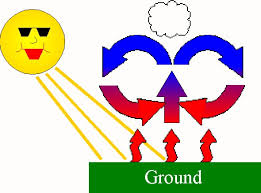
Warm air rises and the cool air sinks demonstrates this type of heat transfer. 
a)
conduction
b)
convection
c)
radiation
d)
Insolation 
35.
What happens when ice cubes melt in a glass?
a)
Heat travels from the ice to the warmer water.
b)
No energy is transferred.
c)
Heat is transferred from the warmer water to the ice cubes.
d)
The water warms up due to the humidity
36.
A brick sinks in water while a wooden block of the same size floats.  This is because the brick has a
a)
lower volume than the wooden block
b)
lower density than the wooden block
c)
higher volume than the wooden block
d)
higher density than the wooden block
37.
Which example below is an example of convection?
a)
Standing on a hot metal bridge
b)
The attic is warmer than the basement
c)
The Sun heating the Earth
d)
Touching hot sand with your feet
38.
Which example below is an example of radiation?
a)
Standing on a hot metal bridge
b)
The attic is warmer than the basement
c)
The Sun heating the Earth
d)
Touching hot sand with your feet
39.
Light is a form of __________ energy. 
a)
Sound 
b)
Electromagnetic
c)
Fun
d)
Thermal 
40.
What is the symbol for Thermal Energy in the specific heat formula?
a)
Q
b)
t
c)
m
d)
C
41.
A barefoot student steps on a hot concrete surface. Most of the heat transferred to the student’s skin by this contact is by the process of—
a)
convection
b)
conduction
c)
vaporization
d)
radiation
42.
There are four cups of hot cocoa. The cup sizes are shown. The temperature of the cocoa in each cup is 25 degrees celsius. Which cup has the MOST thermal energy?
a)
Large cup (Trenta)
b)
Small cup (Tall)
c)
Medium cup (Venti)
d)
All three are the same temperature so they have the same thermal energy
43.
The diagram to the right shows a solid iron bar that is being heated in a flame. The primary method of heat transfer in the solid iron bar is—
a)
convection
b)
conduction
c)
absorption
d)
radiation
44.
What unit do you use to measure Thermal Energy?
a)
J/Kg ºC
b)
Kg
c)
ºC
d)
J
45.
How do molecules at warm temperatures differ from molecules at cool temperatures? 
a)
a.  At warm temperatures, molecules move around more
b)
b.  At warm temperatures, molecules grow in siz
c)
c.  At warm temperatures, molecules exchange electrons more easil
d)
d.  At warm temperatures, molecules combine with each other more easil
46.
Copper, Stainless Steel, Carbon Steel, and Zinc were all heated using 10,000 JOULES of thermal energy.  What material would be have the LARGEST change in temperature?
a)
Copper
b)
Carbon Steel
c)
Zinc
d)
Stainless Steel
47.
Why is there more thermal energy in an iceberg than in a pot of boiling water?    
a)
a.  The pot insulates the heated molecules
b)
b.  Most icebergs are fairly warm to the touch
c)
  c.  Icebergs contain many more molecules than pots of water
d)
  d.  Water does not hold heat very well
48.
A high specific heat means...
a)
It requires less energy to change temperature
b)
It requires more energy to change temperature
c)
It heats up very quickly
49.
What materials would be good insulators for a handle on a pan or pot that would be used on the stove?
a)
wood or plastic
b)
metal or rubber
c)
wood or rubber
d)
copper or steel
50.
When a  piece of aluminum foil is taken out of the oven and cools from 100° C to 50°C, What is the change in temperature?
a)
50°
b)
c)
100°
d)
150°
51.
Conduction can only occur between two objects when –
a)
one object is less dense than the other.
b)
both objects are in physical contact with each other.
c)
one of the objects is made of a metal.
d)
both objects are exactly the same temperature.
52.
If 200 grams of water is to be heated from 24.0° C to  100.0° C to make a cup of tea, what is the mass and what is the change in temperature?
a)
m=100g,  ∆t= 224 C
b)
m=200g,  ∆t=124 C
c)
m=100g,  ∆t=24 C
d)
m=200g,  ∆t=76 C
53.
Which of the following is an example of conduction?
a)
Solar energy warming a room.
b)
Heat rising from the coils of a stove.
c)
Hot air drying a wet towel.
d)
Heat moving from a clothes iron to a shirt.
54.
There are 2 pans of water, one has 100 mL in it and one has 1000mL. You add 4000 joules of energy,  which one has the bigger change in temperature?
a)
100 mL
b)
1000 mL
c)
They the same material so they both heat to the same temperature
d)
They both will cool down.
55.
The particles of a gas move ____than the particles of the same substance in the liquid or solid state.
a)
faster
b)
slower
c)
same speed
56.
If I have 2 blocks of Aluminium (one of 1kg and one of 10 kg) and heat them up with 6,000 Joules of energy.
Which one will have the SMALLEST change in temperature?
a)
1 kg
b)
10 kg
c)
They both heat up  to the same temperature
d)
It depends on the temperature of the room
57.
Which of the following are kinds of heat transfer.
a)
Conduction
b)
Convection
c)
Radiation
d)
All of the above
58.
20 g of water. specific heat of water is 4.18 J/g°C.  temperature changes from 25° C to 20° Chow much heat energy (Q) moves from the water to the surroundings?
a)
418 Joules
b)
209 J
c)
83 J
d)
4.18 J
59.

Heat will always transfer from the ___________ object to the ________ object.

a)

The hottest object to the coolest object.

b)

The coolest object to the hottest object.

c)

The solid object to the liquid object.

d)

The liquid object to the solid object.

60.
The specific heat(c) of copper is 0.39 J/g °C. What is the temperature change(∆t) when 100 Joules of heat(Q) is added to 20 grams of copper?
a)
12.82 °C
b)
24.12°C
c)
351 °C
61.
When the 2nd story of a house is warmer than the 1st floor of a house is heat transfer through 
a)
conduction
b)
convection
c)
radiation
d)
thermal equilibrium
62.
lowest possible temperature on the Kelvin scale
a)
boiling point
b)
insulation
c)
absolute zero
d)
heat
63.
The sun warming your skin is an example of heat transfer through 
a)
conduction
b)
convection
c)
radiation
d)
thermal electricity
64.

What letter is used to represent specific heat capacity?

a)

H

b)

P

c)

C

d)

T

65.
 How many joules of heat are needed to raise the temperature of 10.0 g of aluminum from 22°C to 55°C, if the specific heat of aluminum is 0.90 J/gx°C?    
a)
297 Joules
b)
0.003 Joules
c)
297 J/gx°C
d)
0.003 J/gx°C
66.

The specific heat of platinum is 0.133 J/g°C. How much heat(Q) is released when a 10 g piece of platinum cools from 100°C to 50°C?

a)

66.5 J

b)

665 J

c)

0.0266 J

d)

0.665 J

67.
What  is the formula to calculate heat energy required to raise the temperature of any substance?
a)
Q=mc∆t
b)
Q=mc
c)
Q= ½mv
d)
m=QC
68.
The temperature of an unknown piece of metal with a mass of 30.00 g changes from 25.0 °C to 35.0 °C when the metal absorbs 350.0 J of energy. What is the specific heat of the metal?
a)
1.17 J/g°C
b)
-1.17 J/g°C
c)
0.857 J/g°C
d)
-0.857 J/g°C
69.
Is a measure of how hot or cold something is 
a)
Cold
b)
Heat
c)
Temperature
d)
Thermal Energy 
70.
Specific heat of water is  4.18 J/g°C. Specific heat of wood is 1.760 J/g°What material needs more heat energy to raise the temperature?
a)
Water
b)
Wood
c)
Both are same
71.
The flow of thermal energy from warmer objects to cooler objects 
a)
Ice Cold
b)
Heater
c)
Heat
d)
Convection 
72.
A pot of 2400g of water at a temperature of 25˚C is heated on a stove until the water boils (100˚C).  The specific heat of water is 4.18 J/(g˚C).
Determine the heat energy needed to heat the water in the pot to boiling.
a)
133.76J
b)
43,062.2J
c)
752,400J
d)
1,003,200J
73.
The energy of moving particles
a)
heat
b)
thermal energy
c)
school
d)
temperature
74.

The specific heat(c) of copper is 0.39 J/g °C. What is the temperature change(∆t) when 100 Joules of heat(Q) is added to 20 grams?

a)

12.82 °C

b)

24.12°C

c)

1.95 °C

d)

5128 °C

75.
What would be the effect on the particles if more heat is supplied to the system?
a)
They would slow down
b)
They would stop moving
c)
They would speed up
d)
There would be no effect
76.

Which will heat up faster?

a)

copper

b)

granite

c)

iron

d)

basalt

77.
A high specific heat means...
a)
It heats up quickly with energy added
b)
It requires more energy to change temperature
78.

Which of the following best explains why the sand at the beach is hotter than the water?

a)

Sand has a higher specific heat than water.

b)

Sand has a lower specific heat than water.

c)

There is more water than sand at the beach.

d)

There is more sand than water at the beach.

79.
If I heat up 2 pans of water one has 100 mL in it and one has 1000mL. Which one heats up the fastest?
a)
100 mL
b)
1000 mL
c)
They both heat up at the same speed
d)
They cool down.
80.
How does heat flow?
a)
Always from cold to warm
b)
Always from warm to cold
c)
Both warm to cold & cold to warm
d)
It depends on the temperature
81.
Water has a specific heat of 4184 J/KgºC.  Wood has a specific heat of 1760 J/KgºC.  What material needs more energy to raise the temperature 1ºC
a)
Wood
b)
Water
c)
Both are the same
82.
What would be the effect on the particles if more heat is supplied to the system?
a)
They would slow down
b)
They would stop moving
c)
They would speed up
d)
There would be no effect
83.

_____________ is the form of energy that is transferred between systems or objects with different temperatures.

a)

Temerature

b)

Heat

c)

Specific Heat

d)

Mechanical Energy

84.
If you place some Gatorade in a cooler with ice...
a)
It's particles will speed up.
b)
It's particles will slow down.
85.

How does heat energy reach the Earth from the Sun

a)

Convection

b)

Radiation

c)

Conduction

d)

Insulation

86.
A measure of the average kinetic energy of the individual particles in an object is called:
a)
thermal energy
b)
conduction
c)
convection
d)
temperature
87.
What is the definition of CONDUCTION?
a)
When heat is transferred from objects like rays of light or electromagnetically.
b)
a  hot liquid or air that  expands, becomes less dense, and rises or becomes more dense, and sinks.
c)
When heat transfers from objects that are touching.
d)
When heat transfers through the heater or AC in your house.
88.

If  Q=mcΔTQ=mc\Delta T  , what is ΔT\Delta T   

a)

ΔT=Qmc\Delta T=\frac{Q}{mc}  

b)

ΔT=mcQ\Delta T=\frac{mc}{Q}  

c)

ΔT=Qmc\Delta T=Qmc  

d)

ΔT=mQc\Delta T=\frac{m}{Qc}  

e)

c=QmΔTc=\frac{Q}{m\Delta T}  

89.

What is the definition of CONVECTION

a)

When heat transfers through waves.

b)

When heat transfers from objects that are touching.

c)

Heat transfer when a liquid or gas heats up, expands, becomes less dense and rises; or cools, becomes more dense, and sinks.

d)

Heat traveling from the sun

90.
 How many joules of heat are needed to raise the temperature of 10.0 g of aluminum from 22°C to 55°C, if the specific heat of aluminum is 0.90 J/gx°C?    
a)
297 Joules
b)
0.003 Joules
c)
297 J/gx°C
d)
0.003 J/gx°C
91.
Which of the following is an example of convection?
a)
A hair dryer is drying up your hair.
b)
When the AC or heater changes the temperature.
c)
When a car engine turns hot after being turned on.
d)
When you are making soup and the water is rising and lowering.
92.
Heat transfers from an area of ____temperature to an area of ___ temperature.
a)
high to low
b)
low to high
c)
high to high
d)
It can travel high to low and low to high. 
93.

_________________ is the transfer of energy through or by electromagnetic waves.

a)

Conduction

b)

Convection

c)

Radiation

94.
Mittens help keep your hands warm in winter because:
a)
They are conductors of heat.
b)
They are fuzzy.
c)
They are conductors of electrical energy.
d)
They are insulators.
95.

As water in a freezer turns into ice,

a)

a. the water absorbs energy from the air in the freezer.

b)

b. the water absorbs the coldness from the air in the freezer.

c)

c. the freezer air absorbs heat from the water.

d)

d. the water neither absorbs nor releases energy

96.

Amy wraps her dolls in blankets but can’t understand why they don’t warm up. Why don’t they warm up?

a)

a. The blankets she uses are probably poor insulators.

b)

b. The blankets she uses are probably poor conductors.

c)

c. The dolls are made of materials that don’t hold heat well.

d)

d. None of the above.

97.

Why do we wear sweaters in cold weather?

a)

a. To keep cold out.

b)

b. To generate heat.

c)

c. To reduce heat loss.

d)

d. All of the above.

98.

You pick up a can of soda off of the countertop. The countertop underneath the can feels colder than the rest of the counter. Which explanation do you think is the best?

a)

The cold has been transferred from the soda to the counter.

b)

There is no heat energy left in the counter beneath the can.

c)

Some heat has been transferred from the counter to the soda.

d)

The heat beneath the can moves away into other parts of the countertop.

99.
The amount of energy required to raise the temperature 1ºC for every kilogram is called____?
a)
Thermal Energy
b)
Specific Heat
c)
Temperature
d)
Kinetic Energy
100.
What is the symbol for Specific Heat
a)
Q
b)
t
c)
m
d)
C
101.
Water has a specific heat of 4184 J/KgºC.  Wood has a specific heat of 1760 J/KgºC.  What material needs more energy to raise the temperature 1ºC
a)
Wood
b)
Water
c)
Both are the same
102.
A material was cooled from 100ºC to 40ºC.  What is the temperature change?
a)
60ºC
b)
40ºC
c)
-60ºC
d)
-40ºC
103.
How does heat flow?
a)
Always from cold to warm
b)
Always from warm to cold
c)
Both warm to cold & cold to warm
d)
It depends on the temperature
104.
For a skillet, used for cooking, do you want a high or low specific heat
a)
High, so that it will need more energy to heat up
b)
Low, so that it will change temperature quickly
105.

20.0 g of water. specific heat of water is 4.184 J/g°C. temperature changes from 25.0° C to 20.0° C, how much heat energy (Q) moves from the water to the surroundings?

a)

418 Joules

b)

209 J

c)

83 J

d)

4.18 J

106.

The total kinetic energy in a substance is its (a)  

107.

The average kinetic energy in an object is its (a)  

108.

The movement of thermal energy due to a change in temperature is (a)  

109.

Thermal energy flows from areas of

a)

high temperature to low temperature

b)

low temperature to high temperature

c)

low density to high density

d)

high density to low density

110.

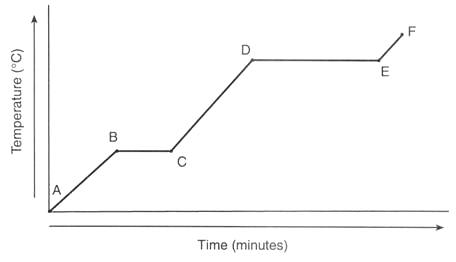
Between which points is the temperature of the substance remaining constant?

a)

A-B only

b)

A-B, C-D, and E-F

c)

B-C only

d)

B-C and D-E

111.

The melting point of the sample is

a)

-60 ºC

b)

20 ºC

c)

60 ºC

d)

100 ºC

112.

Which letter indicates where water is in both the solid and liquid phase at the same time?

a)

A

b)

B

c)

C

d)

D

e)

E

113.

In which region(s) does temperature increase?

a)

Region C only

b)

Regions B and D

c)

Regions A, C, and E

d)

Regions A and B

114.

Describe the substance at letter A.

a)

Solid

b)

Liquid

c)

Melting

d)

Evaporating

115.

At which letter is the substance changing its state of matter?

a)

A only

b)

A, C, and E

c)

D and E

d)

B and D