wayground logo

Free Printable Worksheets

Font size

S
M
L
XL
Worksheets

Periodic Table Ions Isotopes Acids and Bases

Total questions: 112

Worksheet time: 37mins

Name
Class
Date
1.
What is an ion?
a)
A Charged Atom
b)
A Large Atom
c)
A Small Atom
d)
A Cute Atom
2.
Barium atoms want to form...
a)
an anion
b)
a cation
c)
an onion
d)
a cuddly kitten friend
3.
An Arsenic atom wants to form...
a)
An anion
b)
A cation
c)
An onion
d)
A cuddly kitten friend
4.
Why are ions formed?
a)
To make our lives difficult
b)
Because atoms want 8 valence electrons
c)
Because atoms have the same number of protons and electrons
d)
Because atoms gained neutrons
5.
Cations are...
a)
Positive
b)
Negative
c)
Neutral
d)
Purring
6.
Anions are...
a)
Positive
b)
Negative
c)
Neutral
d)
Crying
7.
An atom becomes _________ when it gains electrons.
a)
Positive
b)
Negative
c)
Neutral
d)
Invinsible
8.
An atom becomes _______ when it loses electrons.
a)
Positive
b)
Negative
c)
Neutral
d)
Invinsible
9.
Which particles change the charge in atoms when ions are formed?
a)
Protons
b)
Electrons
c)
Neutrons
d)
Kittens
10.
What is the ionic symbol for Krypton?
a)
Kr
b)
Kr+
c)
Kr-
d)
Kr-2
11.
What is the ionic symbol for a Caesium atom?
a)
Cs+
b)
Cs-
c)
Cs+2
d)
Cs-2
12.

Na ionizes to a charge of _______

a)

+1

b)

+2

c)

-1

d)

-2

13.

Li ionizes to a charge of _________

a)

+2

b)

+1

c)

-1

d)

-2

14.

K ionizes to a charge of _________.

a)

+1

b)

+2

c)

-1

d)

-2

15.

Mg ionizes to a charge of ______.

a)

+1

b)

+2

c)

-1

d)

-2

16.

Ca ionizes to a charge of _______.

a)

+1

b)

+2

c)

-1

d)

-2

17.

Al ionizes to a charge of _______.

a)

+3

b)

-3

c)

+2

d)

-2

18.

N ionizes to a charge of _______.

a)

+3

b)

-3

c)

+2

d)

-2

19.

P ionizes to a charge of _______.

a)

+3

b)

-3

c)

+2

d)

-2

20.

O ionizes to a charge of ________.

a)

+1

b)

+2

c)

-1

d)

-2

21.

Cl ionizes to a charge of _________.

a)

-2

b)

-1

c)

+1

d)

+2

22.

F ionizes to a charge of ________.

a)

-2

b)

-1

c)

+1

d)

+2

23.
Valence electrons are: 
a)
Electrons farthest away from the nucleus
b)
Electrons closest to the nucleus
c)
Electrons that just come and go - they don't stay with the atom
24.
Ions are: 
a)
atoms with a positive or negative charge
b)
atoms with no charge
c)
atoms with ONLY a positive charge
d)
atoms with ONLY a negative charge
25.
When an atom loses a valence electron, it becomes a(n) _____________ ion.
a)
positive
b)
negative
c)
neutral
d)
polyatomic
26.
Negative ions form when atoms _________ valence electrons.
a)
lose
b)
gain
c)
share
27.
all matter is made of what 
a)
energy 
b)
atoms 
c)
electrons 
d)
compounds 
28.
The positive particles of an atom are 
a)
electrons 
b)
positrons 
c)
neutrons 
d)
protons 
29.
the central region of an atom where its neutrons and protons are is its 
a)
nucleus 
b)
electron cloud
c)
core 
d)
center 
30.
an atom with atomic number 6 would have how many protons 
a)
6
b)
12
c)
3
d)
cannot be determined 
31.
Particles in an atom that are neutral and have no charge are 
a)
negatrons 
b)
electrons 
c)
neutrons 
d)
protons 
32.
True or False? Neutrons have a negative charge
a)
True
b)
False
33.
Elements on the LEFT side of the periodic table will most likely form:
a)
Positive ions
b)
Negative ions
c)
Neutral Ions
d)
None of these
34.
Cations are...
a)
Positive
b)
Negative
c)
Neutral
d)
Purring
35.
An atom becomes _______ when it loses electrons.
a)
Positive
b)
Negative
c)
Neutral
d)
Invinsible
36.

Ionic bonds form between two ions that have

a)

negative charges

b)

positive charges

c)

opposite charges

37.

Cations are...

a)

Positive

b)

Negative

c)

Neutral

38.

An atom becomes _________ when it gains electrons.

a)

Positive

b)

Negative

c)

Neutral

39.
Cations are _______ that form ____________ ions and __________ electrons.
a)
nonmetals, positive, lose
b)
nonmetals, negative, gain
c)
metals, positive, gain
d)
metals, positive, lose
40.
Anions are _______ that form ____________ ions and __________ electrons.
a)
nonmetals, positive, lose
b)
nonmetals, negative, gain
c)
metals, positive, gain
d)
metals, positive, lose
41.
Anions are _______ that form ____________ ions and __________ electrons.
a)
nonmetals, positive, lose
b)
nonmetals, negative, gain
c)
metals, positive, gain
d)
metals, positive, lose
42.

When an atom loses a valence electron, it becomes a(n) _____________ ion.

a)

positive

b)

negative

c)

neutral

43.

When an atom gains a valence electron, it becomes a(n) _____________ ion.

a)

positive

b)

negative

c)

neutral

44.
Where are the nonmetals located on the periodic table? 
a)
Blue
b)
Red
c)
Green
45.
Where are metals located on the periodic table?
a)
Blue
b)
Green
c)
Red
46.
What is the charge of an atom that has lost one electron?
a)
-1
b)
-2
c)
+1
d)
+2
47.
What is the charge of an atom that has gained one electron?
a)
-1
b)
-2
c)
+1
d)
+2
48.

Metals are:

a)

Usually cations

b)

Usually anions

49.
What will nitrogen's charge be as an ion (What is the charge of the nitride ion)?
a)
+3
b)
-3
c)
0
d)
-1
50.
How many electrons will a neutral potassium atom lose to become stable?
a)
1
b)
2
c)
8
d)
7
51.
How many total electrons does O-2 (an oxide ion) have?
a)
8
b)
10
c)
6
d)
18
52.
How many total electrons does Mg+2 (a magnesium ion) have?
a)
10
b)
12
c)
14
d)
22
53.
How many total electrons does Na+1 (a sodium ion) have?
a)
10
b)
11
c)
12
d)
22
54.
What charge will an oxide ion have? 
a)
+1
b)
-1
c)
+2
d)
-2
55.
If an element has 3 valence electrons, what charge will its ion most likely have?
a)
+3
b)
+5
c)
-3
d)
-5
56.
How many electrons will a neutral sulfur atom gain to become stable?
a)
2
b)
6
c)
8
d)
3
57.
Will a neutral neon atom gain or lose electrons to become stable?
a)
gain
b)
lose
c)
neither
58.
How many electrons are in a Li+ ion?
a)
1
b)
2
c)
3
d)
4
59.
Which is the correct symbol for the element with 8 protons and 10 electrons?
a)
N3-
b)
O2-
c)
O3-
d)
F-
60.
Sodium ion
a)
Na²⁺
b)
K²⁺
c)
Li⁺
d)
Na⁺
61.
When an atom loses a valence electron, it becomes a(n) _____________ ion.
a)
positive
b)
negative
c)
neutral
d)
polyatomic
62.
When an atom gains a valence electron, it becomes a(n) _____________ ion.
a)
positive
b)
negative
c)
neutral
d)
polyatomic
63.
Atoms are most stable when their outer shell is filled with electrons.
a)
true
b)
false
64.
Adding or subtracting neutrons (charge = 0, mass = 1) makes the element change into an...
a)
ion
b)
mixture
c)
isotope
d)
neutral atom
65.
The atomic number is equal to _.
a)
the number of protons and electrons
b)
the number of neutrons only
c)
the total number of protons and neutrons
d)
the number of protons neutrons and electrons
66.
Helium (He atomic number 2) has 2 protons, 2 neutrons, and 2 electrons) is the He element shown above an atom, an element, or an isotope?
a)
atom
b)
cation  (+ ion)
c)
isotope
d)
anion (-)
67.
The atomic mass is equal to _.
a)
the number of protons only
b)
the number of neutrons only
c)
the total number of protons and neutrons
d)
the number of protons, neutrons, and electrons.
68.
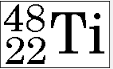
How many protons does this isotope of titanium have? Hint titanium has an atomic number of 22.
a)
48
b)
22
c)
26
d)
70
69.
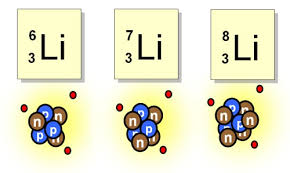
Which atom has  4 neutrons?
a)
Li-6
b)
Li-7
c)
Li-8
d)
they have the same # of neutrons
70.
How many neutrons does Lithium have (atomic mass = 6.94)
a)
3
b)
4
c)
6.94
d)
24.94
71.
How many protons are in this element?
a)
79
b)
196
c)
117
d)
Cannot be determined
72.
What is the number of protons?
a)
34
b)
16
c)
18
d)
S
73.
What is the number of neutrons?
a)
34
b)
79
c)
45
d)
35
74.
If you have 10 protons and 9 neutrons, what would the mass number be?
a)
19
b)
9
c)
10
d)
1
75.
What is the definition of isotope?
a)
atoms of an element with different numbers of neutrons.
b)
materials break down over time at a very consistent rate
76.
What do these isotopes of carbon all have in common?
a)
neutrons & mass number
b)
atomic number and neutrons
c)
atomic number and electrons
d)
protons, atomic number, and mass number
77.

What is a representation of an ion?

a)

Li

b)

Na-22

c)

O-2

78.

What is the mass number of bromine?

a)

35

b)

45

c)

80

d)

79.904

79.

What is the mass number of this Neon atom?

a)

10

b)

11

c)

21

d)

20

80.

How many neutrons does this Neon atom have?

a)

21

b)

11

c)

10

d)

12

81.
If an atom gains electrons when forming an ion, the charge will be:
a)
positive
b)
negative
c)
neutral
82.
If an atom gains electrons, what type of ion is formed?
a)
cation
b)
anion
83.
If an atom loses electrons, what type of ion is formed?
a)
cation
b)
anion
84.
What type of ions do metals form?
a)
cations
b)
anions
85.
What types of ions do nonmetals form?
a)
cations
b)
anions
86.
If two ions with equal and opposite charges come near one another, they form:
a)
an ionic bond
b)
a covalent bond
c)
a black hole 
d)
a hydrogen bond
87.
In the chemical formula for an ionic compound, which item is written first?
a)
positive ion
b)
negative ion
c)
subscript
d)
the female
88.
What will be the compound name of the following chemical formula?
NaCl
a)
Potassium Chloride
b)
Sodium Chloride
c)
Calcium Chloride
d)
Sodium Chlorine
89.
Ionic bonds form between metals and ____.
a)
metalloids
b)
metals
c)
nonmetals
90.
Carbon-13 differs from carbon-12 by:
a)
1 extra neutron
b)
1 less neutron
c)
1 extra proton
d)
1 extra electron
91.
The atomic number is always equal to the number of:
a)
neutrons.
b)
protons and electrons.
c)
protons.
d)
particles in the nucleus.
92.
Ion made of single atom?
a)
Monoatomic ion
b)
Polyatomic Ion
c)
Lonely Ion
d)
Anxious Ion
93.
Ion made of more than one atom?
a)
Monoatomic ion
b)
Polyatomic Ion
c)
Lonely Ion
d)
Anxious Ion
94.
What are monoatomic ions?
a)
Single atoms carrying a positive or negative charge.
b)
A group of more than one atom carrying a positive or negative charge.
c)
Sick atoms who have caught 'mono' by kissing too many other questionable atoms.
95.
Which has a pH below 7?
a)
Acid
b)
Base
96.

What pH is the strongest base?

a)

1

b)

7

c)

4

d)

14

97.
Which of the following is most likely to be basic:
a)
Lemon juice
b)
Vinegar
c)
Laundry detergent
d)
Coke
98.
Which of these pH values would indicate that a solution is a weak base?
a)
4
b)
5.6
c)
8
d)
13
99.
Human blood has a pH between 7.35 and 7.45. Which of the following best describes human blood?
a)
strongly acidic
b)
slightly acidic
c)
strongly basic
d)
slightly basic
100.
The pH scale is a range from:
a)
1-7
b)
0-14
c)
1-5
d)
1-20
101.
A(n) ______ is a substance with a pH less than 7
a)
Acid
b)
Alkaline
c)
Base
d)
Buffer
102.
A(n) _______ is a substance with a pH greater than 7.
a)
Base
b)
Acid
c)
Buffer
d)
Water
103.
What is the only substance with a neutral pH of 7?
a)
Milk
b)
Orange Juice
c)
Water
d)
Blood
104.
Complete the sentence.
A substance that is more basic has a _____ pH than a substance that is acidic.
a)
lower
b)
higher
c)
the same
d)
none of the above
105.

A base is a substance

a)

That releases OH- ions when dissolved in water

b)

That releases H+ ions when dissolved in water

c)

Does not release any ions when dissolved in water

d)

None of the above

106.
On the pH scale higher numbers indicate
a)
acids
b)
bases
107.
A solution has a pH of 7.0.  What would happen to the pH if H ions were added?
a)
pH would go up
b)
pH would go down
c)
pH would stay the same
d)
None of these
108.
A solution has a pH of 7.0.  What would happen to the pH if OH ions were added?
a)
pH would go up
b)
pH would go down
c)
pH would stay the same
d)
None of these
109.
The atomic number is equal to _.
a)
the number of protons and electrons
b)
the number of neutrons only
c)
the total number of protons and neutrons
d)
the number of protons neutrons and electrons
110.
How many protons does this isotope of titanium have? Hint titanium has an atomic number of 22.
a)
48
b)
22
c)
26
d)
70
111.

The atomic mass of an element is defined as the weighted average mass of that element’s

a)

naturally occurring isotopes

b)

least abundant isotope

c)

radioactive isotopes

d)

most abundant isotope

112.
What is the atomic number?
a)
the number of protons
b)
the number of protons and neutrons
c)
the number of neutrons
d)
the number of protons and electrons