
 Worksheets
Psychological Development
Total questions: 111
Worksheet time: 3605secs
The "nature' part of the nature/nurture debte refers to:
the behavioral we acquired throughout our lives
the environment
the biological dispositions we're born with
the outside world
Which of the following is the best example of "nature" in the nature v nurture debate?
living in an urban environment
prenatal care
being raised in a bilingual home
genetic makeup
Which of the following is the best example of "nurture" in the nature v nurture debate?
your chromosomes
your DNA
genetic mutations
environment
A woman marries a colorblind man. If they wish to conceive a child, which factors will most likely affect the vision of their offspring?
mother's genes
prenatal environment
mother's and father's genes
the environment they live in
Inside the nucleus of every cell in our body, except sex cells, are 46:
chromosomes
DNA
genomes
phenomes
Siblings that develop from a single fertilized egg that splits in two are called:
conjoined twins
dizygotic twins
fraternal twins
identical twins
A brother and a sister who are twins have to be:
fraternal twins
identical twins
very similar in appearance
monozygotic twins
The heritability of a trait refers to:
how likely we are to teach our children certain habits and traits
how much genes contribute to a certain trait
how much our environment contributes to a certain trait
the survival advantages a certain trait gives an organism in a given environment
The “nuture” argument suggests that people socialize and behave in certain ways because of
the way they are born
the way they are raised
the genes they get from their parents
the cultural expectations of the society
The “nature” argument suggests that people socialize and behave in certain ways because of
the way they are born
the way they are raised
the friends they socialise with
the cultural expectations of the society
Fraternal twins share the same genetic make up.
True
False
Twins who come from one fertilised egg and have the same genetic makeup.
fraternal twin
zygotic twins
paternal twins
identical twins
The basic building blocks of heredity
genes
chromosomes
DNA
RNA
Twins who come from two different eggs, fertilised by two different sperm.
identical twins
zygotic twins
fraternal twins
Paternal
The heritability of a trait refers to:
how likely we are to teach our children certain habits and traits
how much genes contribute to a certain trait
how much our environment contributes to a certain trait
the survival advantages a certain trait gives an organism in a given environment
A set of genes that are inherited from biological parents.
genotype
phenotype
parental chromosomes
biological genes
The observable properties of the body and behavioural characteristics.
genotype
phenotype
environmental effect
the way we look
The physical growth and development of the body, brain and nervous system at fairly predictable stages in the lifespan.
development
puberty
maturation
growth
A period of time in which the majority of people develop certain skills or abilities.
developmental norms
developmental stages
skill development stages
lifespan development norms
The ideal period of time to be exposed to certain environmental stimuli for development to occur:
critical period
sensitive period
ideal period
developmental period
A sensitive period is linked to the concept of:
experience - dependent learning
expectant - dependent learning
dependent - developmental learning
experience - expectant learning
Examples of behaviour that occur during a sensitive period are:
language
reading and writing
vision
co-ordination and balance
If a specific behaviour hasn't been developed during a sensitive period then it is impossible to learn this behaviour later in life?
true
false
A short period of time in the lifespan to be exposed to certain environmental stimuli for development to occur:
sensitive period
optimal period
critical period
ideal period
If the window closes on a critical period the learning becomes almost impossible to develop at a later stage of life:
true
false
Certain events must occur during a critical period for a person to develop normally:
true
false
Most sensitive and critical periods can be found in the first years of development of most species. This is connected to the concept that:
the reduction of plasticity of the brain as we age.
the increasing plasticity of the brain as we age.
adults have greater brain plasticity than children
the adult brain is larger than a child's
First language acquisition typically begins:
in infancy
in early childhood
in infancy and early childhood
in the womb before the baby is born, when they can hear parents voices
The rapid and early learning of attachment to the first moving object viewed after birth:
modelling
copying
imprinting
development
Who studied the natural behaviour patterns of animals in regards to their behaviour straight after birth:
Lorenz
Bowlby
Harlow
Ainsworth
In Harlow's experiments how long would monkeys spend with the cloth mother every day?
10 hrs
12 hrs
22 hrs
15 hrs
Which of these was not a consequence of separating rhesus monkeys from their mothers in the Harlow study?
Aggressive
Less sociable
Neglectful as mothers
Trouble feeding
At what age do children usually start to form specific attachments / emotional bonds?
5 months
8 months
11 months
18 months
Which of these behaviours best describes Harlow's monkeys that were maternally deprived?
aggressive
soicable
calm and independent
good parents
In which condition were Harlow's monkeys most damaged by early experience?
biological mother from birth
wire mother from birth
cloth mother from birth
biological mother from 2 months
Bowlby found that the first year of life and the responsiveness of the caregiver were important elements to a child's _______________ later in life.
cognitive behaviour
social behaviour
memory formation
sporting ability
Attachment refers to:
an infant's ability to follow large objects with their eyes
the grip an infant will develop on their caregiver
the close emotional bond an infant develops with their caregiver
the infant depending on the caregiver for food and survival
This psychologist studied attachment in baby monkeys.
Harry Harlow
Jean Piaget
Erik Erikson
John Bowlby
Twin studies answer a lot of questions about what big debate in psychology?
Trust v. Mistrust
Nature v. Nurture
Feeling v. Knowing
Concrete v. Abstract
John Bowlby studied infant attachment and showed that between the ages of 6 months and 1 year, infants show distress when separated from the primary caregiver. This is known as
secure attachment
insecure attachment
separation anxiety
autonomy
What did the attachment studies on baby monkeys show?
Baby monkeys preferred the creature comfort of the warm, soft "mother"
Baby monkeys preferred the "mother" that offered them food
Baby monkeys were depressed because they wanted their real mothers
Baby monkeys do not form attachments to their mothers.
Who believed that infants become attached to their mothers because they are the providers of oral satisfaction?
Harlow
Bowlby
Freud
Lorenz
It is suggested that infants take the combined effects of the biological, cognitive and social influences that have helped shape their development into adulthood from what age?
1 year old
2 years of age
4 years of age
6 years old
In Harlow's experiment, when he introduced the mechanical moving monster called "the stressor", what was the result?
the monkey was frightened and went to the mother with the food
the monkey was interested and went to investigate
the monkey was scared and went to the cloth mother for comfort
because the monkeys were orphaned the monster didn't worry them
In the 1940's the psychiatrist John Bowlby began his work on what theory?
Separation theory
Attachment theory
Emotional theory
Social emotional theory
As a result of his observations, Bowlby believed that mothers should not be separated from their infants for any period of time. This idea was called the:
maternal deprivation hypothesis
separation anxiety theory
emotional attachment hypothesis
secure attachment theory
Bowlby based his research on observations of children separated from their parents and left in the care of others after:
The Romanian rebellion in 1989
World war 1
World war 2
The Russian invasion of Romania in 1966
In his studies, Bowlby observed infants engaging in behaviour to get attention from their mothers. He called these behaviours:
attention seeking behaviours
attachment behaviours
care giving behaviours
signal behaviours
As a result of his research Bowlby suggested that there were how many phases in the development of attachment?
2
3
4
6
Who studied the attachment styles of children and developed the Strange Situation experiment?
Carol King
Margaret Floy Washburn
Mary Ainsworth
Marie Curie
Ainsworth's attachment types were each assigned a letter. Which attachment type was type C?
Insecure-avoidant
Insecure-disorganised
Insecure-anxious
Secure
An infant that alternates between wanting the mother and then pushes her away on reunion is displaying signs of which type of attachment?
Insecure-avoidant
Insecure-disorganised
Insecure-anxious
Secure
Which of these best describes a SECURE attachment?
Young children cling to their parent when they are in a new place
Young children are allowed to do whatever they want to
Young children never cry, even when punished
Young children may cry when they are left, but be happy when their caregiver returns

infants using the Strange Situation model, which labeled infants as secure, and insecure in attachment
Infants who are group B type attachment, tend to have mothers who are more:
sensitive, accepting and expressive of attention towards them.
are insensitive to their signals and do not often have close body contact.
are insensitive, awkward with their infants, and are not affectionate.
are sensitive and accepting, but do not often have close body contact.
Which of the following steps is not a part of the "strange situation experiment"?
the infant enters the room with the mother
the mother leaves the infant alone with the stranger
the infant plays with the mother present
the infant plays with the stranger with the mother present

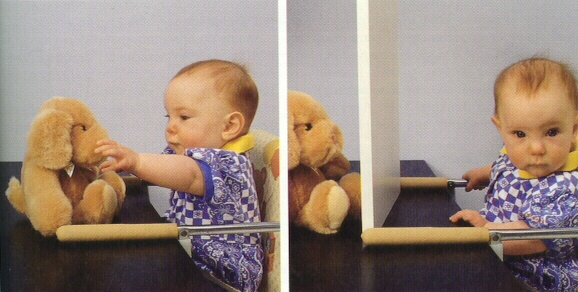
In Piaget's theory, the stage in which infants are only aware of what is immediately in front of them (from birth to about 2 years of age).
Formal Operational Stage
Preoperational Stage
Sensorimotor Stage
Concrete Operational Stage
Piaget's fourth and final stage of cognitive development. The person can think logically, hypothetically, and in the abstract
Preconventional Moral Reasoning
Postconventional Moral Reasoning
Conventional Moral Reasoning
Formal Operational Stage
Sally attempts to retrieve her teddy bear after her father hides it under a blanket. This suggests that Sally has developed a sense of
egocentrism.
object permanence.
conservation.
accommodation.
What years are the Preoperational stage of Development
0-2 years
2-7 years
7-11 years
11+ years
The central theme of Erikson’s theory of psychosocial stages was the development of:
Personality
Psychosocial dilemma
Social Status
Ego Identity

A straight A student turned party goer shows what stage?
Industry vs. Inferiority
Identity vs. Role Confusion
Generativity vs. Stagnation
Trust vs Mistrust

What concept/idea did Erik Erikson introduce with his developmental theory?
Identity Crisis
Id, Ego and Super-Ego
Genetic Epistemology
Ethnographic Methodology

What is an advantage of Erikson's psychosocial theory?
Fully applicable to both males and females
Focuses on childhood
Explains how to move from one stage to the next
Emphasizes the importance of relationships
Erikson characterizes development as a series of what?
Psychosexual stages
Sociophallic stages
Psychosocial stages
Psychomoral stages
The stage that occurs between birth and one year of age is concerned with:
Trust vs. Mistrust
Intiative vs. Guilt
Autonomy vs. Shame and Doubt
Industry vs. Inferiority
Which is an example of the autonomy versus shame and doubt stage?
An infant chewing on a teething toy
teenager trying out new fashions and hairstyles
A preschooler insisting on picking out her own clothes, no matter how mismatched they are
A middle-schooler completing a challenging math assignment
They look back on their lives and either see a sense of worth or failure.
Erikson's theory was based on a conflict between:
personal impulses and the social world
nature and nurture
the social world and the family setting
personal impulses and the environment

