
 Worksheets
The Sun (HS-ESS1-1)
Total questions: 40
Worksheet time: 19mins
Name
Class
Date
1.
This equation shows how mass and the speed of light convert to energy
a)
E=mc
b)
E=mc2
c)
E=mc3
d)
M=d/v
2.
Another word that describes nuclear fusion
a)
Fission
b)
Chromosphere
c)
core
d)
Nucleosynthesis
3.
Atomic process combines nuclei of small atoms to form more massive nuclei
a)
nuclear fusion
b)
nuclear fission
4.
Particle in the nucleus that has no charge but affects the mass of the element
a)
proton
b)
neutron
c)
nucleus
d)
electron
5.
Negative charge in an atom that does not contribute to the mass
a)
proton
b)
neutron
c)
nucleus
d)
electron
6.
A particle with a positive charge that determines the element
a)
proton
b)
neutron
c)
nucleus
d)
electron
7.
The splitting of a nucleus into smaller nuclei is
a)
fusion
b)
fission
c)
half-life
d)
gamma radiation
8.
How do nuclear power-plants work?
a)
Fusion
b)
Half-life
c)
Fission
d)
Fusion or fission
9.
Which atoms combine together during fusion reaction on the sun?
a)
Helium and Hydrogen atoms
b)
Hydrogen atoms
c)
Hydrogen and Lithium atoms
d)
Hydrogen and Carbon atoms
10.
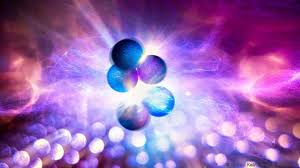
Do all stars make energy through fusion?
a)
Yes
b)
No
c)
Just our sun
d)
Only large stars
11.
_________ happens naturally due to an unstable nucleus.
a)
fission
b)
fusion
c)
radioactive decay
d)
K-capture
12.
Energy that is produced during fusion in the sun's core makes its way to Earth in the form of
a)
electromagnetic radiation
b)
sound waves
c)
photons
d)
nuclei
13.
How do we estimate the lifespan of the sun?
a)
We know how much hydrogen is in it.
b)
We know its radius.
c)
We know its diameter.
d)
We know its brightness.
14.
Why can't fusion happen on Earth?
a)
It requires extremely high temperatures.
b)
It requires extremely high temperatures.
c)
It requires small nuclei.
d)
It requires large amounts of uranium.
15.
Why is modelling important in science?
a)
It helps us support a claim with evidence.
b)
It can change the scale (zoom in or zoom out).
c)
It helps us visualize abstract processes.
d)
It helps us carry out investigations.
16.
The middle of the Sun is called the
a)
Corona
b)
Photosphere
c)
Core
d)
Convection Zone
17.
What is the sun mostly made up of
a)
Helium
b)
Core
c)
Carbon
d)
Hydrogen
18.
What features can you see on the sun
a)
sunspots & prominences
b)
The core
c)
The moon
d)
Earth
19.

What is this
a)
Prominice
b)
sun spot
c)
core
d)
Earth
20.
What happens during nuclear fusion
a)
Hydrogen reacts with Oxygen to create fire.
b)
Hydrogen atoms are forced together to create Helium
c)
Uranium and Plutonium split apart and release radiation.
d)
Helium atoms break down to make hydrogen
21.
Where does nuclear fusion occur?
a)
Space
b)
Radiation Zone
c)
Photosphere
d)
The Core
22.
What layer are you looking at when you take a picture of the sun?
a)
Core
b)
Photosphere
c)
Solar Wind
d)
Corona
23.

Why are sunspots darker than the surrounding areas?
a)
The hotter gas releases less light
b)
The Cooler gas releases less light
c)
They look that way because the light form the sun
d)
They are created by shadows from the moon.
24.
Can only be seen during a solar eclipse; outer layer; looks like a white halo
a)
corona
b)
photosphere
c)
core
d)
fusion
25.
Huge looping eruptions of gas; usually near sunspots; arch out into outer layers than fall back down.
a)
corona
b)
core
c)
prominence
d)
solar flare
26.
These can disrupt electronics on Earth.
a)
Sunspots
b)
Solar flares
c)
Comets
d)
Mars
27.
Without the Earth's magnetic field
a)
We would not have seasons
b)
Ailens would invade
c)
Plants would grow bigger
d)
We would all die a horrible death
28.
Why can we not see the corona when we look at the sun?
a)
It is invisible
b)
It is in the center of the sun
c)
The photosphere is to bright.
d)
There is nothing to see.
29.

What is an explosion on the sun that gives out huge amounts of energy?
a)
Sun Spot
b)
Solar Flare
c)
Sun Ray
d)
Sun Gases
30.

Which statement is true about the sun?
a)
It is a star.
b)
It is the largest star in our galaxy.
c)
It is a planet close to Earth.
d)
It is a moon.
31.

What are spots on the sun that are cooler than the rest of the sun?
a)
Solar Flares
b)
Corona
c)
Sun Spots
d)
Sun Rays
32.

Which layer of the sun is the hottest?
a)
Photosphere
b)
Chromosphere
c)
Corona
d)
Core
33.

What is the sun made out of?
a)
fire and lava
b)
gases
c)
magma
d)
flames
34.

How does the sun keep all of the planets in orbit?
a)
The pull of its gravity
b)
the flames give it power
c)
the sun spots
d)
The solar flares guide them
35.
The temperature of the sun's core is close to
a)
15 million degrees C
b)
3 million degrees C
c)
6,000 degrees C
d)
100 degrees C
36.

The most common elements in the SUN are
a)
carbon and oxygen
b)
water and carbon dioxide
c)
calcium and potassium
d)
hydrogen and helium
37.

The Sun is a giant sized star.
a)
TRUE
b)
FALSE
c)
Maybe
d)
Scientists do not know
38.
The Sun is an average, middle sized star.
a)
TRUE
b)
FALSE
c)
Maybe
d)
Scientists do not know.
39.
The Sun is a
a)
Yellow Super Giant
b)
Yellow Dwarf
c)
White Dwarf
d)
Yellow Giant
40.
What layer gives the sun it's reddish color during a solar eclipse?
a)
convection zone
b)
corona
c)
chromosphere
d)
photosphere
100 %

