wayground logo

Free Printable Worksheets

Font size

S
M
L
XL
Worksheets

American imperialism

Total questions: 100

Worksheet time: 1hrs 5mins

Name
Class
Date
1.

This foreign policy idea promotes staying out of world affairs.

a)

Imperialism

b)

Isolationism

c)

Globalism

d)

Communism

2.

This type of foreign policy encourages stronger nations to extend their influence over weaker ones.

a)

Imperialism

b)

Isolationism

c)

Globalism

d)

Communism

3.

Identify reasons for American Imperialism

a)

Economic Interests

b)

Military Interests

c)

Cultural Superiority

d)

Self Interests

4.

Why did Secretary of State William Seward buy the territory of Alaska?

a)

He saw England in North America as a strategic threat.

b)

He saw France in North America as a strategic threat.

c)

He saw Russia in North America as a strategic threat.

d)

He saw Germany in North America as a strategic threat.

5.

Why did America annex Hawaii in 1898?

a)

Beautiful beaches

b)

Sugar Cane plantations

c)

It's location in the Pacific Ocean

d)

Tourism benifits

6.

Why did the U.S. want to open trade with Japan in the 1850's?

a)

The U.S. wanted access to Japanese markets before European nations.

b)

The U.S. wanted to create naval bases in Asia.

c)

The U.S. wanted to create an alliance with Japan's govt.

d)

The U.S. wanted new raw materials.

7.

Which American Secretary of State promoted an 'open door ' policy with China?

a)

John Kennedy

b)

John Lennon

c)

John Wayne

d)

John Hay

8.

How did many Americans justify imperialism?

a)

We were spreading democracy

b)

We were spreading Christianity

c)

We were providing loans

d)

We were providing educational opportunities

9.

Why was the purchase of Alaska criticized at the time?

a)

It was too expensive.

b)

It was too far away.

c)

It was seen as worthless.

d)

It was seen as too cold.

10.

Why was the queen of Hawaii overthrown in 1893?

a)

She was not liked by her subjects

b)

She tried to limit the influence of foreigners

c)

She tried to make the monarch too powerful

d)

She tried to give better treatment to native Hawaiians

11.

These events lead the U.S. into war with Spain in 1898.

a)

America annexing Hawaii

b)

Spain annexing Puerto Rico

c)

Cuban people being placed into concentration camps

d)

The U.S.S. Maine sinking

12.

When capturing the Philippine Islands, American forces suffered how many casualties?

a)

0

b)

5

c)

10

d)

15

13.

Theodore Roosevelt commanded a cavalry unit in Cuba known as the

a)

Rough Rollers

b)

Rough Riders

c)

Rough Company

d)

Rough Racers

14.

These types of exaggerated news stories helped push the U.S. into war with Spain.

a)

Red Journalism

b)

Orange Journalism

c)

Yellow Journalism

d)

Green Journalism

15.

The Platt Amendment

a)

gave the U.S. the right to intervene in Puerto Rico's business at any time it wanted.

b)

gave the U.S. the right to intervene in the Philippine Island's business any time it wanted.

c)

gave the U.S. the right to intervene in Hawaii's business any time it wanted.

d)

gave the U.S. the right to intervene in Cuba's business any time it wanted.

16.

After the Spanish-American War, the U.S. annexed which former Spanish territories?

a)

Cuba

b)

Columbia

c)

Puerto Rico

d)

Philippine Islands

17.

This American organization was opposed to the U.S. becoming an empire.

a)

Anti-nationalist league

b)

Anti-immigration league

c)

Anti-imperialist league

d)

Anti-internationalist league

18.

America first attempted to buy land to build the Panama Canal from what country ?

a)

Cuba

b)

Columbia

c)

Croatia

d)

Cambodia

19.

How did America end up getting the land it needed to build the Panama Canal?

a)

We supported a revolution in Columbia.

b)

We supported a revolution in Cuba

c)

We supported a revolution in Croatia

d)

We supported a revolution in Cambodia

20.

The Jones Act

a)

gave Cubans U.S. citizenship

b)

gave Filipinos U.S. citizenship

c)

gave Columbians U.S. citizenship

d)

gave Puerto Ricans U.S. citizenship

21.

Which of the following was not a reason why America practiced Imperialism?

a)

Desire for raw materials

b)

Yellow Journalism

c)

Muckraking

d)

Spreading American ideals

22.
Which of the following define Imperialism?
a)
Writing about bad things in society to cause change
b)
Building factories that improves production
c)
Bullying smaller countries for their resources
d)
The US was the police force for the Western Hemisphere
23.
Which of the following American Presidents was a firm supporter of Imperialism?
a)
Woodrow Wilson
b)
Teddy Roosevelt
c)
William Howard Taft
d)
Grover Cleveland
24.
Which of the following is not true about Teddy Roosevelt and Imperialism?
a)
Teddy Roosevelt built the Great White Fleet
b)
Teddy Roosevelt fought in the Spanish-American War
c)
Teddy Roosevelt was a non-interventionists
d)
Teddy Roosevelt had the Monroe Doctrine and the Roosevelt Corollary passed
25.
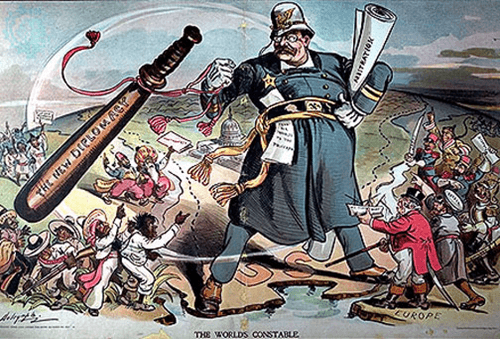
This political cartoon portrays which component of American Imperialism?
a)
Great White Fleet
b)
Monroe Doctrine
c)
Roosevelt Corollary
d)
Teller Amendment
26.
Which of the following defines the Roosevelt Corollary?
a)
Europe was not allowed to imperialize the Americas
b)
America was the police force for the Western Hemisphere
27.
Which country was imperializing Cuba before the US took it over?
a)
France
b)
Spain
c)
Colombia
d)
Mexico
28.
Which of the following defines the Monroe Doctrine?
a)
Europe was not allowed to imperialize the Americas
b)
America was the Police force for the Western Hemisphere
29.
Which of the following men would not be considered an interventionist?
a)
Teddy Roosevelt
b)
Alfred T Mahan
c)
Mark Twain
d)
Albert Beveridge
30.
What book did Alfred T Mahan write?
a)
The Jungle
b)
How the Other Half Lives
c)
The Influence of Naval Power Upon History
d)
Adventures of Tom Sawyer
31.
Which aspect of Imperialism does this picture represent?
a)
Roosevelt Corollary
b)
Monroe Doctrine
c)
Influence of Naval Power Upon History
d)
Spanish American War
32.
Which of the following is not true about Hawaii and its experience with Imperialism?
a)
Hawaii had the resource of sugar
b)
Hawaii's queen was Queen Lili
c)
Missionaries were first sent to Hawaii
d)
Hawaii wanted to become apart of America
33.

Which of the following defines Yellow Journalism?

a)

Writing about bad stuff to cause change

b)

Exaggerating events to sell newspapers

c)

Investigative journalism

d)

Reporting only the truth

34.
Which of the following describes the Teller Amendment?
a)
Promised that America would give Cuba its inedpendence
b)
Promised the US would give Hawaii its independence
c)
Promised the US would give the Philippines its independence
d)
Gave America control over Guantanamo Bay
35.
Which of the following is not true about the Platt Amendment?
a)
Cuba was given its independence
b)
Cuba could not make treaties with other nations
c)
America gets Guantanamo Bay
d)
America gets Puerto Rico
36.
Emilio Aguinaldo fought for independence in which country that America imperilized?
a)
Hawaii
b)
Philippines
c)
Cuba
d)
Puerto Rico
37.
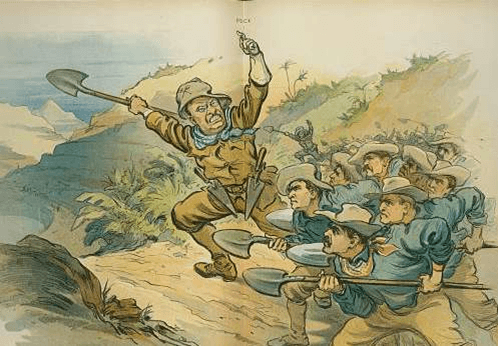
The following political cartoon refers to the construction of what by Teddy Roosevelt?
a)
Naval Base at Guantanamo Bay
b)
Suez Canal
c)
Panama Canal
d)
Washington Monument
38.
Who was imperializing Panama when the US decided it wanted to get the land needed for the Panama Canal?
a)
Paraguay
b)
Colombia
c)
Cuba
d)
Mexico
39.
Which country becomes a possession of the US by way of the Foraker Act?
a)
Cuba
b)
Philippines
c)
Puerto Rico
d)
Panama
40.
Which President featured in the picture fought in the Spanish-American War?
a)
Upton Sinclair
b)
Grover Cleveland
c)
James Garfield
d)
Teddy Roosevelt
41.

What was the US mainly concerned about during imperialism?

a)

finding new markets for trade

b)

acquiring raw materials

c)

world conquest

d)

declaring war

42.

In 1853, Commodore Matthew Perry was able to open trade with

a)

China

b)

Japan

c)

Vietnam

d)

Mexico

43.

Split China into different spheres of influence for European nations, Japan, and the US

a)

Monroe Doctrine

b)

Open Door Policy

c)

social darwinism

d)

laissez faire

44.

US purchased the following territory from Russia

a)

Alaska

b)

Hawaii

c)

Puerto Rico

d)

Cuba

45.

US annexed the following territory due to its strategic location and sugar plantations

a)

Hawaii

b)

Japan

c)

Philippines

d)

Alaska

46.

Declared Latin America as the US' sphere of influence

a)

Monroe Doctrine

b)

Open Door Policy

c)

Hawaiian Annexation

d)

extractive economy

47.

Strategy for how a nation deals with other nations

a)

foreign policy

b)

imperialism

c)

extractive economy

d)

domestic policy

48.

Argued that a powerful navy was key to national greatness

a)

Alfred T. Mahan

b)

Carl Schurz

c)

Josiah Strong

d)

Mr. Salguero

49.

A reason why US acquired islands in the Pacific Ocean

a)

for coaling or fuel stations

b)

for tourism

c)

to trade weapons

d)

for oil

50.

Why was Queen Liliuokalani removed from power in Hawaii?

a)

took away political power from white plantation owners

b)

gave political power to white plantaion owners

c)

betrayed her people

d)

she died and her brother, Kalakaua, took over

51.

Extending power by expanding into territories or controlling other nations is called-

a)

Isolationism

b)

Collective Security

c)

Internationalism

d)

Imperialism

52.

Teddy Roosevelt' s foreign policy of showing military might is called-

a)

Dollar Diplomacy

b)

Moral Diplomacy

c)

Armed Diplomacy

d)

Big Stick Diplomacy

53.

Yellow journalism contributed most directly to-

a)

hostility toward Spain's brutality in Cuba

b)

exposing the truth about what happened to the USS Maine

c)

reminding Americans they were once a British colony

d)

the decline of newspaper profits

54.

The Treaty of Paris resulted in the US acquisition of-

a)

Honduras, Colombia, and Cuba

b)

Mexico, Venezuela, and Chile

c)

Samoa, the Philippines, and Hawaii

d)

the Philippines, Guam, and Puerto Rico

55.

The Open Door Policy-

a)

allowed for open trade with China

b)

restricted trade with China

c)

opened trade with Japan

d)

restricted trade with Japan

56.

One effect of the Spanish American War was-

a)

the US becoming an imperial power

b)

Spain defeated the United States

c)

the US annexed Hawaii

57.

Sanford B. Dole contributed to US expansion by advocating the annexation of-

a)

Puerto Rico

b)

The Panama Canal

c)

Hawaii

d)

The Philippines

58.
 What was the United States warship called that exploded killing over 200 American sailors?
a)
USS Michigan
b)
USS Maine
c)
USS Missouri
d)
USS Maritime 
59.
Which of the following American Presidents was a firm supporter of Imperialism?
a)
Woodrow Wilson
b)
Teddy Roosevelt
c)
William Howard Taft
d)
Grover Cleveland
60.

What disease spread through the Panama Canal?

a)

chicken pox

b)

cancer

c)

flu

d)

yellow fever

61.

Under the terms of the Treaty of Paris, Cuba became an independent nation, the United States agreed to pay Spain $20 million for the Philippines, and the United States acquired Puerto Rico and

a)

Guam

b)

Hawaii

c)

the Bahamas

d)

Panama

62.

Which President is represented in this cartoon?

a)

Herbert Hoover

b)

William McKinley

c)

Teddy Roosevelt

d)

William Taft

63.

What is being built in this cartoon?

a)

The Suez Canal

b)

The Panama Canal

c)

The Colombian Canal

d)

The American Canal

64.

What did President Roosevelt mean when he said, "Walk softly and carry a big stick" ?

a)

Wear quiet shoes when you use a cane.

b)

Try diplomacy when dealing with a country, and if that doesn't work, be ready with a strong military.

c)

Use military first when dealing with a country, and if that doesn't work, try diplomacy.

65.

The Panama canal connected the Atlantic Ocean and what other ocean?

a)

Mediterranean

b)

Arctic

c)

Indian

d)

Pacific

66.
Imperialism is __________.
a)
when a powerful nation uses its resources to help a weaker nation
b)
when a weaker nation invites a powerful nation to help it industrialize
c)
when a powerful nation takes control of the economy and government of a weaker nation
d)
when weak nations join together to fight a strong nation
67.
Cornerstone of American foreign policy that told European powers to stay out of the affairs of the Western Hemisphere. 
a)
Roosevelt Corollary
b)
Adams Doctrine
c)
Truman Doctrine
d)
Monroe Doctrine 
68.
Why did United States business interests favor overseas expansion in the late 1800's? 
a)
to establish a commonwealth of colonies 
b)
to establish military bases around the world
c)
to acquire new markets and sources of raw materials 
d)
to spread democratic ideals to other areas of the world
69.
Areas where the imperial power protected local rulers who had to accept advice from imp. power.
a)
Dollar Diplomacy
b)
protectorate
c)
sphere of influence
d)
Yellow Journalsim
70.
Reporters who published sensationalized stories about Spanish atrocities were called 
a)
Muckrakers
b)
Mugwumps
c)
Yellow Journalists
d)
Conquistadors
71.
The U.S. had a duty to shape "less civilized" parts of the world because English speaking nations had superior character, ideas, & government
a)
Anglo-Saxonism
b)
Social Darwinism
c)
White Mans Burden
d)
Republican
72.
Wrote the book The Influence of Sea Power Upon History, argued that a nation needed a large navy to protect trade ships & defend the right to trade. 
a)
Alfred T. Mahan
b)
John Fiske
c)
Charles Darwin
d)
Marco Polo
73.
Taking control over other countries is called?
a)
Protectionism
b)
Annexation
c)
Imperialism
d)
Expansion
74.
Why did we want to strengthen trade with Latin America?
a)
new naval bases
b)
increase tariffs on European goods
c)
to protect American manufacturers from competition
d)
stop European influence
75.
Why did Americans in Hawaii want to be annexed by the United States?  
a)
Queen Liluokalani was persecuting American sugar growers. 
b)
Annexation had trade advantages for the American sugar growers in Hawaii. 
c)
Laws forced Americans to return land to the Hawaiian government. 
d)
 All are true.
76.
In 1853 Commodore Matthew C. Perry got the Treaty of Kanagawa signed. This treaty granted the United States trading rights at two _________ ports
a)
Chinese
b)
Korean
c)
Japanese
d)
Hawaiian
77.
After he led an unsuccessful revolt in Cuba against Spain in 1868 he escaped to the U.S. In 1895 _______ returned to Cuba to start a new revolt and declared the Republic of Cuba to Spain
a)
Jose Marti
b)
Vladamir Lennin
c)
Teddy Roosevelt
d)
Fidel Castro
78.
In the late 1800's, Cuba produced 1/3 of the worlds ___________
a)
Sugar
b)
Banananas
c)
Coal
d)
Lumber
79.
 What was the United States warship called that exploded killing over 200 American sailors?
a)
USS Michigan
b)
USS Maine
c)
USS Missouri
d)
USS Maritime 
80.
In 1852 The President sent a naval expedition to _____ to force them to trade with the U.S.
a)
Japan
b)
Korea
c)
Puerto Rico
d)
Hawaii
81.
This established a civil government for Puerto Rico
a)
Foraker Act
b)
Platt Amendment
c)
Anti-Trust Act
d)
18th Amendment
82.
The policy in which stronger nations extend their economic, political, or military control over weaker territories
a)
Annexation
b)
Superiority
c)
Imperialism
d)
Expansion
83.
The action of taking something for one's own use, typically without the owner's permission
a)
World Domination
b)
Appropriation
c)
Annex
d)
Imperialism
84.
Add (territory) to one's own territory by appropriation
a)
Imperialism
b)
Annex
c)
Appropriation
d)
World Domination
85.
A cease-fire agreement
a)
Treaty
b)
Armistice
c)
Truce
d)
Pact
86.
A payment levied on the import, export, manufacture, or sale of goods; tax or tariff
a)
Duty
b)
Tax
c)
Tariff
d)
Payment
87.
Best port in the Hawaiian kingdom; Naval base off the coast of Hawaii
a)
Havana
b)
Santiago de Cuba
c)
San Juan
d)
Pearl Harbor
88.
A country whose affairs are partially controlled by a stronger power
a)
Territory
b)
Colony
c)
Protectorate
d)
Province
89.
The US policy of using the nation’s economic power to exert influence over other countries
a)
Dollar Diplomacy
b)
Seward’s Folly
c)
Seward’s Icebox
d)
Open Door Notes
90.
An extension of the Monroe Doctrine under which the United States claimed the right to protect its economic interests by means of military intervention in the affairs of Western Hemisphere nations
a)
Monroe Doctrine
b)
Roosevelt Corollary
c)
Wilson’s 14 Points
d)
Platt Amendment
91.
US Navy Admiral - served in the Navy for 40 years; Urged officials to build up American naval power, so they could compete with other powerful nations
a)
William Seward
b)
Jose Marti
c)
Emilio Aguinaldo
d)
Alfred T. Mahan
92.
Secretary of state under presidents Abraham Lincoln and Andrew Johnson; Early supporter of American expansion; Arranged for the United States to buy Alaska from the Russians for $7.2 million
a)
William Seward
b)
Alfred T. Mahan
c)
Theodore Roosevelt
d)
John Hay
93.
Cuban political activist,  poet and journalist in exile in New York; Expelled from Cuba at the age of 16 because of his revolutionary activities; launched a revolution in 1895; Organized Cuban resistance against Spain
a)
Alfred T. Mahan
b)
William Seward
c)
Jose Marti
d)
John Hay
94.
Believed the US had promised independence; Outraged at the Annexation of the Philippines in the Treaty of Paris
a)
Emilio Aguinaldo
b)
Jose Marti
c)
Poncho Villa 
d)
Francisco Madero
95.
US Secretary of State; Open Door notes - series of policy statements; Letters addressed to leaders of imperialist nations proposing that the nations share their trading rights with the US - creating an open door
a)
John Hay
b)
Theodore Roosevelt
c)
Woodrow Wilson
d)
James Monroe
96.
Sent to Cuba to bring home American citizens;  blew up; 260+ men were killed; its destruction led the US to declare war on Spa
a)
John J. Pershing
b)
U. S. S. Maine
c)
Yellow Journalism
d)
Boxer Reellion
97.
A volunteer cavalry under the command of Leonard Wood and Theodore Roosevelt
a)
Rough Riders
b)
Boxer Rebellion
c)
Yellow Journalism
d)
U. S. S. Maine
98.
Ended military rule in Puerto Rico and set up a civil government; Gave the President of the US power to appoint Puerto Rico’s governor and members of the upper house of its legislature
a)
Platt Amendment
b)
Foraker Act
c)
Open Door Policy
d)
Boxer Rebellion
99.
Series of policy statements; Letters addressed to leaders of imperialist nations proposing that the nations share their trading rights with the US; No single nation would have a monopoly on trade with China
a)
Open Door Notes
b)
Platt Amendment
c)
Foraker Act
d)
Roosevelt Corollary 
100.
An artificial waterway to provide a shortcut between the Atlantic and Pacific oceans - opened in 1914
a)
Panama Canal
b)
Nicaragua Canal
c)
U. S. S. Maine
d)
Boxer Rebellion