wayground logo

Free Printable Worksheets

NEW

Font size

S
M
L
XL
Worksheets

Lewis Structures and Molecular Geometry

Total questions: 35

Worksheet time: 1hrs 12mins

Name
Class
Date
1.

How many bonding electrons are in the Lewis structure of N2?

a)

2

b)

3

c)

4

d)

6

2.

The correct Lewis structure for BF3 would have exactly:

a)

1 double bond.

b)

2 double bonds.

c)

1 triple bond.

d)

no double bonds.

3.

What is the molecular geometry if you have 4 single bonds around the central atom and no lone pairs?

a)

bent

b)

linear

c)

tetrahedral

d)

trigonal pyramidal

4.

What is the molecular geometry of carbon dioxide, CO2?

a)

bent

b)

linear

c)

tetrahedral

d)

trigonal pyramidal

5.

What is the molecular geometry of SiH4?

a)

bent

b)

linear

c)

tetrahedral

d)

trigonal pyramidal

6.

What is the angle between electron groups in the trigonal planar geometry?

a)

90°

b)

109.5°

c)

120°

d)

180°

7.
What molecular shape is the structure shown here? (NH4+)
a)
linear
b)
trigonal planar
c)
tetrahedral
d)
trigonal pyramidal
8.
What molecular shape is the structure shown here? (H2O)
a)
tetrahedral
b)
trigonal planar
c)
bent
d)
trigonal pyramidal
9.
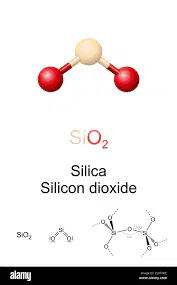
What is the molecular shape of a silicon dioxide molecule?
a)
linear
b)
trigonal planar
c)
bent
d)
tetrahedral
10.
Determine the molecular geometry of ammonia (NH3).
a)
trigonal pyramidal
b)
trigonal planar
c)
bent
d)
tetrahedral
11.
What molecular shape is the structure shown here? (BeCl2)
a)
linear
b)
bent
c)
trigonal planar
d)
tetrahedral
12.

What is the molecular geometry of the molecule?

a)

Tetrahedral

b)

Bent

c)

Trigonal Pyramidal

d)

Trigonal Planar

13.
Choose the correct shape for this molecule:
a)
Bent
b)
Trigonal pyramidal
c)
Trigonal planar
d)
Linear
14.
Choose the correct shape for this molecule:
a)
linear
b)
Trigonal pyramidal
c)
Bent
d)
Tetrahedral
15.
Which of the following is the correct Lewis structure for the compound PBr3?
a)
structure A
b)
structure B
c)
structure C
d)
structure D
16.
 A lone pair is defined as
a)
A pair of bonding electrons
b)
One non-bonding electron
c)
A pair of non-bonding electrons
d)
A pair of electrons on the central atom
17.
What is the VSEPR theory used to predict?
a)
Bond Strength
b)
Polarity
c)
Molecular Shape
d)
Electronegativity
18.
Which of the following shapes has an unshared pairs of electrons on the central atom? 
a)
Bipyramidal
b)
Bent
c)
Trigonal Planar
d)
Tetrahedral
19.
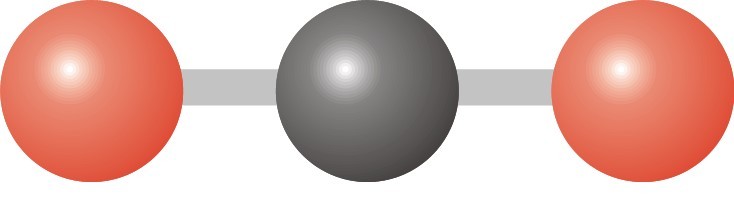
Which molecule would have this molecular geometry?
a)
BF3
b)
CH4
c)
PCl5
d)
CO2
20.
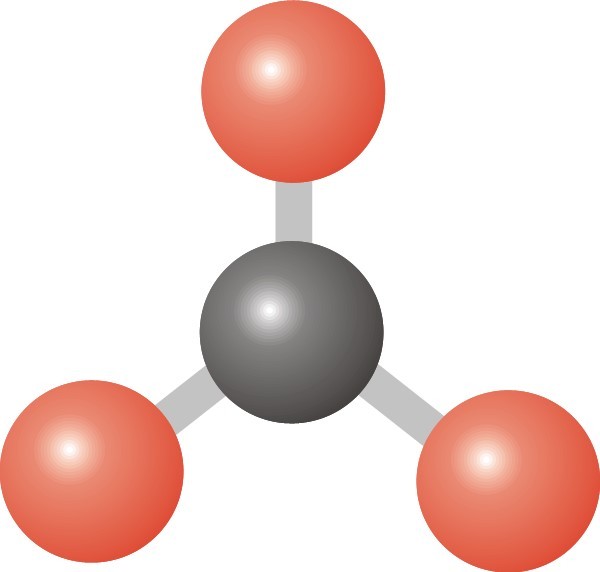
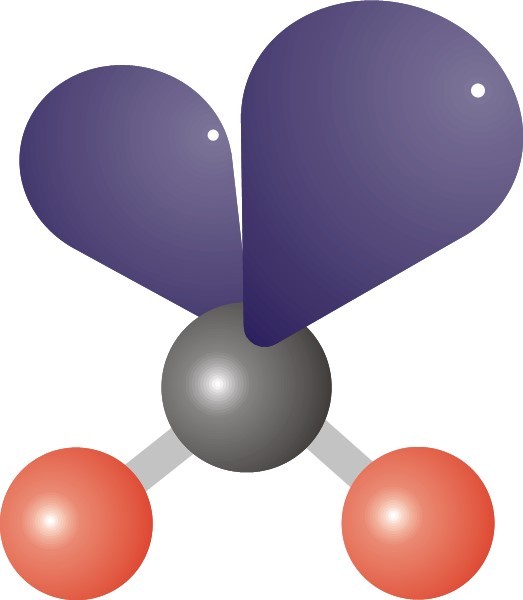
What molecule could this be? 
a)
BF3
b)
CH4
c)
H2O
d)
CO2
21.
What molecule could this be? 
a)
H2O
b)
CCl4
c)
PCl5
d)
NaCl
22.
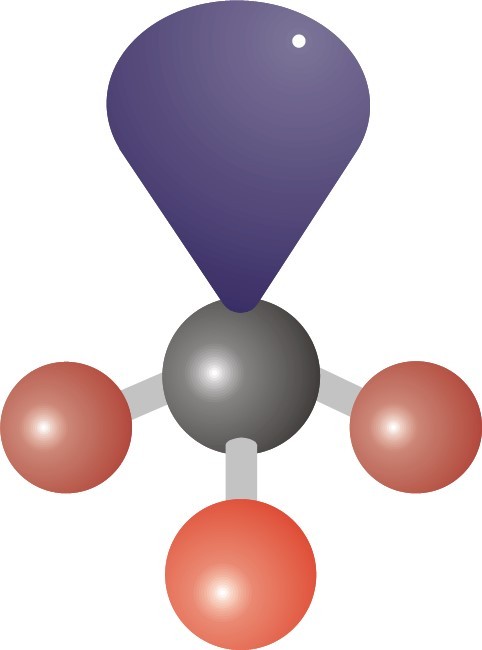
Who could this be? 
a)
CO2
b)
NH3
c)
H2S
d)
CH4
23.
Who could this be?
a)
H2O
b)
NH3
c)
CO2
d)
CH4
24.

What molecular geometry would PH3 have?

a)

Trigonal Pyramidal

b)

Trigonal Bipyramidal

c)

Bent

d)

Linear

25.
How many lone pairs of electrons are on the P atom in PF3?
a)
1
b)
2
c)
3
d)
0
26.
What is the measure of a tetrahedral bond angle?
a)
90 Degrees
b)
109.5 Degrees
c)
120 Degrees
d)
180 Degrees
27.
The bond angle for a trigonal planar molecule is 
a)
90 Degrees
b)
109.5 Degrees
c)
120 Degrees
d)
180 Degrees
28.
Which shapes are altered by unshared pairs of electrons? 
a)
Bent and Pyramidal
b)
Trigonal Planar and Bent
c)
Tetrahedram and Bipyramidal
d)
Pyramidal and Linear
29.
How many unshared pairs of electrons will a pyramidal molecule have? 
a)
1
b)
2
c)
3
d)
4
30.

2 bonded atoms and 0 lone pairs

a)

linear

b)

trigonal planar

c)

bent

d)

tetrahedral

e)

trigonal pyramidal

31.

3 atoms bonded and 0 lone pairs

a)

linear

b)

trigonal planar

c)

bent

d)

tetrahedral

e)

trigonal pyramidal

32.

4 shared pairs and 0 unshared pairs

a)

true linear

b)

trigonal planar

c)

bent

d)

tetrahedral

e)

trigonal pyramidal

33.

2 shared pairs and 2 unshared pairs

a)

linear

b)

trigonal planar

c)

bent

d)

tetrahedral

e)

trigonal pyramidal

34.

3 shared pairs and 1 unshared pairs

a)

linear

b)

trigonal planar

c)

bent

d)

tetrahedral

e)

trigonal pyramidal

35.

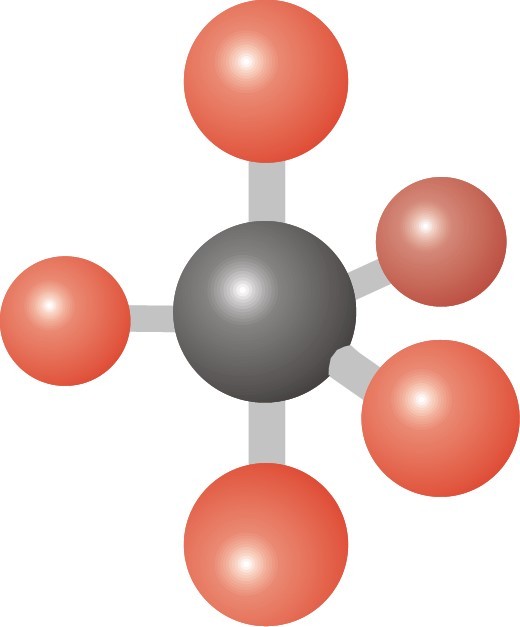
What shape does this molecule have?

a)

tetrahedral

b)

octahedral

c)

trigonal bipyramidal

d)

seesaw