

wayground logo

Free Printable Worksheets

Font size

S
M
L
XL
Worksheets

Waves/Atomic Structure/Average Atomic Mass

Total questions: 30

Worksheet time: 2hrs 46mins

Name
Class
Date
1.
A neutral atom of Carbon-13 has ________ electrons and _________ neutrons
a)
13, 13
b)
6, 7
c)
7, 7
d)
6, 6
2.
Isotopes are atoms of the same element that have the same number of __________ but different number of __________ . Therefore, isotopes of the same element have different masses. 
a)
protons, neutrons
b)
protons, electrons
c)
neutrons, protons
d)
electrons, protons
3.
The nucleus is ____________ charged whereas the electron cloud is ____________ charged. 
a)
negatively, positively
b)
negatively, negatively
c)
positively, positively
d)
positively, negatively
4.
Nitrogen has three occurring isotopes: Nitrogen-13, Nitrogen-14, Nitrogen-15. Which isotope is the most abundant?
a)
Nitrogen-13
b)
Nitrogen-14
c)
Nitrogen-15
d)
Based on the information given, it cannot be determined
5.
The sum of the number of protons and the number of neutrons is called the _____
a)
atomic number
b)
mass number
c)
isotope number
d)

average atomic mass

6.
Which subatomic particle has a positive charge?
a)
Proton
b)
Neutron
c)
Electron
7.
Which subatomic particle has a negative charge?
a)
Proton
b)
Neutron
c)
Electron
8.
Which subatomic particle is neutral?
a)
Proton
b)
Neutron
c)
Electron
9.
Atoms of the same element with different numbers of neutrons are called
a)
Ions
b)
Isotopes
c)
Iotas
d)
Introns
10.
The mass number of an isotope is equal to the number of ______ in an atom.
a)
Protons
b)
Neutrons
c)
Protons + Neutrons
d)
 Electrons
11.
The mass listed on the periodic table for each element is known as the 
a)
average atomic mass
b)
atomic mass
c)
atomic weight
d)
weighted mass
12.

To calculate average atomic mass, you need

a)

the atomic mass of each isotope

b)

the percent abundance of each isotope

c)

the atomic mass and percent abundance of each isotope

d)

to find the average of the atomic masses of each isotope
13.
The mass number of an element that has 18 protons, 18 electrons, and 19 neutrons is _____.
a)
12.5
b)
13
c)
25
d)
37
14.
The atomic number of an element that has 9 protons, 9 electrons, and 10 neutrons is _____.
a)
9
b)
10
c)
19
d)
28
15.
If the number of electrons in an atom changes you make a(n) __________________.
a)
ion
b)
isotope
c)
new element
d)
isomer
16.
How many neutrons does uranium-239 have
a)
92
b)
147
c)
239
d)
331
17.
What is the charge of an atom that has gained one electron?
a)
1-
b)
2-
c)
1+
d)
2+
18.
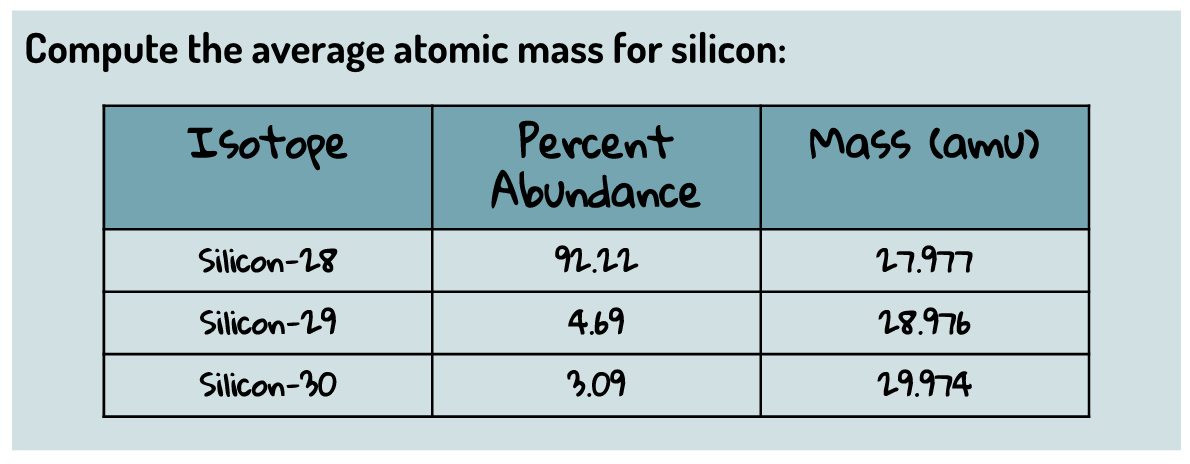
Compute the average atomic mass for silicon:
a)
27.977
b)
28.09
c)
28.976
d)
The average mass cannot be determined from provided information.
19.

Calculate the average atomic mass for chromium if its abundance is 4.35% Cr-50, 83.79% Cr-52, 9.50% Cr-53, and 2.36% Cr-54. (round your answer to the hundredths; just input the number, you do not need to include units)

(a)  
20.

Calculate the average atomic mass for boron if its abundance is 19.9% B-10, and 80.1% B-11. (round your answer to the hundredths; just input the number, you do not need to include units)

(a)  

21.
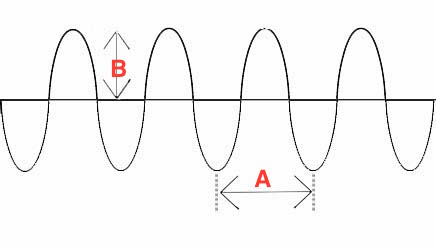
What property of the wave is represented by the letter "B"?
a)
amplitude
b)
crest
c)
trough
d)
wavelength
22.
The highest point on a wave is:
a)
the crest
b)
the trough
c)
the top
d)
the coast 
23.
The lowest point on a wave is the:
a)
Amplitude
b)
Crest
c)
Trough
d)
Wavelength
24.
Which vocabulary term is used to identify the distance between points C & G?
a)
Amplitude
b)
Crest
c)
Frequency
d)
Wavelength
25.
If the frequency gets higher, the wavelength gets 
a)
longer
b)
shorter
26.

The frequency of violet light is 7.5x10¹⁴ Hz. What is its wavelength?

a)

4.0x10⁻⁷ m

b)

4.0x10⁷ m

c)

2.25x10²³m

d)

2.25x10²³ Hz

27.

A wave with a large wavelength will have a ______ frequency and _____ energy

a)

high, low

b)

high, high

c)

low, high

d)

low, low

28.

Red light has a wavelength of 675 nm. What is its frequency?

a)

2.03x10¹¹ m

b)

4.44x10¹⁴ Hz

c)

4.44x10¹⁴ nm

d)

2.03x10¹¹ Hz

29.

What is the frequency of UV light that has an energy of 2.39 × 10 -18 J?

a)

2.32 x 10⁹ Hz

b)

3.61 x 10¹⁵ Hz

c)

1.58 x 10-51 Hz

d)

3 x 10⁸ m/s

30.
What is the energy of light whose wavelength is 4.06 x 10⁻¹¹ m? 
a)
2.69 x 10-44 J
b)
1.63 x 10⁻²³ J
c)
4.90 x 10⁻¹⁵ J
d)
8.97 x 10-53 J
