
 Worksheets
HW#3: PRACTICE QUIZ: Atoms, Elements, & Compounds
Total questions: 35
Worksheet time: 9hrs 45mins
Name
Class
Date
1.
Hydrogen is a pure substance represented by the chemical symbol H. Which of the following best describes hydrogen?
a)
Hydrogen is an element made of two or more kinds of atoms.
b)
Hydrogen is a compound made of only one kind of atom.
c)
Hydrogen is a compound made of two or more kinds of atoms.
d)
Hydrogen is an element made of only one kind of atom.
2.
Carbon (C) and hydrogen (H) are pure substances. Each is made of only one type of atom, but carbon atoms are different from hydrogen atoms. Carbon and hydrogen chemically combine to form methane (CH4).
a)
methane is an element and carbon and hydrogen are compounds.
b)
carbon, hydrogen, and methane are all elements.
c)
carbon, hydrogen, and methane are all compounds.
d)
carbon and hydrogen are elements and methane is a compound.
3.
What is a compound?
a)
an atom with more electrons than protons
b)
a substance in which the atoms of two or more elements are combined together
c)
an atom with more neutrons than protons
d)
a substance in which the atoms of three or more elements are combined together
4.
The chemical combination of two or more different kinds of atoms in fixed amounts is called a(n)
a)
orbit
b)
compound
c)
mixture
d)
element
5.
Atoms combine to form _______.
a)
electrons
b)
molecules
c)
nuclei
d)
neutrons
6.
Carbon dioxide is formed when two oxygen atoms chemically combine with a carbon atom. Which term best describes carbon dioxide?
a)
atom
b)
mixture
c)
element
d)
compound
7.
Where are protons and neutrons located?
a)
in the nucleus
b)
in the electron cloud
c)
in the valence shell
8.
What is the charge on a proton?
a)
positive
b)
neutral
c)
negative
9.
What is the charge of an electron?
a)
positive
b)
neutral
c)
negative
10.
Which part of an atom has no charge?
a)
protons
b)
neutrons
c)
electrons
d)
atoms
11.
TRUE OR FALSE:
Every compound is a molecule but not every molecule is a compound.
Every compound is a molecule but not every molecule is a compound.
a)
TRUE
b)
FALSE
12.

What is the picture displayed?
a)
Atom
b)
Element
c)
Molecule
d)
Compound
13.

What is the picture displayed?
a)
atom
b)
element
c)
molecule
d)
compound
14.

What is the picture displayed?
a)
atom
b)
element
c)
molecule
d)
compound
15.

What is the picture displayed?
a)
atom
b)
element
c)
molecule
d)
compound
16.

Are these molecules also compounds?
a)
YES
b)
NO
17.
Review:
What is the formula for density?
What is the formula for density?
a)
D= M x V
b)
D= V / M
c)
D= V+M
d)
D= M / V
18.

Glucose (C6H12O6) contains atoms of carbon, hydrogen, and oxygen that are chemically bonded together. What type of matter is glucose?
a)
Glucose is an element
b)
Glucose is a compound
c)
Glucose is a mixture
d)
Glucose is a metal
19.

The smallest particle of any element that still has the properties of that element is called
a)
an atom
b)
a compound
c)
a solution
d)
a mixture
20.
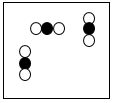
What does the diagram show?
a)
A mixture of two elements
b)
A pure compound
c)
A mixture of two compounds
d)
A mixture of a compound & element
21.

A pure substance that is made from one type of atom is a(n) ______________ .
a)
Mixture
b)
Atom
c)
Element
d)
Compound
22.
What is at the center of every atom?
a)
An electron
b)
A compound
c)
A nucleus
d)
A molecule
23.
Which two particles make up the nucleus of an atom?
a)
protons and electrons
b)
protons and neutrons
c)
molecules and compounds
d)
neutrons and electrons
24.

The chart below lists some substances and their symbols. How many of these substances are examples of elements?
a)
1
b)
2
c)
3
d)
4
25.
What is H2SO4
made up of?
made up of?
a)
2 hydrogen, 1 sulfur, 4 oxygen
b)
1 hydrogen, 2 sulfur, 4 oxygen
c)
2 hydrogen & 4 sodium
d)
1 hydrogen & 6 sodium
26.
H2O2← ?
This number tells the number of atoms present.
This number tells the number of atoms present.
a)
coefficient
b)
molecule
c)
subscript
d)
atom
27.
Which example is a compound?
a)
N2
b)
O2
c)
Cu
d)
H2O2
28.

Salt is a(n)
a)
element
b)
compound
c)
mixture
29.
Which of the following is an element?
a)
Sugar
b)
Salt
c)
Water
d)
Oxygen
30.
What is anything that has mass and takes up space known as?
a)
Mass
b)
Atom
c)
Molecule
d)
Matter
31.

How many oxygen atoms does a molecule of ozone contain?
a)
1
b)
2
c)
3
d)
4
32.

What structure is shown in the diagram?
a)
Diamond
b)
Graphite
c)
Carbon fiber
d)
Carbon nanotubes
33.

What structure is shown in the diagram?
a)
Diamond
b)
Graphite
c)
Carbon fiber
d)
Carbon nanotubes
34.

What is the chemical formula for lactose?
a)
C6H22O11
b)
C12H22O11
c)
CHO
d)
C11H20O12
35.
True/False: Diamonds and graphite are both made of Carbon.
a)
True
b)
False
100 %

