
 Worksheets
Using the Periodic Table
Total questions: 60
Worksheet time: 3600secs
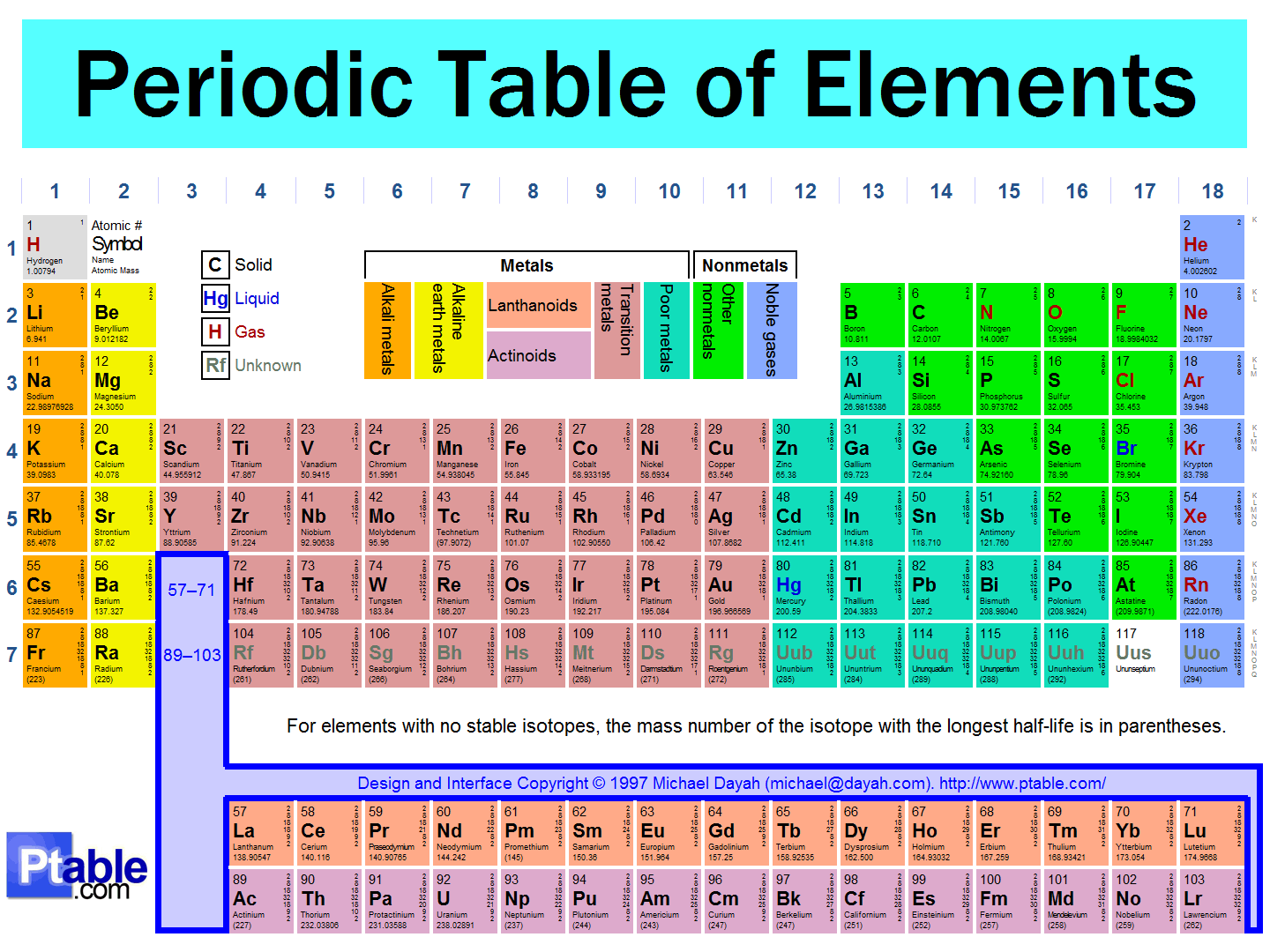
The vertical (up and down) columns in the Periodic Table are called:
groups
towers
periods
atomic numbers
The Modern Periodic Table of Elements is arranged by:
atomic mass
atomic number
valence electrons
number of isotopes

Sodium (Na) is found in Period __.
3
2
4
1

Sodium (Na) is found in Group __.
1
2
3
4
The horizontal (side to side) rows in the Periodic Table are called ____________.
Groups
Families
Periods
Atomic Numbers
All matter is made of ____________.
energy
atoms
air
chemistry
Elements found in Group One of the periodic table are called:
Non-metals
Transition Metals
Alkali Metals
Metalloids
Elements found in Group Two of the periodic table are called:
Periods
Alkali Earth Metals
Metalloids
Alkali Metals
The electrons in the outermost shell (main energy level) of an atom are known as __________ ___________; these are the electrons involved in forming bonds.
Alkali Metals (group 1)
Halogens (Group 17)
Atomic Number
Valence Electrons
The main property of the Halogens (Group 17) is that they are:
gases at room temperature, with a low boiling point.
the most reactive nonmetals.
the electrons in the outermost shell (main energy level) of an atom; these are the electrons involved in forming bonds.
have the same number of protons and neutrons.
Which of the following includes elements that are good thermal and electrical conductors, shiny and have higher density and melting points than Groups 1 and 2?
Alkali Metals
Transition Metals
Non-metals
Metalloids

Which element will have the most similar physical and chemical properties to the element Sulfur (S)? (i.e. shares a group).
Carbon (C)
Phosphorous (P)
Oxygen (O)
Neon (Ne)

Which element will have the most similar physical and chemical properties to the element Lithium (Li)? (i.e. shares the same group)
Sodium (Na)
Magnesium (Mg)
Beryllium (Be)
Calcium (Ca)

Elements that are arranged in __________ have the most similar physical and chemical properties to each other.
periods
groups
What are valence electrons?
Any of an atom's electrons.
Electrons located on the first energy level.
Electrons not attached to any atom.
Electrons located on the outer energy level.
Which period (row) is Lead (Pb) located in?
6
4
Metals
4A
How many electrons does Barium (Ba) have?
13
2
71
56
Why are halogens so reactive?
They want to get rid of their only valance electron
They only need one more electron
They are non reactive, they have a full shell

A rule that states that repeating chemical and physical properties of elements change periodically with the atomic number of the elements is known as the _________.
Periodic Law
Alkaline-earth Metals
Actinide
Group Rule


Which colour on this image of the periodic table corresponds with the Halogens?
red
black
blue
orange
Which colour on this image of the periodic table corresponds with the Noble Gases.
red
black
blue
orange
Which colour on this image of the periodic table corresponds with the Transition Metals.
red
black
blue
orange
Mendeleev first arranged the periodic table of elements by order of increasing __________ _______.
atomic number
atomic mass
atomic symbol
atomic weight
Which of these is the most reactive halogen?
Fluorine
Iodine
Chlorine
Bromine
Which family of elements does not combine with other elements unless under special conditions in a laboratory?
Noble gases
Halogens
Metalloids
Alkaline earth metals
Actinides

If an atom has 12 protons, how many valence electrons will that atom have?
(Remembering that the valence electrons are those in the outer shell and the first holds 2, the second holds 8 and the next 8)
2
10
8
6
How can you tell (from looking at the Periodic Table) how many valence electrons an atom has?
From the Atomic Number
From the Group number
From the Period number
LiBr is called
lithium bromine
lithium (I) bromine
lithium bromide
lithuim (I) bromide
Which of these combinations is an ionic compound made of?
Metal and Metal
Nonmetal and Nonmetal
Metal and Nonmetal
Cation and Cation
Name the following ionic compound: BeCl2
beryllium chlorine
beryllium II chloride
beryllium chloride
beryllium dichloride
When naming a compound, which of these is written first?
Metal
Nonmetal
Anion
Cation
When naming a compound, what must the last part be?
The nonmetal element with "ide" at the end
The nonmetal element with the ending "ite"
The name of the element
The nonmetal element with "ide" at the end, unless it is a polyatomic ion
What is a cation's charge?
positive
negative
neutral
depends on the element
What is an anion's charge?
positive
negative
neutral
depends on the element's charge
Is potassium a cation or an anion?
cation
anion
What is the charge of iron (III)?
+3
+2
+6
+4

The chemical formula for the compound formed from the ions Na + and S -2 is:
Na2S
NaS2
Na2S2
NaS
The chemical formula for an ionic compound of potassium and oxygen is:
KO.
K2O.
K2O2.
KO2.
Al3+ O2-
Which formula results when Ca+2 and Br- ions bond?
Ca2Br2
CaBr
Ca(br)2
CaBr2

